
Ranked the #1 DSO Podcast!
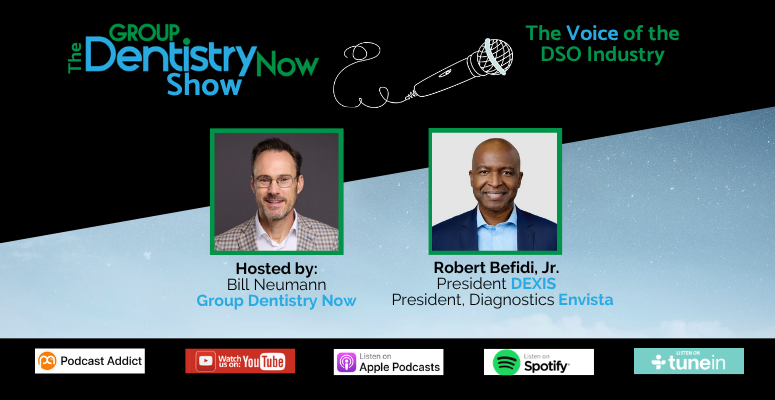
Welcome to The Group Dentistry Now Show: The Voice of the DSO Industry!
The Digital Future of Dentistry: How Technology and Connected Workflows Are Reshaping DSOs
Robert Befidi, Jr., President of DEXIS & President, Diagnostics at Envista joins the show. Robert discusses:
- AI-powered imaging
- Connected clinical workflows
- Navigating industry challenges
To learn more about DEXIS visit: https://dexis.com/en-us
To explore all of Envista’s innovative dental companies visit: https://envistaco.com/en
You can also connect with Robert on LinkedIn here: https://www.linkedin.com/in/robertbefidijr/
Subscribe to our channel for more episodes and stay updated on the latest DSO news, insights, and events!
If you like our podcast, please give us a ⭐⭐⭐⭐⭐ review on iTunes https://apple.co/2Nejsfa and a Thumbs Up on YouTube.
The Digital Future of Dentistry: How Technology and Connected Workflows Are Reshaping DSOs Transcript:
Bill Neumann (00:11):
Hey everyone. Welcome to the Group Dentistry Now Show. I’m Bill Neumann, and as always, we appreciate you joining us today. We’re going to have a great conversation, talk about the DSO landscape, talk about the evolution of the industry and the impact of technology on DSOs and the clinicians that are serving the patients of the DSOs. We have with us Robert Baffiti Jr. He is the president of Dexus as well as the president of diagnostics at Envista Holdings. Did I get that right, Robert? Yes. Great. Well, it’s great to have you on and I’m really interested to have this conversation with you, but if you wouldn’t mind spending a couple minutes on your background so the audience can get to know you a little bit better.
Robert Befidi, Jr. (01:01):
Sure. Happy to be here. Thanks for having me, Bill. So I work for Envista Holdings Corporation. We have assets across most of the landscape that supports dentistry. I joined the firm a little bit three years ago. Prior to that, I spent about a decade on the healthcare business group at 3M. And then prior to that, about a decade in private equity capital markets. And prior to that, about a decade in software engineering roles across consulting, healthcare and the likes.
Bill Neumann (01:34):
And yeah, I was actually listening to an old, old podcast of yours from Wharton. It was like 2007. So it was you and Mark Sinatra were on the podcast. I don’t even know if you remember that, but that goes back 19 years. So I was trying to think back and I’m like, wow, there were podcasts back in 2007. So that must have been one of the first.
Robert Befidi, Jr. (01:54):
It was. We were speaking at a class at Stanford about how to raise capital and how to go buy businesses and grow them beyond the first acquisition.
Bill Neumann (02:07):
Yes, it was certainly pretty interesting. I wanted to ask you a couple more questions because I had a chance to look at your bio, spend a little bit of time on it. It says you’re an avid cook and a world traveler. So I’ve got a question wrapped around cooking. Are you challenging yourself with any new dishes lately? And if so, let us know which ones.
Robert Befidi, Jr. (02:30):
I’m working on Vietnamese pastries at the moment. So one of the dishes is, the English name of it is honeycomb cake. So it’s think about using tapioca and the like as the basis for creating what is a very, very interesting cake.
Bill Neumann (02:50):
Okay. And this is something you haven’t done before or it’s very, very difficult to do?
Robert Befidi, Jr. (02:56):
It’s actually a bit challenging because they have to have the right ingredients at the right temperature and then the sequences in which you do it either results in a flat outcome or actually getting something that you can enjoy with the family.
Bill Neumann (03:13):
Well, that sounds good. And then you also says you’re a world traveler. So are there any must visit cities for anybody in the office or in the audience that is looking to travel? Any that you’ve either been to multiple times because you just had to go back or there’s one that you just are desperate to go back to but haven’t been able to yet?
Robert Befidi, Jr. (03:38):
My philosophy is the world is a very, very big place. I don’t force the must go back to, but I do want to visit many, many other places. And one that I haven’t been to that is on my bucket list is Antarctica. So that’s on my list of places to be that I have not been to yet.
Bill Neumann (03:59):
Yeah, I’ve heard stories that there are certain spots you can go to there, right? It’s kind of limited where you’re allowed to travel to in Antarctica.
Robert Befidi, Jr. (04:08):
Right, right. It’s a plan in progress. I have a former boss who’s been a few times. I have a few friends who’ve been as well. At home, my wife and I have a few kids. Only one of them is supportive of the idea, so it’s going to have to be a two-person trip on that one, but I’m excited about being able to pull it up at some point.
Bill Neumann (04:29):
So you can’t get buy-in from the kids?
Robert Befidi, Jr. (04:32):
No, not all the kids are interested. My wife is not either.
Bill Neumann (04:37):
I understand they probably want to go somewhere sunny with beaches.
Robert Befidi, Jr. (04:40):
Exactly. Keep it simple.
Bill Neumann (04:43):
All right. Well, I appreciate you sharing some personal insights. It’s always fun to learn about people and outside of the industry. DSO market has really evolved. We’ve been tracking the industry for about 15 years now. I would say in the past, let’s say COVID forward or maybe a year or so after COVID, the industry, as far as growth goes, has really changed a little bit. We’ve gone from this crazy fast-paced growth through acquisitions mostly to a slower, more methodical, what would say probably a better way to grow through organic growth. So things have changed quite a bit. What shifts have you seen and how have you seen that impact the DSOs that you work with?
Robert Befidi, Jr. (05:33):
Certainly the ones that we work with, you’ve seen them move from growth at all costs to really more profitable growth, same store standardization practices, more de novo type practices. They want to get to operational stability. They want to get to predictability. They’re managing through that a little more methodically. Particularly you also have a few that are struggling with just the capital structure from only acquisitions and trying to find a way out of that situation as well.
Bill Neumann (06:08):
Yeah, we definitely see that. And because so many are privately held, you hear rumblings, you don’t have the transparency a lot of times. So there’s definitely some challenged DSOs out there. And then I think to your point, there are some that have either grown the correct way or shouldn’t say the correct way, but have grown through de novos and a lot differently, didn’t probably bite more than they can chew, acquire practices that they didn’t necessarily didn’t fit their culture or maybe just weren’t the right fit. So there are some that have grown and continue to grow, and then there are others out there that I think are maybe trying to figure out what to do and maybe even selling off some practices.
Robert Befidi, Jr. (06:57):
Yeah. I mean, the growth at all costs was fueled through very, very cheap capital. And right now the cost of capital is increasing. The growth in the sector isn’t quite what they expected when they went into it. So you have a bit of a mismatch, so they’re having to rework their balance sheets a little bit here. So that creates pressure in terms of our ability to operate profitably.
Bill Neumann (07:23):
Yeah, absolutely. So I know that Dexus has had quite a few innovations that you’ve developed, you’ve rolled out over the past several years. When you have these conversations with DSOs and clinicians, dental practices, what are some of the challenges that are really driving these innovations? Because I’m sure you’re talking to these DSOs looking at what’s working and what’s not, and then you’re adapting to those needs.
Robert Befidi, Jr. (07:51):
Yeah. If you think macro level, the world of dentistry is digitizing and ultimately this sort of patient physical to patient digital transition is one that relies very, very heavily on the quality of the image and the diagnosis that starts everything downstream. And so our innovation is focused on imaging and diagnostics, whether it’s a 2D modality, a 3D modality, intraoral scanner modality, we want to make sure that the image that we capture of that patient has the highest fidelity possible in order to enable the practices to do the right diagnosis so they can then do the right treatment and ultimately get to better outcomes. And so we’re centered around this idea that if we can bring solutions to the market that help clinicians drive better outcomes by getting them started the right way, those are the problems worth solving. And over the past three years, we’ve done innovation on the 2D arena, in the 3D arena on the hardware side.
(08:59):
We have some work we’re doing on the HRM side, which we did late last year, and then a fair bit of innovation around software as well.
Bill Neumann (09:10):
Been a big focus the past couple of years on workflows, and I think that because of some of these challenge we talked about and some we’re going to talk about a little later on in this podcast, things like workforce challenges, the lack of whether it’s hygienists or office managers or even getting clinicians, the dentists can be a challenge for some DSOs depending on the markets. So you’ve got these challenges out there, workflows are changing, but there seems to be this desire to have connectivity and you’ve got a lot of different systems that don’t necessarily work together and talk to each other. So how are you helping DSOs and how are you building out your structure at Indexus to really make these workflows truly connected?
Robert Befidi, Jr. (10:05):
Yeah, we’ve been heavily invested on the clinical workflow side of things, but to your point about the challenges that the practices are facing, you also have just general productivity workflows, you have general administrative workflows. On the clinical workflow side, we have a tremendous amount of automation when you deal with the diagnostics and imaging workflow. And then we have a very robust advanced treatment workflow capability around implant planning and implant placement and the like, because as part of Envista, we have a very robust implant portfolio. With other sister opcos, we refer to opcos as other businesses at Envista. We have the ability to integrate into orthodontics workflow as well as we do on the endodontic side. So if you think about the clinical workflow side of things in general, a lot of the work that we’re doing is really creating connectivity so that the patient information and the experience can flow through those different practices from the scan, whether it’s an image or an intraoral scan to treatment planning to actually get into the prosthetic.
(11:16):
But also we have workflows that are enabling collaboration with specialists and other clinicians and also workflows that enable greater communication with the patient. So think of these on the clinical side. What we are seeing in the marketplace are a number of companies that are also looking at workflows on the administrative side of the practice where they’re looking to automate things above and beyond what the PMS has done traditionally. And that also speaks to the need for more productivity beyond just clinical productivity and clinical consistency that we’re really good at and that clinicians have always looked for. So I expect to see more and more of practice automation in general, although the primary customers for that today are the larger DSOs. We expect that to also play out in smaller DSOs where the need for just automation in general becomes a bigger team as we go forward.
Bill Neumann (12:15):
With clinical workflows, connected clinical workflows, do you see an impact on DSOs? Because a lot of the DSOs out there tend to have younger clinicians that may not be quite as confident or comfortable. And you’re talking about, you mentioned implants, and that could be something that a younger clinician maybe wants to learn or maybe has some mentorship in a larger DSO but might not feel a hundred percent confident. So do you feel like there’s some benefit to having these connected workflows when it comes to whether it’s doing ortho and a GP practice or maybe bringing implants into a DSO and getting more of the younger clinicians to feel confident?
Robert Befidi, Jr. (13:00):
Yeah, implants is a fantastic example. If you go back two years and you use our solution, so the DTX Studio Clinic and you were doing implant planning, the way you are taught to do it at school, it takes anywhere from 40 minutes to an hour for any typical specialist. Today with DTX Studio Clinic, you’re able to do that in under five minutes. So going from your CBCT and everything else that you need on the imaging side through full implant planning, and if you’re going to do guided, being able to have guides from the software. So we’re helping the clinician go from having to do every step manually to actually reviewing a recommendation from the software and making the clinical decision about whether or not they want to tweak things and the like. So if you think about it in the context of young dentists coming out of school or even experienced dentists, just the productivity gain is massive in that regard because we’re providing tools that assist them in being able to do their work more efficiently and spend more time communicating with the patients.
Bill Neumann (14:12):
So DSO, there’s so much technology out there. I think it’s almost tech overload. I mean, we see it in I think our personal lives, there’s so much out there, it’s changing so quickly. And then DSO businesses, the clinicians that are there, it’s the same for them. There’s so much technology now. If you go to a dental trade show, it’s almost all technology. It used to be cements and impression materials and it’s changed really drastically. So I think it could be pretty overwhelming. So how does Dexus help DSO decision makers when it comes to just evaluating all of these different options out there?
Robert Befidi, Jr. (14:53):
Yeah, absolutely. So certainly we’re very, very centered on clinical effectiveness, but also we’re also very centered on simplicity. And we think it’s really important that for the clinician experience, we have simple solutions, but also for the operator, for the organization at large, we also have simplicity at play. So as an organization, one of the critical elements for our success is the amount of commitment that we make to training and education of our customers and every participant in the system. So we are training the technicians that support them as much as we’re training the clinicians themselves, because we think with all this innovation, the ability for our customers and the clinicians that we support to absorb at the rate at which we’re making these releases, we have to be very, very committed to training them and teaching them how to make the best use of the software.
(15:51):
So training is truly important here.
Bill Neumann (15:55):
There’s a focus on consistency, especially when it comes to DSOs, and I think it can be kind of challenging. We talk about workforce challenges, and when we say workforce challenges, some of those challenges are they don’t have enough people, they just can’t find. The other is that, let’s face it, some DSOs have quite a bit of turnover. So you’ve got this turnover that’s going on. So how do you think technology can help? So we want consistency, we want to try and replicate and do the best for our patients, but we also want to have that type of consistency where then we can mentor and train other clinicians that this is a best practice at our DSO. Do you think tech can actually help?
Robert Befidi, Jr. (16:41):
I believe so. I mean, there’s the element of standard protocol, which plays a critical role here, so the ability to do the same thing, consistency across different clinics for those doctors, but also the piece we talked about earlier, which is around automation and the fact that the technology enables a process to run within guidelines that will have consistency in how the process is ran. So that’s an important skill that at least at Envista, we bring from how we run our own business. And as we build software, we think about it that way. Now, at the same time, we also build in some amount of flexibility in our software because we understand that the protocols at different DSOs may be a little bit different, and so we allow them the ability to create these templates and standards that they can replicate and train their staff on so they can always operate in a very predictable, consistent way.
Bill Neumann (17:45):
Our audience is made up of a lot of the large DSOs, but we have quite a few of the what we would call emerging DSOs, so mostly doctor-owned and led three to maybe 25 locations. And if you could talk for a minute or two about the difference, because we hear the word partnership run around quite a bit, and then there are what we would call vendors out there too, and so there’s overlap. Can you talk a little bit about when you talk about partnership at Dexus, what does that mean to you? Because I have an idea of what I think it means, but I’d love to hear from you what that means.
Robert Befidi, Jr. (18:27):
One, it’s really important to understand the pain points of the customer that we’re dealing with. Every DSO is on the different part of the journey for their practices. We are very intentional about bringing solutions that are somewhat encompassing from not only products, software, workflows, training. We bring services as well because we want to be able to help that practice minimize downtime in terms of operationally, want to be able to help them better engage their customers in terms of patients that they’re engaging with, want to be able to help the clinicians really drive the best possible outcome for that patient. And that involves not just advancement in the clinical offerings that we bring, but also being very close to them on the business side and understand their priorities and being able to meet them as best as we can. So training is huge, support is huge, being committed to innovating in their space so that their jobs get better over time is huge, and we try and cover all those facets.
Bill Neumann (19:33):
Yeah, I would agree. You mentioned the top two things, I think the training and support, because you do see, I think especially in the DSO space where a vendor may have a great product, but they can’t support a DSO at scale, so they don’t necessarily have the people or the training and education to do that. So I think that’s when we talk about the difference between partner and vendor, you have to think beyond the product or the solution and it’s all encompassing, right? It’s not just the product, it may be a great solution, but if they can’t support and train at scale, then it’s not going to work.
Robert Befidi, Jr. (20:23):
Yeah, and DSOs are very complex, so yes, they may not be buying hundreds and hundreds of practices anymore, but the footprint is constantly changing. And so the ability to understand what’s deployed, it’s a challenge even for us, even though we have advanced tool that have IOT enabled, we know the heartbeat of our network. In some cases, that practice may have moved, and so the data is changing constantly. So it’s important to have that dedicated set of partners that work with those customers.
Bill Neumann (20:56):
Well, we’re certainly going through some interesting times, I think, in the industry right now. We talked a little bit about some of them, how we went from virtually zero interest rates, money was cheap, or almost free in some cases, to where it’s become, you’ve had to change your model. If you were thinking you were going to grow through acquisition, that’s changed drastically. And then I think you’ve got some pressures too. You’ve got some patients are feeling the. I think inflation in some areas has hit some certain populations harder than others, so they may be more apprehensive to go back for a checkup or maybe go for that implant or whatever that treatment is, treatment acceptance may be down with certain groups and practices. So we’re going through some, I would say, uncertain times. Some practices, groups may be doing a little bit better than others, but you definitely hear rumblings.
(21:59):
So there’s some challenges out there. So you’ve been in different industries, you’ve helped large organizations and smaller organizations go through some uncertain times. So you maybe talk through some leadership principles that you have and maybe help guide some of these emerging groups that we have in the audience and even some of the larger groups that are scratching their head going, “How do we continue to grow in these really uncertain times? Oh, and by the way, insurance isn’t really paying anything more than they have, oh, 15 years ago.”
Robert Befidi, Jr. (22:33):
Yeah, I think it’s important just to understand where value can be created in the spaces that we play in and how to access that value given the changing dynamics. You’re right. I mean, in the current environment, the more expensive procedures are getting pushed back a little bit. I guess we can see that in the data, but a lot of your preventative is still running just as well. And so we’re seeing a number of DSOs take advantage of that and leaning into that. Foot traffic is fairly stable in practices, so there are different ways to think about it, but ultimately you lean into the customer problems that you’re trying to solve. Again, if you’re a DSO, you’re trying to keep your patients healthy longer, you’re trying to provide great satisfaction to those customers who are your patients and great experiences, and then you build your offering around that.
(23:25):
Certainly competitively, you have to react to what the competition is doing, which applies to all of us as is the case, and it’s good to remain agile and be able to react to the realities of the market.
Bill Neumann (23:39):
Yeah, I think agility is crucial. Crystal ball time here. So if we’re recording this podcast in five years, and I hope we are, hope we can get you on the podcast before that, but let’s say it’s five years out, what do you think the market is going to look like? What is a DSO of the future going to look like and maybe even a patient of the future? What are they going to be demanding?
Robert Befidi, Jr. (24:09):
I think there will be a lot more personalized medicine applied to dentistry. So patients are going to demand that the doctor that sees them understands their care really, really well. I think we’ll get to a point where on the dental side, just like we have on the medical side, regardless of which dental practice I go to, I expect my history to come through an exchange of some sort. So we’re probably going to see dental information exchanges like we have on the medical side. There will be an expectation of just a great deal of automation and digitization of dental practices as it stands, and it’ll be fascinating to watch for all of us.
Bill Neumann (24:54):
And I’m sure Dexus is working on some innovation to address these DSOs of the future.
Robert Befidi, Jr. (25:02):
We are. One of the things that has been forefront, if you look at just the category of imaging, there’s been a fair bit of innovation around imaging in terms of the software side of imaging with AI tools being accepted in a dental space. And so that’s one thing where we as a manufacturer of equipment and software have been very deliberate to really make sure that all of that innovation shows up right out the box. So you’re not going to have to go buy separate software in order to have the most advanced imaging capabilities coming out of our hardware pieces, and we expect that to be a standard from us, at least by the end of the year.
Bill Neumann (25:51):
So last question for you before we, and it’s been a great conversation, I really appreciate it. It’s a lot of fun to talk about this and especially talk about what you see in the future, because again, it’s changing so rapidly. It’s going to be really interesting. We say five years, which doesn’t sound really that far away, but we’ve seen just changes in the past couple of years when it comes to artificial intelligence and other technologies and things have really, really changed quickly. So five years, who knows? It’s like a lifetime almost. It’s because I think technology is just rapidly advancing much more so than it once did. You talked about agility, but any other mindset do you think or belief that a dental leader should have to be relevant in five or 10 years?
Robert Befidi, Jr. (26:45):
Yeah, I think customer centricity, remembering that this is about clinical outcomes, so technologies will evolve, technologies will change, but at the end of the day, dentistry is about caring for a patient. You have the whole body transition where the mouth is the starting point for the rest of the body. So there’s this sort of medical, dental integration. We’ve talked about this now for a while. When ACOs first came into the market, that was the big piece why we were going to tie insurance, medical and dental, because from dental we could predict a lot of medical. It’s had some traction, but not as much as we would’ve liked to see. I think that’s going to be a big play as we go forward, as now we’re seeing that also come from the dental side, not just the medical side. So ultimately it’s still about patient care.
(27:37):
Technology will be enabling that, but ultimately it’s about patient care. So being curious, staying focused on patient care, and then using all these tools to help improve outcomes for patients is what I believe matters most.
Bill Neumann (27:50):
Excellent. Well, thank you, Robert. If there’s anyone in the audience that wants to connect with you, what’s the best way to do that or the best place to do that?
Robert Befidi, Jr. (28:00):
I’m available on LinkedIn. Our information is broadly available out there, so it’s highly likely that they’re a customer or know someone who’s a customer, so happy to engage.
Bill Neumann (28:12):
Excellent. And we’ll drop your LinkedIn handle in the show notes, and we really appreciate your time, Robert Baffini. And you are, again, president of Dexus, president of diagnostics at Envista Holdings.
Robert Befidi, Jr. (28:28):
Thank you. Good to be with you. Thank you so much.
Bill Neumann (28:30):
Thank you, Robert.