
Ranked the #1 DSO Podcast!
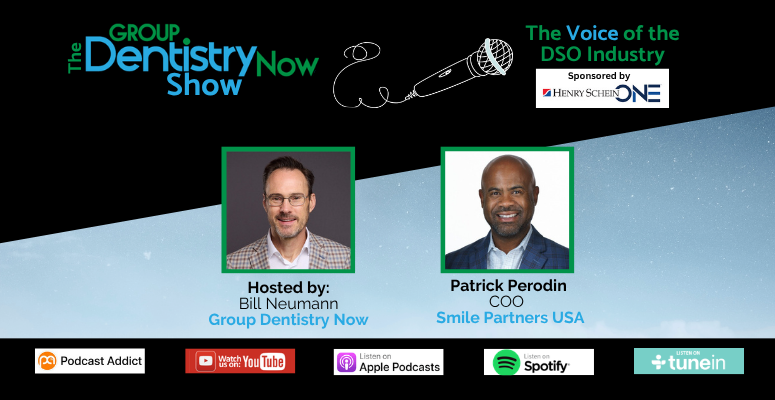
Welcome to The Group Dentistry Now Show: The Voice of the DSO Industry!
Scaling Dental Operations: Patrick Perodin on Technology, Same-Store Growth, and the Human Element at Smile Partners USA
Patrick Perodin, COO of Smile Partners USA shares his thoughts on:
- Office managers: the center of everything
- Beyond acquisitions: organic growth
- Day to day for this COO
To contact Patrick, you can find him on LinkedIn here: https://www.linkedin.com/in/pp822921735/
You can learn more about Smile Partners USA here: https://smilepartnersusa.com/
Thank you to Henry Schein One for sponsoring this episode. To learn more about ascend by Dentrix visit: https://dso.pub/ascend
Subscribe to our channel for more episodes and stay updated on the latest DSO news, insights, and events!
If you like our podcast, please give us a ⭐⭐⭐⭐⭐ review on iTunes https://apple.co/2Nejsfa and a Thumbs Up on YouTube.
Scaling Dental Operations: Patrick Perodin on Technology, Same-Store Growth, and the Human Element at Smile Partners USA Transcript:
Dentrix (00:12):
You’ve heard the phrase grow or be left behind, but growth becomes a lot harder when every new location adds complexity. Ascend by Dentrix gives growing dental groups the consistency, visibility, and connected workflows needed to scale with confidence. In fact, Ascend practices have achieved a 6.9% increase in net production, 70% treatment plan completion, and 12% more new patients per month. And if you’ve heard Ascend is the platform for the future, here’s what leading organizations are discovering. The future is already here. The industry’s growth-minded dental groups are building on Ascend today. Ascend by Dentrix. Dentistry, uninterrupted, growth unlocked.
Bill Neumann (01:05):
Welcome everyone to the Group Dentistry Now Show. I’m Bill Neumann, and as always, we appreciate you joining us today. I’m really excited about this conversation. We have Patrick Peradin, who’s the COO of Smile Partners USA. And it’s good to see you, Patrick.
Patrick Perodin (01:21):
Good to see you as well, Bill.
Bill Neumann (01:23):
So Patrick and I met in Boston and it was hot. It was July and it was during the craziness of COVID. So it was Yankee, which is typically in January and they had to push it to the summertime, which was actually great because I had never been to Boston in the summer. So we got a chance to meet and hang out. And actually Yankee did a really nice job outside. They had Irish dancers and had a little beer garden. And yeah, I thought it was pretty cool, but got a chance to meet Patrick. Gary Picard from Pacific Dental was the one that introduced us. And at the time, I guess you were at Pacific and you were in Virginia, I think, kind of managing that district?
Patrick Perodin (02:10):
I was, yeah. I had Virginia and Massachusetts and Maryland as a regional partner at that time with PDS.
Bill Neumann (02:16):
So you’ve been in the industry, you’re now with Smile Partners USA based in Michigan, but you’ve been a healthcare operator for 30 years, 19 of those in dentistry. You were at the Smileest, you were the president and COO at Marquee Dental Partners for a while. We talked about Pacific and your role there. Can you talk a little bit about how you got into dentistry? So I’m kind of curious, you were outside the industry, what were you doing before you got into dental and how did you make that transition?
Patrick Perodin (02:53):
Yeah, it’s pretty interesting. It was by accident really. I at the time was in healthcare management working in hospitals, so I worked for a big hospital system in DC, and I was just getting tired of what I was doing. I was working at the corporate office in risk management, and at the time me and my wife decided to open a deli. We’re from New York. We figured every place should have a deli, and we’re in Maryland and we didn’t see a ton of them. So we opened this deli and we had it for probably two years, and I was like, “Man, what am I doing? I’ve got all this education, experience in healthcare.” And then I started looking around and I got a random email for Levin Group, the dental consulting company, which was a big consulting company at the time, and they were looking for dental consultants.
(03:35):
I didn’t know what that was, so I said, “Sign me up,” and then interviewed, and that was my intro into dentistry, and then never looked back.
Bill Neumann (03:44):
That’s pretty cool. That place has been an incubator for a lot of people that have really made a name for themselves in the industry. John and Chris McClure from Align Dental Partners started there as well.
Patrick Perodin (03:58):
That’s right. Yeah, know them well, worked with both of those guys, and I know they’re kicking butt and doing well.
Bill Neumann (04:03):
Yeah, that’s great. I did not know that. So you cut your teeth there at the Levin Group, and then where did you go from there?
Patrick Perodin (04:12):
I did a little bit of back
Bill Neumann (04:13):
And
Patrick Perodin (04:14):
Forth with
Bill Neumann (04:14):
The
Patrick Perodin (04:15):
Hospital stuff at that time,
Bill Neumann (04:16):
And
Patrick Perodin (04:16):
Then I landed at Quantum Leap Success and Dentistry, another smaller consulting firm with Dr. Mike Kestner down in Texas and ran that for a couple years. And then from there I got a call. It’s all about who you know, right? I got a call. Actually, David Noe, who’s doing some FinTech stuff, was kind enough to introduce me to the folks at PDS, and I talked to Dan Burke and Steve Thorn at the time, and they had a regional partner opening in Virginia wanting to open up that market, and opportunity was great and took it, and that was in 2016.
Bill Neumann (04:49):
Nice. That’s great. Well, it’s pretty interesting. I mean, the hospital side of things make sense, right? That’s very similar. What’s different about it? What’s different about the hospital systems compared to dentistry?
Patrick Perodin (05:05):
Yeah, the biggest thing is you don’t sell much in the hospital. Somebody comes in and they need something, their insurance pays for it. There’s not much of a, “Hey, you got to convince somebody to do something.” As we all know in dentistry with insurance not being much of insurance, it’s really kind of supplemental. There’s a sales component to it and making sure that patients understand that getting healthy is important and their oral health is important, but there’s some convincing to do to help them understand and pay for that. And so I think that’s a big thing. Number two is a lot of hospital administration was about cost management, staff management and systems versus how do we grow the business? How do we look for ways to increase revenue? How do we look for different ways and technologies to get patients healthy? So those are some of the big changes that I saw there.
Bill Neumann (05:59):
All right, we’ll switch gears a little bit. What are maybe one or two things that people in the dental industry don’t know about you?
Patrick Perodin (06:09):
Yeah, so a couple things. I originally grew up in New York. I talked about the deli thing. So I’m a huge Knicks and Jets fan, so Nixon five, pretty happy to see them raise the banner yesterday, which was pretty neat and get their rings. And so I didn’t think I’d be alive to see a Knicks championship, which was neat. I don’t know if I’ll ever be alive to see a Jets championship. I don’t know if that’ll ever happen. That’s one thing. And second, I don’t know, maybe I know. I think the other thing is talking about dental, I was in a movie as a kid. I was 10 years old. I was in a movie called Compromising Positions. It’s a comedy about a dentist who gets murdered from doing some kind of behind the scenes naughty things, I guess. Had Susan Sarandon and Ralph Julia and Joe Montagna, just some famous people that you know.
(06:57):
It’s a bit of a B-list movie, but it was pretty neat to be in a dental movie as a kid.
Bill Neumann (07:03):
Yeah, some big names. How did you end up getting a role there? Was that when you were in New York?
Patrick Perodin (07:09):
Yeah, I was in New York and they were filming it out where I lived out in East Hampton, New York, and they needed a kid’s choir to be part of the storyline, and they picked us and we were singing a song called Grandfather’s Clock. And pretty funny to look back and see 10-year-old Patrick in a movie.
Bill Neumann (07:28):
How are the royalties from that?
Patrick Perodin (07:31):
They stopped after the first $50 they paid it. They give 50 bucks and a lot of candy, which was the payoff.
Bill Neumann (07:40):
Oh gosh. Well, that’s pretty cool. Now I’m going to have to see if I can find that movie somewhere on YouTube or maybe Tubi or Pluto or one of the freebies where you’ve got a bunch of commercials, but I bet you it’s somewhere we can find it.
Patrick Perodin (07:53):
Probably, yeah.
Bill Neumann (07:55):
So let’s talk a little bit about just, I think we look at 2026, we’re going into 2027, and it feels like the past couple years have been everything’s AI now. And so from an operations perspective, you’re probably inundated with all these wonderful solutions out there. What have you seen or what are you using that’s working and maybe some solutions that you’ve looked at that maybe aren’t quite there yet?
Patrick Perodin (08:26):
It’s a great question. I think to your point, it could be overwhelming. There’s so much AI out there and there’s so many companies doing different things in the space. I think what we’ve really focused on is on the clinical side is how we can support our docs in case presentation. And so we’re using Overjet and we’ve got Overjet deployed in all of our offices, which is fantastic to be able to have that tool for patient education and to have docs use that. So that’s been great. Right now we’re looking into a couple of different other areas. We’re using iSpace, Sabrina to do rev cycle management verification, insurance verification on the front end, which obviously that’s really big in rev cycle and getting accurate claims and getting fast verification. So that’s been great. And now we’re deployed in about 30 offices as we continue to stretch that out.
(09:19):
And we’re really looking into a couple other options is ambient voice listening in the operatories for clinical note-taking and getting claims out, and there’s some doctor coaching components to that. And we’re also looking at AI receptionists being able to answer incoming phone calls when we’re not in the office or when we’re too busy with some outbound components as well that can go into your practice management system and look at schedules and being able to fill schedules by making outbound calls. So all of that we’re looking at, but more to come. It’s exciting that there are so many options, and I think every day we look at some of these things, they’re just getting better and better.
Bill Neumann (10:00):
Yeah, but there’s also so many of them, I guess it can be a little overwhelming. Who’s going to be around in a year? There’s a lot of solutions out there that are off, there’s multiple solutions packaged up, but maybe one of the solutions is good and the other four or five are kind of ugh. So it will be nice to have a single solution that does multiple things, but it doesn’t seem like there are any yet. On the scheduling side of things, do you do online scheduling? Have you been able to figure that out?
Patrick Perodin (10:35):
Yeah, we do online scheduling through Next Health that’s integrated into our websites. And so that’s been really helpful in filling schedules. I always tell the offices, if you’re like me, I only schedule my life online. If I have to pick up a phone, it’s probably going to be tough to get me into your business. And so online scheduling and having that gateway for people to come in and see you is so critically important in our world. People don’t sit in the middle of the day at their desk and say, “Let me call the dentist.” It’s in the morning or it’s at night when they’re home on weekends. And so having that access when the office is not open to go ahead and schedule online is really, really critical.
Bill Neumann (11:11):
So give us an idea of what your day-to-day responsibilities are. What is Patrick doing on maybe not a Monday, but just in general, if you could take an overview of a week, what are you typically doing? Are you in a plane visiting practices a lot?
Patrick Perodin (11:29):
Yeah, a lot. Yeah, I am 1K in United and I’ve got the highest status at Marriott. I’m on the road a lot. I think it’s important for me as a COO to be in offices, be with our docs, or be at our support center with our support team, understanding how important we are to the field and making sure that our offices have great support and our patients get a great experience. And so yeah, a lot of office visits, a lot of time in the field, dinners with docs, breakfast, coffee with docs, just making sure that we understand what their needs are, they feel supported, and we’re giving them all the correct resources to be successful in treating patients.
Bill Neumann (12:09):
And so when you’re in those offices, you’re working closely with the office managers and doctors, pretty much everybody. What does that look like when you’re at the office? Who are you interfacing with?
Patrick Perodin (12:21):
Yeah, I try to travel with our regional managers just to be able to coordinate and talk about things. How are we going to best support the offices? How do we look to grow the offices? And then we’re going in and talking to those office managers and those docs. We need to hear from the front lines. I think sometimes we get caught up in what’s on a computer screen and looking at numbers versus going in and really feeling and seeing and hearing what’s going on in the offices. So that’s why we spend a lot of time in the field. And I have to say our CEO, Dave Gaspar does the same. He’s really pretty unique in that he loves spending time in the field as a CEO and doing those same things with docs. And so we both see the world the same way that our job is to support those offices and be in the field and be present.
Bill Neumann (13:06):
So talk a little bit about those office managers. I’m curious as you talk about technologies and maybe some office managers might be going, okay, if you don’t want me answering phones and what else are you going to outsource? Talk about the importance of the office manager because I think in a lot of cases that’s the first, when you’re a patient and you’re coming in and we know patients don’t typically look forward to going to the dentist, unfortunately. Sometimes they don’t, depends on what I guess they’re having done, but that first impression is that office manager.
Patrick Perodin (13:41):
Yeah, I think it’s the most important position in dentistry. I think they’re the key to the patient experience, they’re the key to the office experience, they’re the key to growing the practice, they’re the key to having a really good culture in the office. And so that role is so critical and so important. It’s why we spend so much time with them. We do a weekly call with all of our office managers every week on Fridays to teach and to learn from each other and to just really talk about the business and talk about the experiences that we have every week. But it is such an important position and we know that, and that’s why we put so much energy and effort into our office managers.
Bill Neumann (14:23):
We didn’t talk about this at the beginning, but you’re a Michigan-based organization. What states are you in? How many locations? If there is a typical practice, what does that tend to look like? Is it multi-specialty?
Patrick Perodin (14:37):
Yeah, we buy mostly general practiced dental offices. Some may have some integrated specialty, but we typically look for an office that’s, I don’t know, seven to eight at least operatories and bigger. We love to partner with docs that are going to see things as we see it, that we are in the business of taking care of patients. We want really, really good partners that care about their patients and they’re looking to continue to grow their business and practice to help more patients. We’re about at 130 locations. We are in Michigan, Illinois, Ohio, Massachusetts, which is a new partnership for us, which is doing great, Ohio, Colorado, Alabama, and Georgia. And so yeah, really, really good footprint, continually looking to grow and add good partners, but we feel really good about our growth right now.
Bill Neumann (15:32):
Okay. So Midwest, but then you’ve got Colorado, so that’s West, and then you’ve got East, which is Massachusetts. So when you make a move like that, is that typically a group, a small group that might have multiple locations, you can look at that to move into a state?
Patrick Perodin (15:48):
That’s exactly right. We partner with MFD Dental and Steve Markowitz there recently in Massachusetts, so that was six locations. And yeah, we’re looking to partner with really good partners like him and get a group of offices when we enter a new market.
Bill Neumann (16:04):
Yeah. Well, great. Let’s see. How about, we went from an industry and you’ve been around for a while, so it used to be acquisitional growth. When money was cheap, everything was just what can we buy? Everybody looks smart. As long as you had a checkbook, you could just grow through acquisition. Now, some groups don’t look so smart. Maybe some of those acquisitions were either they overpaid or they weren’t a cultural fit. So there’s some issues as we know in the industry, but the focus has changed, which probably all we should have been on is same store growth. You can grow through acquisition, but you should probably be focused on how do you grow the existing practices. So what are you doing at the practice level to grow those individual practices? Is it maybe trying to gain more treatment acceptance? We see some focus on clear aligner treatment where general dentists can get more comfortable doing that and keeping more of that specialty in-house.
(17:07):
What’s the strategy then?
Patrick Perodin (17:09):
Yeah, we’re looking to continually expand hours because I think the typical practice is like a Monday through Thursday and maybe a partial Friday or one Friday a month. And so looking at Fridays and Saturdays as expanded hours, evenings, mornings, looking to add providers for sure. Some of our practices have the capacity and the patient flow to add an additional hygienist, additional GP. Specialty growth is really in our windshield right now as we added a new specialty director to be able to look at specialty opportunities within those four walls and to have integrated specialists that travel throughout the market to provide those services to patients. To your point, looking at clear aligners and implants, which are two of the fastest growing segments in dentistry right now and looking to add those services as well. But it’s also increasing case acceptance and doing the core things at the office to get better case acceptance and get more patients into treatment.
(18:04):
And so we look at several growth factors with our ops team in partnership with our docs to see how can we grow our offerings to patients, and those are some of the ones that we’re focusing on right now.
Bill Neumann (18:15):
Great. I mean, it seems like everybody’s trying to figure that out, right? There’s some groups that have pretty much stopped acquisitions altogether, and that’s really where the focus is. And I think there’s a lot of focus on cost containment as well. Are you taking a look at that with your supplier partners?
Patrick Perodin (18:34):
Yeah, we are. It’s funny, before this call, I just got off a call with our procurement manager and some vendors to look at our cost. We’ve got some pretty good partnerships, but that’s always a lever to pull. We’re always looking at ways to get better pricing on labs. We do a lot of just cost initiatives to look at some of the vendors that we’re using. Can we get better pricing? Can we get better services? So that is certainly something we’re constantly looking at as my job as COO is to look at any opportunity to be more cost-efficient.
Bill Neumann (19:11):
Support, let’s talk a little bit about that. We touched on your role, you’re going into the practices a lot. When you look at the role of a DSO, that S, we talk a lot about that. It really is supposed to be support, but what does that mean? As a clinician, if I partner with you, what is my expectation and maybe where is the support and maybe where is the hands-off where it’s maybe leave the clinical to me as the dentist and you can support me in other things, but what does that look like?
Patrick Perodin (19:51):
Support is allowing the dentist to be able to walk into the practice that day and focus on their patients and not have to worry about legal and HR and recruiting and billing and taxes and all those other things that dentists typically don’t want to do. And so the better we get at those services and providing that support, the better patient’s care becomes because the doctor is solely focused on that. And so what I work with with my team is how do we take as much off the dentist plate as possible so they can solely focus on patient care and be able to answer their questions, answer their calls, be present, train their staff, all those sorts of things that, again, they just don’t want to or necessarily feel like they should do, which is why they join our group. And so we need to continue to improve that.
(20:47):
I’m always looking at ways to improve the operations. How do we give our operators more tools to be able to support our docs? But great is when our doctors feel like they can solely focus on their patients and not have to worry about those backend back office items.
Bill Neumann (21:04):
And do you feel like it’s different so that the needs from the doctors are different? When you go into one practice and you’re talking to it, you’re like, “Wow, okay, you certainly don’t need help here, but you need maybe help in other areas where the practice down in Ohio versus the one in Michigan may operate a little bit differently.”
Patrick Perodin (21:26):
Every single practice is unique, and that’s part of the regional manager’s job is to find out what that support looks like because it’s not one size fits all. We might have a young dentist that’s fresh out of dental school that may need clinical support and hooking them up with one of our clinical leaders to get that clinical support. It could be one office. Another office could be struggling with patient flow and hooking them up with our marketing team. And Justin, our chief marketing officer, may have to dive in and help there. It could be a recruiting issue where our recruiting team needs to dive in. And so every practice’s needs are unique, and that’s what’s great about us is we have the services to be able to support really any situation or any barrier that an office may have.
Bill Neumann (22:09):
You mentioned that you work closely with the regional managers, the regional lab. So how many of them do you have and typically how many practices does a regional manager manage?
Patrick Perodin (22:22):
Yeah, we have two vice presidents of operations that those regional managers report up to. And so each of the vice presidents have five to six, depending on who it is, regional managers. So we have 11 total, and they typically have anywhere from, I’d say, seven to 12 locations depending on their experience and the size of those practices. Not all practices are the same level of attention. And so their day-to-day is being 80% in the field and being present, being in offices, might be coaching a doc, might be coaching an OM, might be just something as simple as reviewing a P&L with a doc and the office manager, but they are really field facing being present for those teams and supporting them.
Bill Neumann (23:09):
Excellent. And do you see the career path, a lot of office managers move into a regional position? How does that typically work?
Patrick Perodin (23:17):
Yeah, they do. If I look at almost all of our regional operators, they probably even started as either dental assistants or front desk coordinators or treatment coordinators. And so they’ve been able to learn and grow and develop and become regional managers, which is really, really cool to see the evolution of our folks that have put in the time and effort and gained that experience to really advance their careers. And so we love internal promotions. We love seeing people grow. And yeah, I’d say all of our regional managers serve that one of those positions for the most part. Yeah.
Bill Neumann (23:49):
That’s great. Yeah, I mean to have that experience, and you can be certainly very relatable to your office managers that you’re working with now that yes, I was there. I was at the front desk at some point or I was as an office manager.That’s great because I think a lot of people are looking for opportunity. You see this is a challenge. We talk about recruitment and retention. You may have some practices that have that. It’s not just the doctors or the hygienists, you have it with office staff as well. So I think to have those type of career paths, do you tend to have a clear pathway to growth for people, whether they’re office managers or maybe even people in clinical positions whether hygienists or dental assistants or even doctors that maybe want to do something bigger or different?
Patrick Perodin (24:46):
We do. Yeah, we’re always looking for clinical leadership. It’s one of the things that we focus on is what doctors that want to do something maybe beyond the chair, maybe it’s mentoring a young doc, maybe it’s being on our clinical advisory board. Those are all opportunities that we love to promote, and we’ve got really good momentum on getting doctors to transition into that world, especially doctors that are looking for that next step that maybe they’ve been chairside for 25 years and they’re looking for another opportunity to stay in dentistry, but do something different outside the chair. And that goes same with our non-clinical staff, is always encouraging them to do other things. And it might not be office manager or regional manager. It could be a training position. It could be helping another manager in another office and having extra responsibility, but that’s how you build a really good company culture is helping people with that next step in their career to feel like they’re part of something bigger and part of something more important.
Bill Neumann (25:45):
I think it’s really important now. Again, I think we thought a lot of the challenges with recruitment and retention were driven by COVID, and once that was over, that they would flatten out and we’d get, but it still seems to continue on. So I think to have that clear pathway for people to, because I think in general, people want to stay. They don’t want to make changes, but they feel like they don’t necessarily have any opportunity, then that’s when they end up leaving. So that’s great.
Patrick Perodin (26:18):
And I think we can’t be afraid as leaders in the industry is sometimes you just may not have that opportunity, but if they still grow and go somewhere else for a bigger role, I still see that as a win. We’d love to keep everybody, but sometimes there’s just not a seat for them. And so I don’t necessarily feel terrible when someone has the growth because of what they did with us at Small Partners and they go on to bigger and better things. I still think that’s a pretty healthy thing for the industry.
Bill Neumann (26:43):
Yeah, that’s well said and unselfish of you because you still need to replace them, right?
Patrick Perodin (26:50):
Yeah.
Bill Neumann (26:51):
How about practice management software? This is an interesting topic because at different groups, some may have three or four. So you’re acquiring practices or you’re acquiring small groups. A lot of times they’re not necessarily going to have the PMS that you maybe would like them to use. Now, are you all using pretty much one dedicated PMS, and how does that integration process look like? Because that’s a tough thing to change.
Patrick Perodin (27:23):
Oh yeah. Yeah, we’re moving there. Our CEO, Dave, made the very conscious decision to go to one platform, and so we are transitioning all of our practices to one platform, to Denakon. Right now, we’re probably 25-ish practices into that conversion process. The hope is to get to two systems by December, and then we really push hard in 2027 to get everybody on one platform. And listen, everybody’s going to have a different opinion on it. I think our opinion is that it would make our life easier from a data perspective, from a training perspective, from a lot of different areas. And so that’s why Dave has pushed us to do that. And so we’re looking by Q3 of next year to be on one platform and in conjunction with the data warehouse build and some of the other things we’re doing on the tech side, it should help us have better insight and better visibility in the business.
Bill Neumann (28:22):
Is that a challenge for you right now because you’re pulling from different systems?
Patrick Perodin (28:26):
It is. It is. I think every morning we wake up and we think 99% of the data is right, but there’s always that question because we’re pulling from different systems of that 1%. And so as we are moving to one system, we have way higher confidence levels that we’re going to have better data.
Bill Neumann (28:46):
I heard somebody in the industry mention this. I don’t know if it’s true or not, or if you’ve thought this through, but it’s kind of an interesting insight with the rise of technology and vibe coding and all of this, the ease of now being able to create your own software. Somebody though had mentioned, and they were with one of the big tech companies in the industry, that eventually groups are going to be creating their own PMS systems and they’re going to be able to customize them. And I don’t know when or if that’ll happen, but I though it was an interesting statement coming from a company that has a PMS system.
Patrick Perodin (29:26):
Yeah, I’ve heard the same. If it was up to me to create that, that’s the wrong thing. I don’t have the IT experience, but I think that is coming one day because every PMS does something different. They all have their strengths, they all have their challenges, but somebody is going to customize and really create their own, and I think it’s probably coming sooner than later.
Bill Neumann (29:50):
Yeah, maybe the PMS companies will let you jailbreak theirs and then customize it. This is a great conversation. I always find this, the operations side of the industry is you’re kind of an unsung hero, I think, because, and I’m sure you’ve kind of seen this before, when you get people to come from outside the industry, and it’s great to get different perspective, but I don’t think they realize the nuances of dentistry and how different it can be than, like you said, on the hospital side of things, or if you come from outside of healthcare, how different it can be. So I think having really solid operations people is just, it’s key to success, and you can’t necessarily plug somebody in that’s been managing multi-site retail into dentistry and think that that’s just going to work without a steep learning curve.
Patrick Perodin (30:52):
That’s right. Yeah, the experience certainly helps. I think we have seen operators outside of the industry do well, but to your point, the credibility to be able to walk into a dental office and talk the talk of a dentist and be able to know what their days and weeks and hours look like because of experience makes a big difference in your credibility and being able to support them.
Bill Neumann (31:20):
So last couple of questions for you, Patrick. We’re in November of 2026, you’re already probably looking at 2027. What initiatives do you have? You discussed a little bit of some of them on the tech side of things earlier, but what initiatives do you have for the operations team? And then what do you think 2027, what’s the outlook that you just have? Is it going to be much like 2026 or what does 27 look like when you get out your crystal ball?
Patrick Perodin (31:55):
Yeah, for us really it is continuing our process of integrating systems. It’s building our data warehouse, looking at some of the AI technology we have, trying to continue to develop our office managers with better training and resources and tools, really rounding out our operations team to make sure that we have the right support for our offices for 27. We’re super bullish on 27. I think with all the things that we’re putting in place right now, we’re excited about 27, we’re excited about growing. That’s always any DSO is looking to grow. And we’re looking really to our doctors to help us with that, bringing in new perspectives, bringing in new clinical leaders, helping us look at how can we be better for our patients. Those are all things that we constantly talk about every day as a leadership group and really excited about what we’re building and putting in place.
(32:51):
We’re going through budget season now and we’re trying to figure out how we’re going to grow and what levers to pull. And so exciting time for us as we gear ourselves up and get ready for 27.
Bill Neumann (33:01):
Excellent. Well, I appreciate you taking time in between your trips to the practices and having this conversation. Again, this has been a long time coming. We’ve been trying to schedule this for probably, I don’t know, four or five months at least.
Patrick Perodin (33:17):
Yeah, I think so. Yeah.
Bill Neumann (33:18):
So we’ve been able to do that. And last question for you. If people want to contact you or learn more about Smile Partners USA, what are the best ways to do that?
Patrick Perodin (33:30):
Yeah, I’m on LinkedIn. You could find me at Patrick Peradin. I think that’s the best way. I love connecting with folks on LinkedIn, and I think that’s the best way to reach out to me. Would love to hear from anybody. I love talking shop. I love talking about the industry. I can learn a ton, maybe we can learn from each other. So yeah, just reach out on LinkedIn, say hello, and be happy to connect and talk about anything that’s on the table.
Bill Neumann (33:53):
Excellent. Well, thank you so much, Patrick. Great to have you on and thank you everybody for watching or listening to this podcast. Until next time, this is the Group Dentistry Now show. Good seeing you, Patrick.
Patrick Perodin (34:06):
Thanks. Great to see you too.