

Sponsored Content
How a two-appointment workflow gives clinicians a reason to adopt, and keeps a network on one standard.
More than 40 million Americans wear dentures. They rely on them to eat, to speak, to smile in photos, and to feel like themselves. Yet getting a denture still resembles something much closer to the 1990s than the 2020s. Clinicians and patients experience five or six appointments stretched over months, adjustment after adjustment, and the result depends heavily on the dental lab, or even technician, that made it.
While crowns, bridges, and implants now run on scanning, design software, and digital manufacturing, dentures have been slower to follow. And for DSOs that depend on repeatable systems, the gap is a drain on margin. Most networks know they need to close it, but either don’t know how, or haven’t been able to make changes stick.
Two approaches, and a sacrifice either way
If you ask a dentist what a great denture looks like, they’ll usually describe a traditional, hand-crafted approach. Built by a skilled technician, a hand-crafted denture delivers the aesthetics, comfort, and durability patients and clinicians want. However on the negative side, there’s an added cost in time and variability. A hand-crafted denture typically takes five to six appointments, with repeated adjustments along the way, and the quality of the result depends on the technician who made it. Like any craft, it doesn’t scale cleanly.
The other option is digital dentures. Whether milled or 3D-printed, they promised what other digital workflows already delivered: fewer appointments, more precision, and predictable results. Some delivered on the appointment count, but many clinicians found they were sacrificing when it came to aesthetics and durability. Printed dentures in particular can look flatter and feel more artificial, and they tend to be less durable. When one fractures, it generally can’t be serviced and has to be replaced, which adds cost for the practice and the patient.
Beyond materials and manufacturing, scanning adds another hurdle. Capturing an accurate scan for a denture is harder than scanning teeth. Soft tissue moves and has few fixed landmarks (such as other teeth) for a scanner to work from, so a good scan takes technique many doctors haven’t had reason to build.
What we’re left with is a reality that asks dentists to give something up, and makes it nearly impossible for DSOs to scale dentures.
Because of this, many times a dentist will try a digital denture workflow, run into the problems we’ve outlined here, and then switch back to analog because they’re the one answering to patients at the end of the day.
What’s been missing is all of it at once: a denture clinicians are proud of, delivered in fewer appointments, through a workflow they trust.
What the tradeoff means for a DSO
For a single practice, the denture tradeoff is based on the dentist’s and patient’s preferences. For a DSO, the compromise gets made hundreds of times, and every sacrifice is compounded. Because nobody sees these costs on a single line of the P&L, they’re easy to underestimate.
Chair time. A traditional denture case takes five or six appointments, and every one of them occupies a chair and a clinician. Across a network, that’s a significant amount of capacity committed to a single service line.
Lost production. Some clinicians, faced with a process they find frustrating or unreliable, stop taking denture cases all together. Those patients end up going to a referral practice, a competitor practice, or just skip it. To add insult to injury, among patients who do start treatment, a longer timeline can easily lead to treatment being put off or canceled.
Rework that comes out of margin. Remakes, relines, adjustments, and early replacements all cost chair time and lab spend without producing anything new. Because materials, methods, and labs vary by location, they’re hard to forecast or benchmark.
A fragmented lab network. Denture work that’s spread across many labs and materials, doesn’t benefit from volume leverage and has no consistent quality bar to boot. Every newly acquired practice arrives with its own labs, which the network then has to consolidate or live with.
What it takes to break the tradeoff
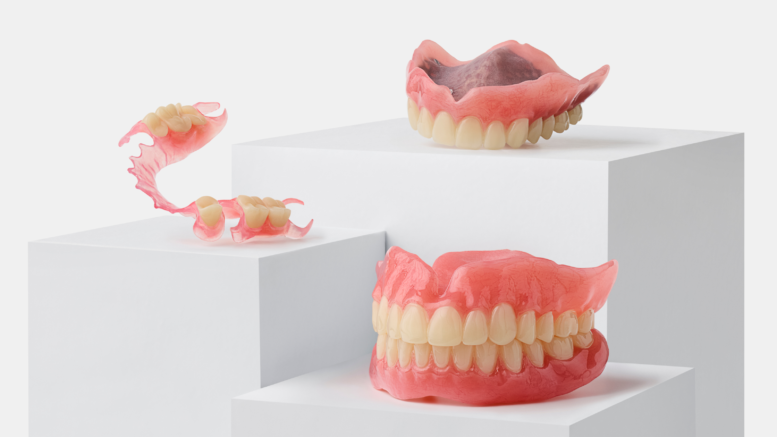
That’s the problem Dandy set out to solve. Rather than refine either existing approach, Dandy asked what dentures would look like if they were designed from scratch with today’s technology. The answer is Dandy Fusion™ Dentures, built on a hybrid manufacturing process that combines the strengths of both digital and analog.
It starts with a digital scan, which drives a 3D-printed mold. Hand-poured acrylic is then added to that mold. It’s three simple digital steps that deliver the precision, fit, and repeatability that clinicians, patients, and DSO leaders need. Fusion is a denture designed to look and perform like a hand-crafted one, with consistency and a workflow that cuts the timeline in half, built in.
On the adoption front, a shorter workflow only helps if clinicians feel confident running it, and that’s where many digital denture attempts have fallen short. So Dandy built support in from the first case. That includes guided workflows that walk clinicians through each step, hands-on training, and AI Scan Review, which helps doctors who are new to scanning for dentures capture what they need the first time.
What a better denture means for a DSO
More capacity. Cutting three or four appointments from a denture case gives chair hours back to the schedule, and at roughly $400 in production per chair hour, those hours matter. Enable Dental, a DSO operating across 12 states, projects that a two-appointment workflow will open up more than 10,000 appointments a year across its network. That time can go to new patients, higher-value procedures, or shorter waits.
Unlock same-store growth. A workflow clinicians trust gives those who had previously opted out a reason to start offering dentures again. And, a shorter timeline means more patients who start treatment will actually finish it.
Less rework. Fusion™ Dentures are finished in traditional acrylic, so adjustments and relines happen chairside, the way clinicians already handle a conventional denture, with no new protocol to train on or enforce. Fit issues that might have meant a remake with 3D printed dentures can often be handled in the same visit. Guided workflows, hands-on training, and AI Scan Review also help doctors get the scan right the first time, which cuts down on remakes in the first place.
More leverage with fewer labs. One denture workflow lets a network consolidate denture work with a single lab partner, which means more volume leverage and one standard to hold the lab to. Newly acquired practices can move onto the same workflow and bring their denture volume with them instead of adding more labs to manage.
The business case also comes with another benefit that’s harder to put a number on: higher clinician satisfaction. Doctors keep their autonomy. They get the technology and support to do their best work and deliver dentures they feel good about. For a network competing for strong clinicians, that’s a major recruiting and retention advantage.
What DSO leaders should be asking
If dentures are still managed location by location in your network, a few questions are worth putting on the table before your next lab evaluation:
- Of the clinicians in our network who have tried digital dentures, how many went back to analog, and what drove that decision?
- How many appointments does a denture case take across our locations, and how much does that vary?
- How many of our clinicians decline denture cases, and what revenue does that represent?
- How much are remakes and relines costing us in chair time and lab spend?
- When a clinician adopts a new digital denture workflow, what support do they get, and is it enough to make them confident from the first case?
The answers show whether your denture approach is working.
Fix your denture approach
For a DSO, leaving dentures as it is has a price. The chair time, lost production, rework, and lab sprawl add up, and they compound with every new location and every acquisition.
The fix is a workflow clinicians choose themselves, standardization that scales, and materials that both clinicians and patients are happy with.
Ready to see how Dandy Fusion™ Dentures could fit into your network’s denture strategy?