
Ranked the #1 DSO Podcast!
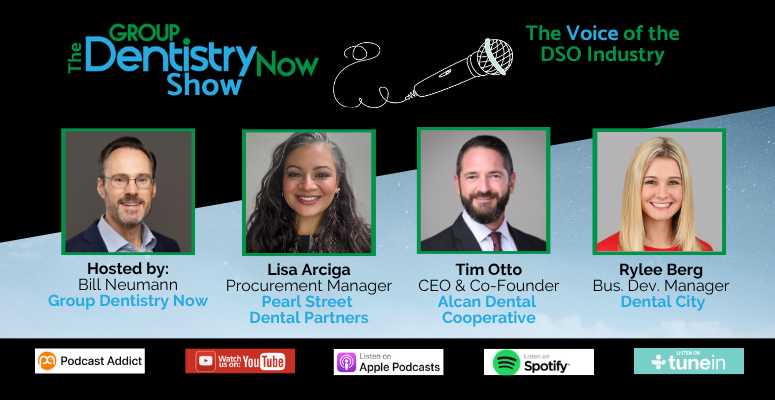
Welcome to The Group Dentistry Now Show: The Voice of the DSO Industry!
2026 Dental Procurement Panel: Standardization, Partnerships, and Future Strategies
Lisa Arciga, Procurement Manager at Pearl Street Dental Partners, Tim Otto, CEO of Alcan Dental Cooperative & Rylee Berg, Business Development Manager at Dental City discuss:
- Standardizing Procurement
- AI in Purchasing
- Last Minute Ordering
To connect with Dental City visit: https://dentalcity.com/ or contact Rylee Berg at rberg@dentalcity.com
Connect with Lisa Arciga at lisa@pearlstreetdentalpartners.com or visit https://www.pearlstreetdentalpartners.com/
You can also learn more about Alcan Dental Cooperative at https://www.alcandentalcooperative.com/ .
Subscribe to our channel for more episodes and stay updated on the latest DSO news, insights, and events!
If you like our podcast, please give us a ⭐⭐⭐⭐⭐ review on iTunes https://apple.co/2Nejsfa and a Thumbs Up on YouTube.
Choose your favorite listening app below and subscribe today so you don’t miss an episode! Full transcript is also provided below. See all of our podcasts HERE.
 |
 |
 |
 |
 |
 |
DSO Podcast Transcript – 2026 Dental Procurement Panel: Standardization, Partnerships, and Future Strategies.
Bill Neumann (00:12):
Welcome everyone to the Group Dentistry Now Show. I’m Bill Neumann and as always, we appreciate you joining us. Have a great discussion today around dental procurement, and we try and do at least one panel discussion about procurement as it’s rapidly changing with the advent of technology and new products and just all the changes that are going on in the industry. So this is going to be our 2026 procurement panel discussion. We’re going to talk about cover topics like standardizing processes, stronger supplier and manufacturer partnerships, what that means to the organizations we have on the podcast, some bottlenecks you may be encountering, and maybe some strategies around those bottlenecks. And then just any best practices you can all share with us. And then we appreciate Dental City for sponsoring this discussion we have with us from Dental City. Rylee Berg, a familiar face in the DSO space.
(01:16):
She’s the business development manager at Dental City. Rylee, thanks for helping us put this together.
Rylee Berg (01:24):
Absolutely. Excited to be a part of it.
Bill Neumann (01:27):
And we also have with us Lisa Arciga. She is the procurement manager at Pearl Street Dental Partners. She’s a dental assistant as well. And we were talking off camera about how important it is that you really know in procurement, understand clinical products, and of course as a dental assistant and actually still practicing, she really has a lot of experience and knowledge when it comes to the clinical products and it comes to procurement. So Lisa, it’s great to have you on.
Lisa Arciga (01:58):
Thank you. Thank you for having me.
Bill Neumann (02:02):
And lastly, we have with us Tim Otto. He is the CEO and co-founder of Alcan Dental Cooperative. Tim, welcome to the Group Dentistry Nowshire. Thanks for being a part of this as well.
Tim Otto (02:14):
Thanks for having me, Bill.
Bill Neumann (02:16):
Yep. So let’s kind of kick things off here. Rylee, why don’t we start off with you, a little bit about your background and your role at Dental City and maybe a little bit about what Dental City does.
Rylee Berg (02:28):
Absolutely. I’ve been with Dental City for six years and I started on the special markets team. So it was back in 2020 when the industry or the world was crazy, and that’s really when the DSO and special market space really blew up. So I’ve been along for the ride with all of the changes and innovations, technology advancements, and it’s been really exciting to be a part of it. So today I lead the special markets team. We have four key account managers and four special markets account managers that support DS Health and make sure that there’s a true partnership and they feel supported every step of the way.
Bill Neumann (03:15):
Thanks, Rylee. And Lisa, what about you? We talked about your dental assisting background, but maybe talk a little bit about, you’ve been with Pearl Street for quite a while and you went from dental assisting to, well, you’re still doing dental assisting. And now of course you’ve got that procurement hat as well. But talk about a little bit about how that role, you went from assisting to procurement, and then also give us a little bit of background on Pearl Street, if you don’t mind.
Lisa Arciga (03:48):
Well, Pearl Street became Pearl Street probably in, I don’t know the exact date, but it was about to be 2020 before the chaos of COVID. Before then, we were a smaller company. I’ve been with Dr. Jennings since 2006. We used to be DMS and they had a vision and they grew. And so we became Pearl Street. I have been with Dr. Jennings since December 2006. And so when I came on board, about a year after coming on board, I took over all the ordering process, became his lead assistant. And I think mainly because I was so strict on the orders and so strict on the budget, he said that this would be a great role for me for the company basically. So little by little, we transitioned me into doing a little bit of double. I still assist Dr. Jennings. He’s not in the office as much as he was back then.
(04:55):
So it’s given me an opportunity to transition into the procurement part. I do get out of the office a little bit more. I go to the other offices that we are acquiring and I do a little bit of training. Our procurement program that we use is Dentira. So I train all our offices on how to properly use that and basically try to train our offices the best ways to order and keep an eye on budgets.
Bill Neumann (05:26):
And you have over 50 practice locations, correct?
Lisa Arciga (05:30):
Yes, currently we do. We’re in the process of acquiring a few more, but right now we’re at about 50, 51.
Bill Neumann (05:38):
Excellent. And we had Dr. Jennings on the podcast, boy, about a month ago with, I know we also had David Meese on, the CEO. So we can put a link in the show notes to that too, in case anybody wants to check out Dr. Jennings and Dr. Meese. All right, Tim, moving on to you, because you’re a little bit different as far as an organization goes. You’re CEO and co-founder, and you’re partnered with your wife who’s a dentist. Is that correct?
Tim Otto (06:11):
Yep, exactly.
Bill Neumann (06:12):
And it’s Alcan Dental Cooperative. So talk a little bit about your role at the organization, how you became the co-founder with your wife, and just the size of the organization, the practices that you are partnering with.
Tim Otto (06:30):
Yeah, I feel well suited for this and I kind of geek out on procurement because in my past life I did degrees in finance and management, international MBA, and ended up working for AeroElectronics, which was a $26 billion a year at the time distribution company. So I ran a hundred million dollar business unit for them, and my role was supply chain, both on the sales and the stocking side of things. So you’re speaking near and dear to my heart when we talk about procurement, especially as it pertains to the dental industry. After that, went to work for a global manufacturer on the manufacturing side of things and ran distribution for them for North America for a while. And then at that point I was traveling a couple hundred days a year and decided that that was not the life that we wanted for our families.
(07:18):
So my wife and I decided that we would combine the best of both worlds. She went back to pediatric residency, and during that time I studied the business of dentistry. Left my role in corporate America and started building the foundations of what would become Alcan Dental Cooperative. One of the stated goals of our group is that we are eschewing private equity, eschewing outside investment, and remaining 100% doctor-owned and operated. So that’s kind of the unique selling proposition of Alcan versus other dental partnership organizations is that we are going to keep ownership at the doctor level in perpetuity. And a lot of others say that, but they don’t necessarily have a structure that is conducive or supports that. So anyway, that’s the foundation of Alcan Dental Cooperative. I run the business side of things. My wife obviously runs the clinical side of things, being the petadonist in the couple.
(08:20):
And so we have a really good yin and yang. Ultimately, the business decisions are guided and led by the clinical decisions, which is also kind of unique about us. And we can talk a little bit about that today, whereas I would, as a business guy, maybe choose a less expensive or a gray market approach towards procurement. My wife as the clinical director says, no, absolutely not. We’re going to have our Fuji SEM. We’re going to have these spring circonia crown disease quality products that we refuse to compromise on. And so my job as the business manager is to enable those and obviously do my best to source those not only as inexpensively as possible, but also having reliable supply chain partners like Dental City so that we know we can get that product into the hands of our clinicians when it’s needed.
Bill Neumann (09:11):
Excellent. So let’s get into the discussion portion. Talk about standardization a little bit. And Lisa, we can kick things off with you. As you’re acquiring, you talked about that you’re looking to acquire some practices probably in the process of that, but as you acquire practices, they all do different things. They’re all buying from different suppliers, have different manufacturers that they work with. They may have a procurement platform, they may not. Can you talk a little bit about some of the challenges that you encounter when you onboard a practice or a group of practices and you’re trying to standardize that? And what does that look like when you have to come in and talk to them and find out what they’re doing and move them more towards the Pearl Street way of doing things?
Lisa Arciga (10:03):
Well, one of the great things about Pearl Street is that they don’t really force anything on anybody. They’re not forcing changes with ordering. We show them, we try to encourage them, “This is how Pearl Street does it, and we have found that we can get way better savings for you.” One of the things that we present right off the bat is the Dentera platform where we allow them to see this is how vendors allow us to save money is they’re competitive on their pricing. We show them the differences. Because we have our preferred vendors, we have really good pricing with them. Some of the new offices are a little hesitant about ruining relationships with their current vendors. So we don’t force a change. And that’s one of the great things about Pearl Street. But on my end, it kind of makes it a little bit difficult because I have to keep everybody within budget.
(11:04):
And so a lot of new offices come into Pearl Street not having to go by monthly budgets. And so all I can do is go, I sit with them, I show them the process, I talk to them about it. I try to get a relationship started like with Dental City. A lot of these offices that come in, they have their preferred, which would be Patterson or Shine because they stick with one vendor. And so the hardest part for me is just getting them to accept that this could work for you, this could save you money when they haven’t really worried about the whole saving money on supplies, which surprises me. I mean, I’ve worked in a private also before Dr. Jennings, and the bottom line is always there. You always want to try to save and keep your overhead down, but it’s amazing to me how many offices don’t really do that because what they need, they need.
(12:10):
And we don’t encourage changing the important clinical items. We’ll make recommendations to change to help save money, but we don’t compromise on the quality of the products. But we do offer these vendors that will give you those quality products at a better rate than what you’re paying with another vendor. That to me is what’s harder for me coming into it is just showing them, not necessarily forcing it, but encouraging a change.
Bill Neumann (12:46):
Tim, over at Alcan, how do you standardize things? I mean, are you acquiring. You’re more of a DPO model, but there’s still an acquisition, right? It’s just that the practices just retain the majority share of equity. Is that –
Tim Otto (13:04):
Exactly. So we’re a combination. We do both de novos as well as affiliations is what we call them. But very similar to what Lisa was saying, the act of going in and change management within these organizations when we come in and implement our systems and processes, it’s the toughest thing in the world. As humans, we’re programmed to not like change, to be averse to change. And that’s something that we as an organization have become very skilled at is showing them that these changes are going to benefit them, going to benefit their doctors, and ultimately, most importantly, going to benefit the patients. We take a more hands-on approach it sounds like possibly than PearlStreet because we do require anybody that affiliates with Alcan to use our systems and processes. And part of the reason of that is that we do want to be able to drive a certain level of standardization, not necessarily in the materials being used, but the process by which those materials are procured.
(14:05):
And it’s important that we do that and we’re all speaking the same language, we’re all using the same system, because ultimately that’s how we’re going to work with suppliers like Dental City to prove our value to them because this is a relationship and our relationship goes both ways. Dental City, in order to provide us the best value, both by keeping the materials in stock and by providing us the lowest price possible, they need to know and understand that they’re working with an organization that also values their time and values that partnership as well and does things to make it as easy as possible for them to do business with us vis-a-vis one of the main things, which is a centralized ordering platform that everybody in the organization uses. So yeah, we definitely go to great lengths to make sure that our users are all using the same platform.
(14:57):
Regardless of the materials they’re purchasing, we want them going through that one individual platform.
Bill Neumann (15:06):
Bradley, it’d be great to get your perspective. You work with a lot of groups, all shapes and sizes. From a standardization process, I mean, do you see, because Lisa, you’ve got Lisa’s side of things where they’d like to standardize, they offer up the systems and the processes and the solutions. And a lot of times the practices come over, some probably don’t. And then there’s the other approach, which is a little bit more like Alcan where this isn’t what you’re going to do, but this is, “Hey, this is our system. You’re coming over and working with us.” Do you see a lot of similarities with practices that you work with? Some do, some don’t. Some are standardized, some aren’t standardized at all?
Rylee Berg (15:58):
Yeah. And I think it goes back to the infamous saying that if you know one DSO, you know one DSO or group practice, they all have different processes, different goals. And our philosophy has always been we want to meet customers where they want to be met. And whether that’s Lisa and Pearl Street, and they have offices that already have a great relationship with other suppliers, we understand that relationships are essential. And it’s always been one of the most important things in the dental industry. It’s not that we want to take that away, but we’ll be a partner with those offices and just let them know that Dental City is here to support them in whatever capacity that they’ll allow us.
(16:48):
And then when it’s someone like a group like Elkin and they do have a more structured formulary, they know exactly what products all of the offices are ordering. That’s where we can analyze those very specific products, reach out to the manufacturer partners and make sure that we have the appropriate prices in place and also work on our internal solutions and our purchasing team to make sure we’re stocking those products because they have a good idea on what the forecast looks like, what they need on a month-by-month basis. So it really just comes down to having a conversation with each group, knowing what their goals are, and just really understanding what the partnership between that group and Dental City should look like and what they want it to look like.
Bill Neumann (17:40):
So next question, Lisa, I just wanted to start with you. With your approach, which is not a little, I wouldn’t say it’s hands-off, but it’s like you present and then what would you say the buy-in or the compliance is? Do you think that most of the practices do follow the lead of Pearl Street?
Lisa Arciga (18:02):
Yes.
Bill Neumann (18:03):
Yeah.
Lisa Arciga (18:03):
Yeah. We don’t have 100%, I’m not going to lie about that, but I think we have about 98% that once we introduce it and we show them and they see the savings, they buy in and they run with it and it ends up being a great partnership with everybody.
Bill Neumann (18:23):
As we switch gears here, how about bottlenecks? Is there anything when it comes to purchasing and procurement you feel like just it isn’t automated or you haven’t automated it yet and you just feel like you get bogged down doing things that maybe you don’t want to? Lisa?
Lisa Arciga (18:43):
I think mainly for me, because of the fact that we do things a little bit differently, I still have to review and approve. And so when I’m making changes, I still have to contact the office, let them know what I’m recommending for change. And so we get bogged down with our communication because I’m speaking to assistants that need to speak to their doctors. And that’s where I get held up because of the way we do our things at Pearl Street. It’s not necessarily because there’s something wrong with the system. It’s just that I need verification before I can make any changes or recommend something to be changed. If I’m going to go from one vendor to another and to show them, look, I can save y’all more money if we do this, then that’s where I get held up. But other than that, it runs pretty smoothly for us.
Bill Neumann (19:41):
How about you, Tim? Any areas of bottlenecks?
Tim Otto (19:45):
I mean, Lisa nailed it. Now I’ll admit that we are in a very different space. Being pediatric, our SKU count is like 200 versus general dentistry where Lisa’s SKU count is probably 2000 and counting. So we’re lucky in that regard. Part of the onboarding process with Alkan when we affiliate with somebody is we go through, my wife goes through with the owner doctor and goes through their formulary, goes through their purchase history and determines what that doctor likes to do. So if they have a specific crown company they want to work with, that they have a certain composite that they want to use, we make sure that that’s added into the formulary, set as the preferred product for that office. And then we work with the suppliers and possibly the manufacturers depending on what the product is to say, okay, here’s our price for that.
(20:41):
It’s set in the formulary so that when the lead RDA at that office goes to place that product in the cart, it pops up, it’s there automatically for them. They click one button and it goes through a very streamlined approval process. So doing the work ahead of time to remove those bottlenecks is one of the most important things that we have done. However, I’ll caveat that with saying also sit in a rarefied area of not having a tremendous SKU count. So it makes our supply chain a little bit easier to manage than leases at Pearl Street.
Bill Neumann (21:17):
Yeah, fair. Moving on to automation and AI, where we live in this world of AI overload, everything is we can automate everything and we can AI everything. Not really, but it seems like that’s the pitch anyway. But I think there are some technology solutions out there that we can leverage. Lisa mentioned Dentera and platforms like that that can be used in order to just have a lot more visibility, make things a little bit easier. Rylee, from Dental City’s perspective, what are you doing as an organization to make it easier for organizations like Alcan and Pearl Street to manage their procurement processes a little bit easier?
Rylee Berg (22:07):
Sure. Starting with the RFPs and/or individual office quotes, we have quoting tools in place where we’re able to map our Dental City SKU so they can see exactly what the Dental City item number is compared to what they’re currently using. And then we can also take it a step further by offering alternative products as well. So if they’re using a direct company and they want to try to streamline it and order from less places, we have the ability to do that. Or if they have a strong relationship with one manufacturer versus another and they need help finding what the alternatives are, we have tools in place to do that. And then as far as having relationships with procurement platforms, I feel like that’s one of the things we’re known for in the industry, at least over the last couple years. If a group chooses a procurement platform, we do our absolute best to have a strong relationship with that platform.
(23:10):
Because again, our philosophy is we want to meet the customer where they want to be met. And one of the things with doing that is if they’re on a platform, we need to make sure that they’re still having the best experience with Dental City and that platform. And it’s a streamlined process. So the end goal is always an API integration to make sure we’re sending the information through code. So the groups have accurate information to our stocking status, the live negotiated pricing, and invoices, tracking information, and everything else that happens after the order, as well as our customer service team has strong communication with the contacts at each platform so we can be in constant communication if we need to troubleshoot something.
Bill Neumann (24:05):
Now, Lisa, you mentioned using a procurement platform. Is there anything else you’re doing from an automation standpoint or leveraging AI to help with the procurement process?
Lisa Arciga (24:16):
Not currently.
Bill Neumann (24:19):
So Dentira, you rely on that and Dental City. Okay, that’s great. Yeah, I mean that’s the benefit of having strong, which is going to be our next topic is strong partners, industry partners that can really help you alleviate or not have to do these things internally and leverage their expertise. Tim, how about you? Is there anything that you’ve automated or used AI to help with the procurement process?
Tim Otto (24:48):
Yeah, I think you nailed it earlier where it’s like we’re looking for a reason to use AI when we really shouldn’t be. It’s like a shiny toy. When you have a hammer, everything looks like a nail. And so we’re actually trying to limit our use of it to where it’s really going to impact the patient experience and the bottom line. Our procurement platform is called Valium, and there’s some stuff that’s going on there with predictive ordering and things like that. But from what we have seen, there’s other lower hanging fruit that we can do in our offices to generate that patient experience. So for right now, like Lisa said, no, we use it as an ordering platform. It’s got the API integrations with our main suppliers, and that’s good enough. But our supply spend is less than 5% of overall revenue. So there’s other areas that we can have a lot heavier leverage on our bottom line by deploying AI elsewhere.
(25:47):
Just my two cents on it.
Bill Neumann (25:49):
Yeah, that makes a lot of sense. There’s a lot of talk around. Again, we talked about a technology AI, and I think sometimes it’s just let your partners handle all that and then go from there. Supplier versus manufacturer dynamics, this is always an interesting conversation because I come from the manufacturing side of the business, so I know that really well. And I think dentistry is, I don’t know if it’s unique, but you do have this uniqueness where you have the manufacturer and then you’ve got the supplier or the distributor, and they really offer two different sets of solutions. So Tim, maybe we can kick it off with you. When you look at the relationship you have with the supplier, what are some best practices or what do you look for in a supplier? And what do you look for in a manufacturer as well? Because we have a lot of suppliers and manufacturers in the audience too.
(26:52):
I’m sure they’re looking for, “Hey, what can we do better?” Go ahead.
Tim Otto (26:57):
Yeah, I think it all depends on what your supply chain strategy is. And for ours, again, being from that world, I had a pretty clear vision of what our strategy is going to be, which is to minimize the tail as much as possible. So we have a primary, a secondary, and a tertiary supplier that we procure probably 95% of our spend from. The remaining 5% is direct to manufacturer either because of a existing relationship that we have or because that manufacturer only goes direct and doesn’t go through suppliers. So in analyzing which suppliers we want to use, obviously pricing and their ability to get down to the levels that we need them to are important. But for the most part in our world, and I’m sure the same with Pearl Street, what they have is a price designated by the manufacturer that each of these suppliers gets.
(27:52):
And then it’s up to the supplier to compete with each other as to A, how low they’re willing to go, B, what level of inventories they’re willing to carry. And then C, what does that relationship overall look like? I know that not only I can pick up the phone, but any one of my team members across the country can pick up the phone and immediately be in contact with Rylee, one of her teams, somebody from Leanne’s team, and we know that we have that support. And if there’s an issue, they’re going to be on the phone working with us immediately, whether it’s AP, whether it’s rerouting deliveries, or whether it’s refunds and working with the manufacturer to ensure that we have the support. So having that relationship, and it truly is a relationship with those suppliers, is as valuable as just having a lowest cost.
(28:40):
And that’s, excuse me, really what we look for in our relationship.
Bill Neumann (28:44):
Sure. How about you, Lisa?
Lisa Arciga (28:48):
I agree. So of course we have agreements with manufacturers. We stay in contact with them. We involve them in our family gathering that we do yearly. They come out, they present. We have relationships like with Ivacar, 3M, Garrison. They come and introduce their products to the majority of our offices. And we encourage growth with these manufacturers also. And we always have them in contact with the supplier and the Denter platform to make sure that our pricing is live, that everything is updated properly. But just like Tim said, when I have an issue, I’m able to get on the phone right away and call Jane from Dental City and she helps me right away. Same thing with my other two preferred vendors. So I agree with Tim. Again, we have a huge SKU count where there’s a lot more that we offer than what they do.
(29:58):
I I think I answered it.
Bill Neumann (30:01):
Yep, I think you did. And Rylee, how about from your standpoint, what should groups be looking for in a supplier partner? And obviously you work with just about all the manufacturers out there for sure, unless they’re direct. So how should they be holding their manufacturer partners accountable as well?
Rylee Berg (30:24):
Yeah, I think first to sum up what Lisa and Tim were saying and talking about the difference between the manufacturer relationship versus the supplier relationship is manufacturers drive the clinical innovation and product education. They know their products more than anyone. We have 50,000 products, so we’re never going to be the expert in one singular category or manufacturer. So they know theirs, that’s what they’re good at, that’s what they’re experts in. And then suppliers drive the operational infrastructure. We help with the formulary enforcement, and also we have the supply chain reliability. So I’d say those are the two biggest. And because of that, having relationships with both the manufacturers and suppliers are essential. Tim, I feel like the perfect example is the Zerconia Crown project that we did a couple years ago where your offices were using one and we knew we needed to find a value product.
(31:38):
So we reached out to Acerro and Acerro was able to find their alternative skews to what LCAN or KidsTooth team was currently using. Crowns are difficult. I don’t know if you’ve ever looked at the crowns, but I wouldn’t be able to match that by myself without a heavy research. But they were able to do it almost immediately. They were able to provide us a really great cost so we could get to the price point where kids tooth needs needed us to be at. And we also didn’t stock any of those SKUs. So we had to connect with our purchasing team, understand the forecast, and start stocking all those skews and bringing them in. And without the manufacturer relationship, that wouldn’t have been really possible. It would’ve been incredibly difficult.
Tim Otto (32:28):
Yeah. And just to clarify on that, I think that was actually the 3M crown situation because we have a very tight relationship. This goes back to the manufacturer of a supplier relationship. We have a very deep relationship with Sprig crowns. And so Sprig are the only Zirconia crowns that we use. And having that relationship with those suppliers and the manufacturers is something that really is what Alcan has become known for. So my wife Alex is a success speaker for Sprig, and when we partner with a company, we make the commitment to them to utilize them. It’s not just about price, it’s about the quality, it’s about the value that’s created. So with that being said, I just wanted to Rylee correct real quick. Alkan is Sprig only for Zirconia crowns, but for the 3M crowns, I remember doing this project with you guys and it was a massive difference.
(33:27):
We not only got to the price point that we needed, but everybody remembers the great crown shortage of when was that? 22, 23, and you guys were there to help support us and have that inventory in place for us. And that really is where that relationship becomes extremely valuable.
Rylee Berg (33:44):
Yeah, you’re exactly right. Thank you for the correction on the manufacturer. But yes, it was 3M. Same exact process
Tim Otto (33:50):
Though. Yep. Yep, absolutely.
Bill Neumann (33:53):
Excellent. Well, I’ve got a couple closing questions here. This is a great conversation. This is the fix it question. So is there something, Lisa, in the dental supply chain that just always seems to be an issue that whether it’s Dental City could fix it or a manufacturer could fix it or some other vendor could come in and fix it, you’d be grateful. Anything that just drives you crazy?
Lisa Arciga (34:24):
Honestly, I don’t think it’s the supplier issue or a manufacturer issue. I think it’s us ordering issue. It’s the fact that somebody realizes, oh my gosh, I just used elast of my cement. I need it here tomorrow. So if we could ship overnight, that would be awesome, but I know that’s impossible. But that’s the only thing I have an issue with is just the speediness of getting supplies in sometimes. But it falls on us because placing orders at the very last minute.
Bill Neumann (34:55):
Well, we talked a little bit about AI, and I wonder if there’s a future where they talked about predictive ordering where somehow eventually we’ll get to a place where you’re, hey, you’re probably running low based on your history. We should probably reorder that now. Hopefully we’ll get to that point, but that’s where AI may come in at some point. Rylee, do you have anything to say about that since I kind of threw that out there? But I know there’s been talks about predictive ordering.
Rylee Berg (35:31):
Yeah, there has been. And we do that in some capacity today. It is manual, but if we know that an office needs to order two cases of gloves each month, we do have auto ship capabilities, but I mean that’s really only to the extent of it. And I know there’s some procurement platforms out there that are trying to do things, but I feel like it would be really difficult just because, and Lisa, you know probably better than any of us, but what the supply set each office needs is so reliant on the patients they’re seeing that they are that week. So I’d be curious to see what does happen in the future.
Bill Neumann (36:11):
Yeah, that’s a great point. Tim, how about you? Same question.
Tim Otto (36:16):
Yeah, I mean we’ve looked at the, kind of alluded to this earlier, the predictive ordering stuff, and there’s even our practice management software has an open API, so we could theoretically go in there, have the AI scrape the system or the codes that were completed last week, and then based on the codes that were completed, create an example or a sample shopping cart for the lead RDA to then go in and approve. But the time that we would spend developing that system versus just training our team and having the platform and the system and processes in there to support a highly skilled team member who’s good at their job and knows what’s coming up the next week, not just what happened last week, I don’t think the juice is worth the squeeze. I still think that I’m a huge advocate for AI and Alex speaks nationally on the AI subject.
(37:08):
But at the end of the day, my stance is still this, that AI will not replace a single team member in our office. It will enhance and will augment their capabilities, but at the end of the day, it’s dentistry, we’re in the business of people, it’s customer service business, and we need team members who are well-trained, team members like Lisa to train other team members and do the right things by the patient. So that’s my two cents on it.
Bill Neumann (37:34):
Excellent. So as we wrap things up here, final question. So we’re halfway through the year, so I’d love to learn from each one of you, what’s your focus for the rest of the year? And then also how do people get in touch with you? So Lisa, why don’t we start with you and we can go around and final thoughts, what’s going on for the rest of the year, how to get in touch with you?
Lisa Arciga (38:00):
Well, our focus for the rest of the year is of course acquiring these, I believe it’s five new locations we’re looking at. So my focus personally is to do a little bit better job of encouraging the use of the Gentera platform, training an assistant properly on ordering properly so that we don’t run into situations like that where they’re calling me and telling me I need this tomorrow. The best way to get ahold of me is my long email, which is lisa@pearlstreetdentalpartners.com. Or I can give you my phone number.
Bill Neumann (38:43):
What we’ll do is we’ll put your email address in the show notes so people can reach out to you, Lisa. Thank you so much. And Tim, how about you? What’s going on at Alcan for the rest of the year? What’s your focus? And then how can people best get in touch with you?
Tim Otto (38:57):
Yeah, so we’ve got five de novos coming on board between now and the end of the year, which we’re excited about. And then we are still accepting applicants for affiliations this year. We’re very limited in the amount of spots that we have open. So if you are interested and you are in Texas, Arizona, or Michigan, reach out to us and we’d be happy to chat with you. And then we also, I’ll just do a quick plug, have an education platform coming out that we’ve been working on for a couple of years called Edu-Stack. So we’re launching that in the United States, hopefully end of Q3. So more to come on that. That’s an exciting subplot.
Bill Neumann (39:38):
Great. All right. And Tim, how do people get in touch with you?
Tim Otto (39:42):
Same as Lisa. Email is best. Reach out to either my own email or typically Alex is the easier one to find. She’s the face of the group. I’ve got a face and a voice for radio, I’ve been told.
Bill Neumann (39:59):
Great. Thank you. And Rylee, you just had a big announcement while I was sitting here. So you have a change in CEO that just happened about 20 minutes ago. At least that’s when I got the. So that’s one of the things that you have to look forward to, a new CEO at your organization. I’ll let you say who that is. And then anything else that you’ve got going on for the rest of the year that we should be aware of?
Rylee Berg (40:28):
Yeah, Dental City has seen great growth over the last couple years, and we’re just making changes to try to keep up with that growth. So we’ve expanded our team. Last month, we added another key account manager to have someone available to continue growing or working with groups that are coming on board. And then today we announced that Jordan Lorenz has been named the CEO. And we haven’t had one before. We’re a privately held organization, so we have the same two owners who have been running the business since we started 35 years ago. So this is very new, very exciting. Jordan’s definitely the best person for the job, and I can’t wait to see everything he does in this role. But aside. Oh, go ahead.
Bill Neumann (41:22):
Oh, go ahead.
Rylee Berg (41:23):
I was going to say, aside from that, the rest of this year, we’re just excited to continue building new relationships with the platforms, manufacturers, groups, and just seeing what this year brings.
Bill Neumann (41:36):
How do people get in touch with you, Rylee?
Rylee Berg (41:39):
They can email me as well. It’s rberg@dentalcity.com. I’m also active on LinkedIn. It’s Rylee Berg. And then my cell too. I’m always available, text or call.
Bill Neumann (41:53):
Excellent. Well, thank you everybody. Great discussion and really appreciate it. I’m excited to see what the rest of 2026 has in store for all of the organizations that are on this podcast. And thank you everybody for watching today. Until next time, this is the Group Dentistry Now Show.