

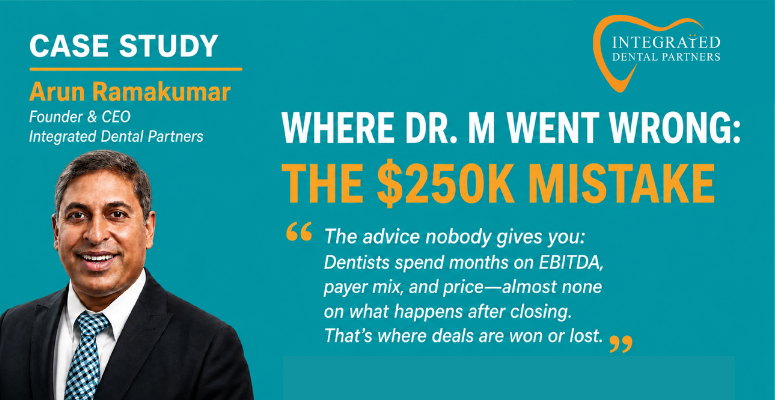
The acquisition is the easy part. What happens in the first 180 days determines whether you inherit a thriving practice or spend the next two years repairing one.
By Arun Ramakumar, Founder & CEO, Integrated Dental Partners | San Francisco Bay Area
I worked with a dentist, I’ll call her Dr. M, who did almost everything right when buying her first practice.
She was patient, reviewed several opportunities, and eventually found a well-run office with a loyal patient base, a healthy hygiene recall program, and a team that had worked together for years. She acquired it for roughly half of annual revenue genuinely favorable terms.
Within two months of closing, the office manager resigned.
That single departure triggered more than a year of team uncertainty, patient attrition, and operational disruption.
The acquisition was good. The transition was not. And in dentistry, the transition often determines whether a good acquisition becomes a successful practice or an expensive lesson.
Buyers plan the transaction. What about the transition?
First-time buyers are taught to evaluate collections, profitability, active patients, hygiene production, payer mix, lease terms, equipment, cash flow, and purchase price. All of that matters.
But a dental practice is more than financial statements, operatories, equipment, and patient charts. It is also a network of relationships. Patients trust familiar team members. Employees rely on established routines. The office manager may hold years of knowledge that appears nowhere in the due diligence package. The seller may have built loyalty through hundreds of small interactions that cannot be transferred through an asset-purchase agreement.
A buyer can diligently investigate the numbers and still fail to plan the transition. That is where many first-time buyers get it wrong.
Know what you’re optimizing for
Before discussing a specific practice, I usually ask the dentist a more basic question: why do you want to own one?
Many dentists assume ownership is simply the next step in their careers. But ownership can mean very different things. Are you seeking clinical autonomy, greater income, a long-term lifestyle practice, or the foundation for a multi-location group? How many days do you want to practice? How involved do you want to be in hiring, billing, scheduling, compliance, payroll, and team management?
The answers should shape the type of practice you pursue, and they should also shape what you optimize for when comparing options. In competitive markets, first-time buyers often default to two questions: how close is the practice to my home, and how cheaply can I buy it? Those considerations matter, but on their own they say nothing about team stability, hygiene retention, payer mix, patient loyalty, facility capacity, or growth potential.
“The best practice is rarely the perfect practice. It is one that is sufficiently strong, appropriately priced, and aligned with your why.”
The most expensive mistake: underestimating the team
When ownership changes, employees immediately begin evaluating the new owner. Even when they do not say it directly, they are asking:
Is my job secure? Will my compensation or schedule change? Will this dentist respect what we have built? Can I trust this person? Will the culture disappear?
A transition that feels exciting to the buyer may feel threatening to the team. Long-standing employees often feel a genuine sense of ownership over the practice. They helped build patient relationships, supported the seller, and developed many of the routines that hold the office together. How the buyer behaves during the first 90 days will largely determine whether the team remains committed or begins looking elsewhere.
You have not earned the right to change everything on day one
New owners often arrive with energy and ideas. New software, scheduling templates, protocols, compensation systems, vendors, and performance expectations. Some of those changes may be necessary. The problem is usually not the idea. It is the timing.
During the first few months, the buyer does not yet understand why the practice operates the way it does. Some processes may be inefficient. Others may exist for reasons buried in institutional knowledge the buyer has not yet accessed.
The first three to six months should focus on understanding. Learn how patients move through the practice. Identify who influences the team. Understand why the schedule is built the way it is, which procedures are referred out, what frustrates employees, and which parts of the culture patients value most.
Ownership gives you authority. It does not automatically give you credibility. Trust develops when the team sees that you listen, communicate clearly, follow through, and make changes for understandable reasons.
Dr. M’s problem was not clinical. It was transitional.
Dr. M was direct, decisive, and confident. Those qualities served her well clinically. But with a team already anxious about the ownership change, her communication was interpreted differently. Questions sounded like criticism. Decisions felt abrupt. Employees were unsure when they were being consulted and when they were simply being informed.
Small misunderstandings accumulated.
When the office manager resigned, Dr. M did not merely lose an employee. She lost the person who knew which patients needed extra reassurance, which employees worked well together, why certain scheduling exceptions existed, and how the previous owner resolved conflict. That knowledge was not documented in a manual. It left with her.
The dentist – office manager relationship is an operating asset
One of the strongest predictors of practice performance is a capable lead dentist paired with a capable office manager who trust each other. The dentist provides clinical leadership, patient confidence, and production. The office manager provides operational discipline, team coordination, financial oversight, patient communication, scheduling accountability, and consistency. Neither can carry the practice alone.
That does not mean every incumbent manager should be retained indefinitely. Longevity is not the same as competence. But the buyer should evaluate the office manager with the same seriousness used to evaluate collections, hygiene, and cash flow. Before closing, the buyer should understand the manager’s authority, compensation, credibility with the team, financial ability, relationship with the seller, and willingness to support the transition.
“Continuity should be managed deliberately – not assumed.”
The six-month hygiene cycle is the first major test
Dental practices have a built-in transition checkpoint: the hygiene recall cycle. About six months after closing, many patients return for the first time since the ownership change. That appointment becomes a quiet decision point. Patients are gauging, often unconsciously, whether the practice still feels like the one they trusted, same faces, same familiarity, same approach to their care or whether something has shifted.
Most dissatisfied patients do not formally complain. They simply fail to reappoint.
That is why post-acquisition patient attrition is often misdiagnosed as a marketing problem. In many cases, it is a transition problem. The decisions made during the first 180 days staff retention, communication, scheduling, treatment philosophy, patient introductions, and pace of change shape what happens when the recall cycle comes around. Marketing can bring in new patients. It cannot fully replace a loyal patient base that quietly leaves.
Preserve first. Improve second.
Most acquired practices have genuine opportunities to add value. Referred procedures may be brought in-house. Hygiene capacity may be expanded. Scheduling, insurance participation, case acceptance, accounts receivable, marketing, and technology may all be improved. But value creation must be sequenced correctly.
The first responsibility is to preserve the revenue, people, patient relationships, and culture that justified the purchase price. Only then should the buyer begin making larger operational changes.
“Do not destroy one dollar of existing value while trying to create fifty cents of new value.”
Why a regional DSO partner can help
A first-time buyer is being asked to make several major decisions at once, identify the right practice, evaluate its financial and operational health, arrange financing, negotiate the purchase, complete due diligence, retain the team, manage the seller transition, maintain patient confidence, and continue practicing dentistry. At the same time, the dentist suddenly becomes responsible for payroll, recruiting, compliance, billing, collections, credentialing, marketing, technology, procurement, insurance administration, and financial reporting. Most dentists were never trained to manage all of those functions.
A capable regional DSO can provide expertise both before and after the acquisition. Before closing, it can help identify the right practice for the partner dentist evaluated not only by revenue and asking price, but also by team stability, hygiene strength, payer mix, referral leakage, provider capacity, demographics, competition, cultural fit, operational risks, and growth potential. Experienced operators may also recognise issues a first-time buyer could miss: a practice that depends too heavily on the seller, has a fragile team, or produces financial results that will not survive the transition.
After closing, a regional DSO can guide the dentist through the transition helping determine what must be preserved, what can be improved, when changes should occur, and how those changes should be communicated. The dentist should remain focused on clinical leadership, patient care, treatment planning, and building trust with the team. The DSO should reduce the burden of non-clinical management: finance, human resources, compliance, recruiting, billing, procurement, technology, marketing, reporting, and insurance administration.
The purpose is to support the practice, not corporatize it. A regional DSO should strengthen the systems behind the practice while preserving the clinical judgment, team relationships, patient trust, and local identity that made it worth acquiring.
The closing is only the beginning
First-time buyers should absolutely investigate the financial statements, patient charts, lease, equipment, patient base, and purchase price. But they should examine the transition with equal seriousness.
The practice acquired on closing day is held together by people, trust, habits, and relationships. Preserve those first. Understand the practice before trying to reinvent it. Then add value carefully, deliberately, and with the right support.
You bought a good dental practice. Now make it a better one.
About the Author
 Arun Ramakumar is the Founder and CEO of Integrated Dental Partners, a regional dental service organization based in the San Francisco Bay Area. Before founding IDP, he spent eighteen years as CEO of AccuDental & Orthodontics, growing it from a single practice into a multi-location Bay Area group. That experience, including watching a national DSO acquisition process up close, is what shaped his conviction that the regional stewardship model is the right path for independent Bay Area dentists. He writes on DSO consolidation, dental practice succession, and what community-based dental care actually looks like in practice.
Read Arun’s other article: Why I Chose Regional Over National: The DSO Model Big Groups Can’t Copy