

As DSOs continue to scale, procurement has emerged as a critical function that directly impacts clinical performance, operational efficiency, and the patient experience. At Salt Dental Partners, procurement is designed not as a control mechanism, but as an enabler of growth and a supporter of clinicians.
In this Q&A, Charles Fisher, Vice President of Procurement at Salt Dental Partners, shares how his team approaches supplier partnerships, supports rapid expansion, and balances cost discipline with clinical autonomy. Drawing on experience across healthcare and manufacturing, Fisher offers a practical look at how procurement can evolve into a strategic advantage for modern DSOs.
Salt Dental Partners is a doctor-led partnership organization supporting pediatric dentists, orthodontists, oral surgeons, and general dentists.
In recent years, Salt has scaled rapidly into a national platform, but what’s more important is how they’ve grown. Their focus has been on aligning with high-quality practices and building infrastructure around them—not over them. That approach has allowed them to grow with consistency while maintaining the integrity of each practice.
Headquartered in Phoenix, Arizona, and founded in 2019, the organization has grown to include more than 207 practices, 82 brands, 292 doctors, and 1,950 team members, serving over 416,000 active patients across 20 states.
Procurement plays a critical role in enabling Salt’s growth by creating a consistent, scalable foundation—without compromising clinical autonomy. As they expand across states, specialties, and new locations, the goal isn’t to centralize control, it’s to remove complexity and ensure teams can operate seamlessly from day one.
Background and Role
Q: What does procurement look like in a fast-growing DSO environment, and what are your primary priorities when evaluating partners and suppliers?
A: Procurement has a very clear role: support the clinician, remove friction from the system, and deliver value at scale—without getting in the way of care. As we grow, procurement is focused on building a system that makes it easier for our teams to operate at a high level, not harder.
What Procurement Looks Like at Salt:
1. Removing distractions from the practice
Our doctors and teams should be focused on patients, not managing vendors, chasing supplies, or questioning pricing. Procurement creates a streamlined, reliable supply chain so clinical teams can stay focused on delivering care and experience.
2. Enabling, not restricting
We are intentional about where we standardize and where we do not. In commoditized categories, we drive consistency and efficiency. In clinically sensitive areas, we preserve flexibility. The goal is to support decision-making, not dictate it.
3. Delivering value in the background
The best procurement function is often invisible to the end user. Behind the scenes, we are leveraging scale, aligning partnerships, and optimizing cost structures without disrupting clinical workflows.
How We Evaluate Partnerships:
We hold our partnerships to a high bar because they directly impact both provider and patient experience.
1. Alignment with Our Philosophy
If a partnership doesn’t understand autonomy and patient-first care, it won’t work. We need partnerships that can operate within a model that prioritizes outcomes and experience over rigid standardization.
2. Ability to Support a “Wow” Experience
This goes beyond product quality. It’s about consistency, availability, and reliability. If a product or supply chain issue disrupts a patient visit, it’s a failure—regardless of cost.
3. Simplicity and Reliability at Scale
As we grow, complexity is the enemy. We prioritize partnerships that can simplify ordering, fulfillment, and onboarding across all locations so our teams have a consistent, predictable experience.
4. Transparency and Trust
We expect clear, consistent pricing and open data sharing. Trust is built through transparency, and it’s critical to maintaining alignment as we scale.
5. Continuous Improvement Mindset
Our strongest partnerships don’t wait to be asked—they proactively bring forward ideas that improve outcomes, reduce cost, or enhance the experience for both patients and providers.
The Role of Procurement at Salt
At its core, procurement exists to support the clinical mission. We are here to:
- Protect the provider’s time and focus
- Ensure the patient experience is seamless and high-quality
- Leverage scale to deliver responsible cost management
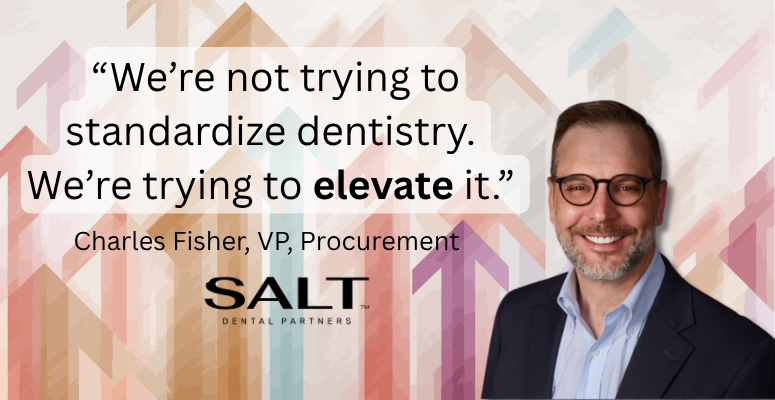
All three must coexist. If we reduce cost but create friction, we have failed. If we preserve autonomy but ignore efficiency, we have missed the opportunity. The balance is what makes it work—and it’s what makes Salt different. We are not trying to standardize dentistry, we’re trying to elevate it.
Salt is a 1-of-1 organization. Our model is built around delivering exceptional clinical outcomes and a “wow” patient experience, and that starts with empowering our doctors. Clinical autonomy
Experience and Strategy
Q: You have extensive experience across healthcare and manufacturing. How has that shaped your procurement strategy in dentistry?
A: My experience taught me that scale only creates value if it is paired with discipline, visibility, and alignment.
In more mature industries, supply chains are highly structured, with strong data infrastructure and a clear understanding of total cost. Dentistry has historically been more fragmented, with pricing inconsistencies and limited visibility into utilization.
At Salt, we bring that discipline into dentistry while respecting the clinical environment. We are not trying to standardize dentistry, we are building a platform that elevates it.
How That Experience Shows Up in Our Strategy:
1. Driving Standardization Where It Doesn’t Impact Care
In manufacturing and broader healthcare, unnecessary variation is one of the biggest sources of inefficiency. The difference is we do it thoughtfully. In dentistry, not all variation is bad—so we focus on eliminating noise, not restricting clinical choice.
2. Building Data as the Foundation
In every industry I’ve worked in, the most effective procurement organizations are data-driven. You can’t manage what you can’t see.
At Salt, we’ve prioritized visibility—understanding spend at the SKU, provider, and location level. That allows us to:
- Identify pricing inconsistencies
- Track utilization patterns
- Quantify savings opportunities
- Maintain pricing integrity over time
This is what turns procurement from reactive purchasing into a strategic lever.
3. Shifting from Vendors to Partnerships
In manufacturing, the strongest supply chains are built on long-term, strategic relationships—not transactional buying.
I’ve brought that same mindset to Salt and supplier base and building deeper partnerships. These partnerships are accountable not just for price, but for:
- Service and reliability
- Support for new locations and growth
- Ongoing cost and product optimization
That level of alignment is critical in a high-growth environment.
4. Creating Scalable Infrastructure
One of the biggest lessons from my prior experience is that what works at 20 locations breaks at 200 if you don’t build the right systems early.
Procurement at Salt is focused on building infrastructure that scales:
- Simplified ordering channels
- Consistent pricing frameworks
- Clear governance with flexibility built in
The goal is to support growth without introducing complexity or friction into the practice.
5. Balancing Cost Discipline with Experience
In manufacturing, cost efficiency is often the primary driver. In healthcare, and especially at Salt, it’s more nuanced.
We’re not optimizing for cost at the expense of experience. Every decision is filtered through three lenses:
- Clinical outcome
- Patient experience
- Operational efficiency
Cost matters—but it has to align with those priorities, not override them.
That cross-industry experience has reinforced a simple principle: Procurement should be structured, data-driven, and disciplined—but never at the expense of the end user.
At Salt, the end user is both the provider and the patient. Our role is to take the complexity out of the system, build strong partnerships, and deliver the benefits of scale—so our doctors can stay focused on what matters most: delivering exceptional care and a “wow” experience.
Supporting Growth and Consistency
Q: How does procurement support rapid growth across multiple states and specialties?
A: Procurement plays a critical role in enabling Salt’s growth by creating a consistent, scalable foundation—without compromising clinical autonomy.
As we expand across states, specialties, and new locations, the goal isn’t to centralize control—it’s to remove complexity and ensure our teams can operate seamlessly from day one.
- Building Scalable Infrastructure
We establish standardized purchasing channels, aligned partnerships, and consistent pricing frameworks that can be deployed quickly across new practices. This allows us to integrate and support growth without disrupting operations. - Driving Consistency Where It Matters
In non-clinical and commoditized categories, we create alignment to reduce variation, improve reliability, and capture the benefits of scale. This ensures a consistent operational experience across all locations. - Preserving Clinical Autonomy
At the same time, we maintain flexibility in clinically sensitive areas. Our role is to support providers with strong options and data—not dictate what they use. That balance is key to maintaining both quality and engagement. - Leveraging Partnerships for Scale
We work with a focused group of strategic partnerships that can grow with us—ensuring consistent supply, support for new offices, and the ability to scale without service disruption. - Creating Visibility and Accountability
With detailed data and reporting, we can monitor spend, identify variability, and maintain pricing integrity across the network—ensuring we’re capturing value as we grow.
Procurement ensures that as Salt grows, the experience stays consistent—for both the provider and the patient. We simplify the system, align the right partnerships, and leverage our scale—so our doctors can stay focused on delivering exceptional care and a “wow” patient experience, regardless of location.
Vendor Partnerships and KaVo Dental
Q: Salt Dental Partners works closely with KaVo. How did that relationship first develop and what factors led your team to choose KaVo as a key equipment partner?
A: Our relationship with KaVo developed around a shared commitment to quality, consistency, and true partnership.
As we evaluated equipment partners, KaVo stood out not only for the reliability and performance of their products, but for their ability to support a growing, multi-site organization like Salt. Consistency across locations, service support, and long-term scalability were all critical factors.
Equally important was the alignment in approach. There’s a mutual understanding—if KaVo invests in supporting our teams, infrastructure, and growth, we’ll invest in the partnership. That level of alignment is what made them a natural fit as a key equipment partner.
Q: Who are some of the people or teams at KaVo that your organization collaborates with most closely? What makes those relationships effective from both a clinical and procurement perspective?
A: We work closely with Christine Hart and Shannon Targon, and both have been key to building a strong, effective partnership.
Christine, in particular, has been a true advocate for Salt. She operates as a partner and collaborator—highly responsive, solutions-oriented, and deeply aligned with how we think about supporting our teams. She understands that decisions ultimately impact the patient experience, and consistently brings that patient-centric mindset into the conversation.
From both a clinical and procurement perspective, that combination matters. There’s a clear understanding of what our doctors need, paired with the ability to execute operationally—whether it’s supporting new locations, resolving issues quickly, or ensuring consistency across the organization.
That level of alignment, responsiveness, and shared focus is what makes the relationship work.
Q: What KaVo products or equipment are currently being deployed across Salt Dental Partners practices?
How do those technologies support your clinicians and improve the patient experience?
A: Across Salt practices, we primarily deploy KaVo handpieces and preventative maintenance (PM) equipment as part of our core clinical infrastructure.
These are preferred products within our network because of their reliability, performance, and consistency—three things that matter significantly in a high-volume, multi-site environment. From a clinical standpoint, dependable equipment allows our providers to operate efficiently and confidently without disruption.
From a patient experience perspective, that reliability translates directly into smoother appointments, reduced downtime, and a more consistent experience across locations.
Equally important, when we evaluate these products through a total cost of ownership lens, KaVo stands out. The durability, serviceability, and long-term performance make them the right choice—not just clinically, but operationally and financially as we scale.
Q: What differentiates KaVo from other dental equipment manufacturers you have evaluated? Are there specific features, reliability factors, or service capabilities that make them stand out?
A: What differentiates KaVo is that they truly understand what it takes to support a growing organization like Salt—they “get it.”
There are a number of strong manufacturers in the market, like Dexis and A-dec, but KaVo consistently performs at that same level. Where they stand out is in their reliability and consistency across every phase—from product performance to service and ongoing support.
At Salt, we believe consistency compounds. When equipment performs the same way, every time, across every location, it reduces friction for our teams and creates a more predictable, high-quality patient experience. KaVo delivers on that consistently.
It’s not just about features—it’s about execution. They are dependable, responsive, and they follow through. That level of reliability is what elevates them and makes them a trusted partner within our organization.
Q: As Salt Dental Partners continues to grow, how do you see strategic partnerships with companies like KaVo evolving?
A: As Salt continues to grow, our strategic partnerships will become deeper, more integrated, and more aligned around long-term value creation.
We’re moving beyond traditional supplier relationships toward true partnerships—where there’s shared accountability for performance, consistency, and supporting our teams at scale.
How Partnerships Like KaVo Will Evolve:
- Greater Integration into Our Operating Model: Partners like KaVo will play a more embedded role—supporting standardization where appropriate, helping streamline workflows, and ensuring consistency across all locations.
- Shared Focus on Outcomes and Experience:The relationship will continue to center on what matters most: clinical outcomes and the patient experience. That means aligning not just on products, but on how those products perform in practice every day.
- Scalable Support as We Grow: As we expand, we’ll rely on partners who can scale with us—supporting new locations, onboarding teams efficiently, and maintaining service levels across a broader footprint.
- Continuous Improvement and Innovation: We expect our partnerships to bring forward new ideas—whether it’s product innovation, service enhancements, or ways to improve total cost of ownership as we grow.
The future of partnerships at Salt is about alignment and mutual investment. As we continue to scale, partners like KaVo who understand our model, support our teams, and consistently deliver will become even more critical to helping us provide exceptional care and a “wow” patient experience.
Support, Training, and Implementation
Q: Beyond the equipment itself, how important is vendor support when selecting partners like KaVo? What type of training, onboarding, or service support has KaVo provided to your practices?
A: Vendor support is just as important as the equipment itself—especially in a scaled, multi-site environment like Salt.
You can have a great product, but if the onboarding, training, and service aren’t there, it creates friction for the clinical team and ultimately impacts the patient experience. That’s why we place a high value on partners who can support the full lifecycle—not just the initial sale.
KaVo has done this well. They’ve been strong in training and onboarding, ensuring our teams are set up correctly from the start, and just as important, they’ve been responsive and reliable on the service side. Whether it’s supporting new locations, troubleshooting issues, or maintaining equipment performance over time, they show up consistently.
That level of support reinforces adoption, builds trust with our clinicians, and ensures we’re getting the full value out of the equipment—both operationally and clinically.
Q: When rolling out new technology or equipment across multiple locations, what challenges do you face and how do partners like KaVo help streamline the process?
A: Rolling out technology across a multi-site organization comes down to managing consistency, minimizing disruption, and driving adoption.The biggest challenges are variability across locations, coordinating installs and training at scale, and ensuring the clinical team is confident using the equipment from day one. If not managed well, it can create friction in the practice and impact both provider efficiency and the patient experience.That’s where strong partnerships make a difference. KaVo helps streamline the process by bringing structure, consistency, and hands-on support—from planning and installation to training and ongoing service. They understand how to operate at scale, which reduces variability and ensures a smoother rollout across locations.
Just as important, they stay engaged after implementation. That follow-through—making sure the equipment is performing as expected and teams are fully supported—is what drives long-term success and adoption.
Procurement Strategy and Value
Q: From a procurement standpoint, what does “value” really mean for a DSO like Salt Dental Partners?
How do you balance cost efficiency with quality, durability, and clinical performance?
A: At Salt, “value” goes well beyond price—it’s about total cost of ownership and the impact on both the provider and patient experience.
We evaluate value through a broader lens: clinical performance, reliability, durability, service support, and consistency across locations. A lower upfront cost means very little if it introduces variability, downtime, or friction in the practice.
How We Balance Cost and Quality:
- Total Cost of Ownership Over Unit Price
We prioritize products and equipment that perform consistently over time, require less maintenance, and integrate seamlessly into the clinical workflow. That’s where true savings are realized. - Protecting Clinical Performance
We don’t compromise on products that directly impact clinical outcomes or the patient experience. In those areas, quality and reliability take precedence, with cost evaluated in context. - Standardizing Where It Makes Sense
In commoditized categories, we drive consistency and efficiency to capture savings at scale—without affecting care delivery. - Leveraging Scale Through Partnerships
By aligning with a focused group of strategic partnerships, we’re able to achieve competitive economics while maintaining high standards for performance and support.
Value is achieved when cost, quality, and experience are aligned—not traded off. At Salt, procurement’s role is to deliver that balance—ensuring we operate efficiently while giving our clinicians the tools they need to provide exceptional care and a “wow” patient experience.
Q: How does your procurement team collaborate with clinicians when deciding on equipment and technology investments?
A: Collaboration with clinicians is central to how we approach procurement at Salt—decisions are not made in isolation.
We view procurement as a partner to our doctors, not a gatekeeper. Clinicians are directly involved in evaluating equipment and technology, providing input on performance, usability, and clinical impact. That feedback is critical in shaping what we standardize and where we maintain flexibility.
How the Collaboration Works:
- Clinician-Led Input: We engage providers early—whether through pilots, trials, or direct feedback—to ensure the equipment meets real clinical needs.
- Procurement Brings Structure and Data: Our team layers in total cost of ownership, scalability, service support, and partnership alignment to complement the clinical perspective.
- Pilot and Validate Before Scaling: We test where appropriate, validate performance in practice, and then scale solutions that deliver consistently across locations.
- Ongoing Feedback Loop: Even after rollout, we stay close to our clinicians—adjusting as needed to ensure the technology continues to support both care delivery and the patient experience.
The best decisions happen at the intersection of clinical insight and operational discipline. At Salt, procurement ensures we bring the right structure and economics, while our clinicians ensure we’re selecting solutions that truly enhance care and deliver a “wow” experience for patients.
Future Outlook
Q: Looking ahead, what trends are you seeing in dental equipment and technology procurement? How are those trends influencing Salt Dental Partners’ purchasing strategy?
The biggest shift we’re seeing in dental procurement is the move toward digital, data-driven, and scalable technology ecosystems—not just individual products.
Technologies like AI diagnostics, digital imaging, and integrated workflows are no longer optional—they’re becoming foundational for DSOs that want to deliver consistent, high-quality care at scale.
At the same time, procurement itself is evolving, with more organizations moving toward digital procurement platforms and centralized visibility to better manage spend, standardize processes, and leverage scale.
Key Trends We’re Seeing:
- Shift to Digital and Integrated Workflows: From imaging to CAD/CAM and treatment planning, dentistry is becoming fully digitized—driving efficiency, speed, and more predictable outcomes.
- AI and Data-Driven Decision Making: AI is improving diagnostic consistency, reducing variability across providers, and giving DSOs better insight into performance and outcomes at scale.
- Greater Focus on Total Cost of Ownership: Organizations are moving away from lowest-price purchasing toward long-term value—durability, serviceability, and consistency across locations.
- Continued Consolidation and Scale Leverage: As DSOs grow, procurement is playing a larger role in driving enterprise value through standardization, partnerships, and centralized purchasing power.
How This Influences Salt’s Strategy:
At Salt, these trends reinforce how we approach procurement:
- Investing in technologies that drive consistency and outcomes across all locations
- Prioritizing partnerships that can scale with us, not just supply products
- Focusing on total cost of ownership, not short-term price
- Leveraging data and visibility to guide decisions and maintain alignment
Most importantly, we apply these trends through our lens: Technology should enhance the clinician’s ability to deliver care—not complicate it. We’re not chasing technology for the sake of innovation—we’re investing in solutions that improve clinical outcomes, simplify operations, and elevate the patient experience at scale. That’s how procurement stays aligned with what matters most at Salt.
Final Thoughts
Q: If you had to give advice to other DSOs or emerging dental groups about building strong vendor partnerships, what lessons have you learned from working with companies like KaVo?
A: The biggest lesson is that strong partnerships are built on alignment—not just economics. It’s easy to focus on price, but the real value comes from working with partners who understand your model, can scale with you, and are committed to supporting your teams over the long term.
Key Lessons Learned:
- Choose Partnerships, Not Just Suppliers: Look for organizations that are willing to invest in your success—operationally, clinically, and strategically. The best partnerships feel collaborative, not transactional.
- Alignment Matters More Than Price: If a partner doesn’t understand your priorities—whether that’s autonomy, patient experience, or growth—it will create friction over time, regardless of cost.
- Consistency is Everything: In a multi-site environment, variability creates inefficiency. Partners who deliver consistent performance, service, and support across all locations are invaluable.
- Hold a High Bar for Support and Responsiveness: How a partner shows up after the sale matters just as much as the product itself. Training, onboarding, and service are critical to long-term success.
- Think Long-Term and Mutual Investment: The strongest partnerships are built on a simple principle: if they invest in supporting your growth, you invest in them. That alignment drives better outcomes on both sides.
The right partnerships don’t just help you buy better—they help you operate better. For DSOs looking to scale, that distinction is what ultimately drives consistency, efficiency, and a better experience for both providers and patients.