

Sponsored Content
In group dentistry, clinical efficiency is often discussed through the lens of production, scheduling, staffing, and provider utilization. But for Dr. Sunny Pahouja, Owner of Lifetime Smiles and Founder of Dental Investment Group, efficiency begins much earlier. It begins at the tooth level, with visibility, isolation, suction, retraction, documentation, and the ability to complete treatment predictably.
That is why his conversation around Zyris and the Isolite system quickly became more than a product discussion. It became a broader look at how oral environment control can influence clinical quality, team productivity, reimbursement, patient experience, and even provider wellness.
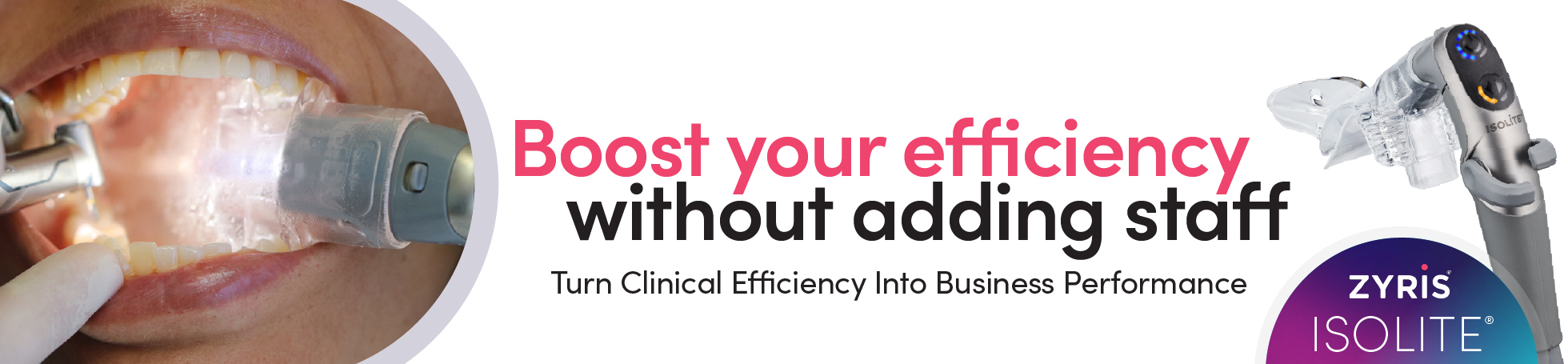
Zyris positions Isolite as an all-in-one system for total oral environment control, combining continuous hands-free suction with integrated retraction and, in select models, illumination. The goal is simple but powerful: keep the field dry, visible, and accessible so providers can work more efficiently while patients remain more comfortable.
“I’m a big proponent of efficiency. I’m a huge proponent of making sure you’re really maximizing every minute, every hour that you’re at the practice.”
For dental groups and DSOs, that message is especially relevant. As staffing pressures continue, reimbursements remain challenging, and providers are asked to balance quality with productivity, systems that simplify the clinical workflow can have an impact far beyond a single procedure.
Zyris and the value of oral environment control
The Isolite system addresses several daily obstacles at once. It helps retract the tongue and cheek, provides continuous suction, supports a dry field, and, with the lighted version, improves intraoral visibility. Dr. Pahouja described the system as a way to remove some of the most common interruptions dentists face during restorative procedures.
Saliva, water, tongue movement, cheek interference, aerosol, and poor access all slow a procedure down. They also create stress for the doctor, the assistant, and the patient. In posterior dentistry, especially on difficult second molars, those challenges become even more pronounced.
“It has a built-in light in there, and it has a way to keep the tongue out of the way. It has a way to keep your teeth isolated from all that contamination that happens.”
For clinicians, this is not a minor convenience. Isolation affects everything from preparation quality to bonding protocol to the final restoration. When the field is compromised, the doctor slows down, the assistant works harder, and the patient often becomes more fatigued.
Dr. Pahouja sees Zyris as a clinical tool that also supports the business side of dentistry.
“Zyris solves not just the clinical side, but also the business side of your problems.”
That statement captures the larger opportunity for group practices. A product that improves access and isolation can also improve schedule flow, procedure efficiency, documentation, claim support, and staff utilization.
Better isolation for better restorative dentistry
Dr. Pahouja was direct about the relationship between isolation and clinical outcomes. When he uses Isolite, he said he is able to prep, restore, and build up teeth with better control because he is not constantly fighting moisture and soft tissue.
“When I’m using that, I’m able to practice so much better clinical dentistry. I’m able to provide my patients such a high-level experience from a clinical outcome. My preps are cleaner, my buildups are better, my fillings are so much better because I’m able to keep that tongue away.”
He emphasized the posterior challenges that every clinician understands. The tongue can invade the field. The buccal cheek can limit access. Moisture can contaminate the preparation or restorative surface. The assistant may need to reposition suction repeatedly. These issues are not dramatic individually, but they compound throughout the appointment.
“Think about the cheek, the buccal cheek just gets in the way and you’re trying to place a restoration on upper second molars, and sometimes it’s a nightmare. But guess what? That Isolite comes into play and it is such a huge time saver.”
For group dentistry leaders, this is where a clinical product becomes an operational asset. If providers across locations can reduce interruptions, work with a clearer field, and perform more predictable restorative care, the benefit is multiplied across the organization.
Dr. Pahouja pointed specifically to teeth that many clinicians consider difficult to access, including second molars.
“That’s where the tongue gets in the way, that’s where that buccal cheek gets in the way. And having something like that really allows you to practice the best dentistry you can without contaminating the field.”
Visibility and the lighted Isolite advantage
Zyris offers Isolite models with and without light. Dr. Pahouja prefers the lighted version because of the added visibility and the built-in composite filter. For restorative dentists, that illumination can be especially helpful in areas where an overhead light or loupe light may not fully reach.
“My favorite one is with the light because you have your composite filter in there built in, and then you have your regular LED light, super bright.”
Visibility is often discussed as a clinical benefit, but Dr. Pahouja also connects it to provider confidence. When the mouth is illuminated from the inside, he said, he can better visualize the full tooth structure, margins, decay, fractures, and access areas that are otherwise difficult to see.
This also matters for clinical photography. Dr. Pahouja frequently takes intraoral photos and shares clinical images with colleagues. He said the quality of his photography improves when the Isolite system is in place because the entire mouth is better lit.
“The pictures that I take when I have my Isolite in there come out so much better and so much brighter.”
The reason, he explained, is that the light is not only coming from the camera or the loupe. The oral cavity itself is illuminated.
“When you have a light that’s lighting up the entire mouth, that picture just comes out so much better.”
For DSOs and emerging groups, stronger clinical photography can support standardization. Clearer photos help patients understand treatment, help teams communicate, and help front office teams submit more complete insurance claims.
Stronger documentation and cleaner claims
One of the most important business implications of Isolite, according to Dr. Pahouja, is documentation. When clinical images are bright and clear, they become more useful for patient education, team communication, and insurance support.
“Make sure you show your patients that dentistry. Because one, it’s on record with those patients: ‘This is what was wrong with your tooth, this is what I did for you, and this is what the expected outcome is.’ And then it’s great for the insurance company.”
This point is highly relevant for group practices with centralized billing or revenue cycle teams. Incomplete documentation can create delays, denials, appeals, and additional administrative work. Strong clinical photos can help support the narrative and reduce back-and-forth.
Dr. Pahouja tied photography directly to claims payment.
“I see so many doctors complain about not getting paid on time, not getting paid for core buildups, not getting paid for crowns. But guess what? When you take good pictures, good photos, 99% of the time you’re going to get that claim paid.”
For a single practice, this can improve workflow. Across a group, the impact can be much larger. Better images, better records, and better claim support can reduce friction between the operatory and the business office.
Clear images also support internal education. Hygienists, assistants, and front office team members may not see what the doctor sees after an old restoration is removed or decay is excavated. Photos help the entire team understand the diagnosis, the need for treatment, and the final outcome.
“It’s a testament to not just really doing it for your patients, but also helping and educating your staff, helping your team understand the reason behind why you do the dentistry you do.”
Infection control and aerosol management
Zyris also plays a role in infection control by providing continuous suction and using disposable mouthpieces. For groups with compliance teams and standardized clinical protocols, these features are important.
“You have constant suction running. They’re disposable. Once you’re done using the mouthpiece, you toss it, you put a new one in for every patient.”
Dr. Pahouja recalled how the COVID era made many clinicians more aware of aerosols and debris. Face shields made the issue visible in a way many providers had not fully appreciated before.
“During COVID, a lot of us had those shields on and you would look at that shield after a couple of appointments and it had stuff on there. I was like, ‘Holy cow, all that stuff was just on our faces.’”
After incorporating Isolite, he noticed a meaningful difference in the amount of material reaching his face shield.
“I saw such a huge improvement with just gunk and stuff not flying up in the air and getting all sucked up with that.”
For group practices, infection control is not only about compliance. It is also about creating a consistent standard of care across locations. Tools that support suction, retraction, isolation, and visibility can help practices create a cleaner and more controlled treatment environment.
A second pair of hands for assistants and hygienists
One of the strongest operational arguments for Zyris is staffing flexibility. Many practices are working with lean teams. Assistants may move between rooms, take scans, capture x-rays, prepare patients, or support multiple providers. In those situations, hands-free isolation can function like an additional set of hands.
Dr. Pahouja said this is useful even when an assistant is present, because that assistant is not always chairside for the full procedure. For expanded function dental assistants placing fillings, isolation becomes even more important.
“Even if I have an assistant, there are a lot of times my assistant’s not in the room. If she’s placing fillings and she doesn’t have an assistant, you want to make sure that field is not contaminated with saliva.”
The same logic applies to hygiene. Pahouja sees value in using Isolite for scaling and root planing, ultrasonic procedures, and hygiene appointments with heavy buildup. Because hygienists typically do not have dedicated assistants, continuous suction can reduce interruptions and improve comfort for both the patient and provider.
“For hygienists, I think it’s great, especially for SRPs. There’s a lot of little stuff in that biofilm that is not pretty. If you have this automatic suction at all times, 100% of the time, then it doesn’t matter. It’s doing the job for you. It’s an assistant for you right there. And all you have to do is just do what you’re good at.”
For DSOs, this may be one of the clearest use cases. A system that supports doctors, EFDAs, and hygienists can create efficiencies across multiple departments, not just restorative dentistry.
Efficiency that compounds across the schedule
Dr. Pahouja does not view efficiency as rushing. He views it as removing friction. When the tongue and cheek are controlled, the field is dry, suction is continuous, and visibility improves, the dentist can stay focused and productive. He estimated that most patients can tolerate Isolite well, while acknowledging that some patients with strong gag reflexes may not be candidates.
For the patients who can use it, the difference can be substantial. Dr. Pahouja said the system allows him to work with fewer stops and starts.
“I would say probably a good 95 plus percent of the patients you can use the Isolite on. The buccal cheek is already retracted, the tongue is already out of the way. There’s so many different things.”
Those small efficiencies can add up across the day. Dr. Pahouja described reducing his crown preparation time over the course of his career while still maintaining clinical quality.
“Now I’m saving about 20 minutes per prep, doing still great dentistry.”
If a doctor performs several crown preparations in a day, those saved minutes can become an additional procedure, an emergency visit, a new patient exam, or simply an earlier end to the day.
“If you were doing, let’s say, three crowns a day, that’s an hour that you just saved. You can be doing another procedure that increases production there. You could be adding some emergencies, adding some new patient exams, whatever you want to do with that hour, or if you want to just leave early, leave early and enjoy more time with family.”
That flexibility is critical. Efficiency should not only serve production. It can also serve provider satisfaction and retention.
Supporting quadrant dentistry
Zyris can also help make quadrant dentistry more practical. When the patient is comfortable and the clinician has better control of the field, it becomes easier to complete more treatment in fewer visits.
“When you have an Isolite in the mouth, you can easily do quadrant dentistry because now you’re not sitting there and doing a little bit, the patient’s mouth gets tired, and now you’re just moving at such a faster pace. And the patient appreciates it.”
From the patient perspective, fewer appointments are often preferred. From the practice perspective, fewer visits mean fewer room turnovers, fewer anesthesia starts, fewer setups, and less administrative work.
Dr. Pahouja explained that efficiency is not only about the time spent drilling or restoring. It includes everything around the appointment.
“You don’t have to turn over the room five different times, you don’t have to set up the room five different times.”
This is why Zyris can matter at the group level. The value is not limited to one saved minute here or there. The value is in the cumulative effect of a smoother appointment.
“Your overall productivity increases so much more than you think because it’s not just one little thing, but it really starts to add up in so many different avenues of that procedure for that patient.”
The Dental Investment Group and the business of better systems
Dr. Pahouja founded the Dental Investment Group in 2017 after recognizing a gap in the profession. Dentists were trained clinically, but many lacked structured conversations around ownership, overhead, investing, student loans, retirement planning, staffing, and business operations.
“I just wanted someone to talk to about practice ownership, retirement planning, investing.”
The group has grown to more than 26,000 doctors and now covers far more than investing. Members discuss practice management, clinical systems, insurance, staffing, mental health, and the operational realities of dentistry.
That is one reason Zyris resonates with the group. Members are not just looking for products. They are looking for systems that can help them practice better, run better, and live better.
Dr. Pahouja said previous Zyris promotions within the Dental Investment Group received strong interest, including from doctors who already used the system and wanted to upgrade.
“Some people were using it, they had the old system. They’re like, ‘Hey, this new system is slimmer, easier to place it in the mouth. It’s more comfortable around the corners of the mouth.’”
Other doctors discovered the system for the first time.
“I had no idea that something like this even existed. Well, this is pretty cool because now I can try this and get a great deal on it.”
That response reflects a broader truth in dentistry. Many providers are hungry for practical tools that improve the workday immediately.
Buying back time
Ultimately, Dr. Pahouja’s message about Zyris and efficiency comes back to time. Some doctors may use efficiency to produce more. Others may use it to create breathing room. Others may use it to get home earlier.
“For some people, it might be, ‘Hey, I want to produce more.’ For some people, it might be like, ‘Hey, I want to buy more time.’ And time is so precious, nobody knows what the future brings.”
That is an important message for group dentistry leaders. Efficiency is not only a financial metric. It is a clinical quality strategy, a staffing strategy, a patient experience strategy, and a provider wellness strategy.
Zyris and the Isolite system fit into that conversation because they address a fundamental clinical challenge: controlling the oral environment. By improving isolation, visibility, suction, comfort, and documentation, the system can support better dentistry and a better workflow.
For Dr. Pahouja, that is the real business case.
“What efficiencies allowed me to do is just be able to get more time for my family.”
In dentistry, every second and every millimeter matter. For modern dental groups, the systems that protect those seconds and millimeters may be the same systems that help providers deliver cleaner dentistry, reduce stress, improve documentation, and build more sustainable careers.