

Sponsored Content
It’s after 7 a.m. A patient calls her dental office because the dull ache in her tooth is getting worse. She is hoping someone can tell her what to do.
Across town, the morning rush is underway at another practice. One team member is checking in a patient, another is answering an insurance question, and the phone is ringing. Again. The team isn’t purposely ignoring the caller, but they simply can’t be everywhere at once.
Operationally, moments such as this look like workflow challenges. To patients, they’re personal experiences that shape how they view a practice.
For dental service organizations (DSOs), delivering a consistent patient experience across multiple locations has never been more challenging. According to the American Dental Association Health Policy Institute, 79.3% of dentists reported having an adequate number of administrative staff in early 2026. That means roughly one in five didn’t.
Among dentists who recently recruited administrative employees, 58% described the process as very or extremely challenging. [1] Of course, those staffing challenges are multiplied across locations for DSOs. One practice may be fully staffed, while another struggles to answer calls during lunch. A third may excel at scheduling but fall short on patient follow-up. Patients don’t experience staffing models. They experience conversations.
As organizations balance patient care with increasingly complex operations, administrative responsibilities often compete with clinical priorities. The result can be missed calls, delayed responses, inconsistent scheduling, and unnecessary pressure on front-office teams.
This is where AI receptionist technology is beginning to make a meaningful difference. But not all AI receptionist platforms offer the same capabilities.
What an AI receptionist is — and isn’t.
The term “AI receptionist” is often used broadly, but the category has evolved significantly. A true AI receptionist platform should:
- Answer inbound calls within seconds, 24/7, using a natural, conversational voice.
- Handle real-time conversations, including follow-up questions, changes in topic, and multiple patient needs within a single interaction.
- Perform actions directly within the practice management system (PMS), including scheduling, rescheduling, cancellations, and patient record updates.
- Manage communication across multiple channels, including phone, text, email, and web chat.
- Meet healthcare security and compliance standards, including HIPAA requirements and SOC 2 Type II certification.
An AI receptionist isn’t simply a phone tree, a missed-call text-back tool, a traditional answering service, or a chatbot attached to a website. While those tools serve a purpose, they don’t replace or extend the capabilities of the front desk.
Meet Link AI: software designed for the realities of managing DSO operations.
Historically, most front-office technology has been voice-only. These systems are great at answering calls, but patient interactions extend well beyond the phone. A patient may text after business hours to ask about office availability, call the next day to schedule an appointment, and later email an insurance question. When those interactions occur in separate systems, practices often spend valuable time managing disconnected workflows.
Link AI for A-dec+ helps centralize those conversations. Working alongside most existing practice management systems, it brings phone calls, text messages, emails, and web chats into a single platform while supporting routine administrative functions such as scheduling, reminders, forms, payment collection, and after-hours inquiries. The platform can also proactively support practice growth by conducting appointment confirmations, following up with overdue patients, and helping reduce gaps in recall programs. For DSOs, that means more standardized communications across locations, while creating additional opportunities to reconnect patients with care.
Support patients in their preferred language.
Communication is a critical part of the patient experience. Link AI supports multilingual communication through phone, text, and email, helping practices connect with patients in more than 80 languages, including Spanish, French, German, Italian, Portuguese, and Dutch. Rather than requiring callers to select a language from a menu, the system automatically detects the language being spoken and responds accordingly. This capability helps practices create a more welcoming experience for diverse patient populations, while reducing administrative complexity at the location level.
Streamline patient interactions across the organization.
Patients expect convenient digital experiences throughout their healthcare journey. Link AI can create a simple, streamlined process without multiple touchpoints, and complete routine administrative tasks within a single interaction. For example, after scheduling an appointment, a patient can digitally make prepayments and receive forms to complete, sign and submit before arriving for care. Information is then synchronized with the PMS.
Fewer handoffs, fewer vendors, and fewer opportunities for delays.
Provide top-notch security and compliance.
As practices adopt new technologies, protecting patient information remains a top priority. Link AI is HIPAA compliant and SOC 2 Type II certified. While HIPAA focuses on safeguarding protected health information, SOC 2 Type II certification demonstrates that an organization’s infrastructure, security controls, and operational processes have undergone independent auditing and validation. For DSOs managing patient data across multiple locations, these standards provide additional confidence that sensitive information is being handled responsibly.
See analytics from all locations in one dashboard.
One of the challenges of managing multiple practices is maintaining visibility into performance. Link AI’s multi-location analytics consolidate operational data into a single dashboard, allowing leaders to quickly answer questions such as:
- Which locations have the highest no-show rates?
- Where are appointment confirmation rates lowest?
- Which practices generate the most after-hours patient inquiries?
Identify revenue opportunities faster.
Practice management systems contain valuable patient information, but accessing it requires manual reporting and analysis.
Using natural language prompts, teams can identify opportunities more quickly. For example, your staff can simply request a list of patients who are more than six months overdue for a cleaning and generate a targeted outreach campaign without the need for spreadsheets, complex filtering, or technical expertise. For DSOs focused on growth, this capability helps transform existing patient data into actionable opportunities.
Connect your clinic from the front desk to the operatory.
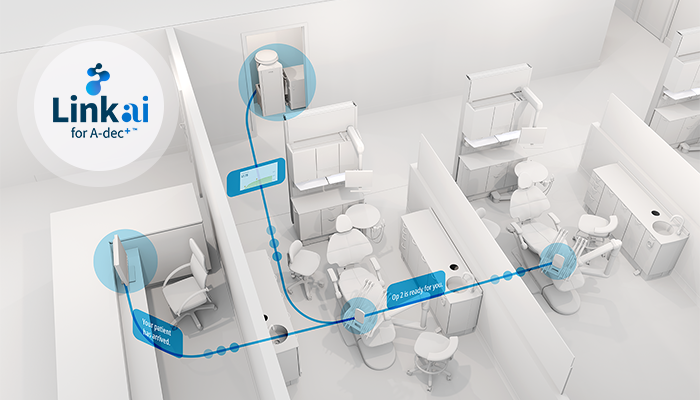
Link AI works as a standalone solution—and you don’t need A-dec equipment to use it. But if your organization has compatible A‑dec Pro delivery systems, it’s even more beneficial. Link AI seamlessly integrates with A‑dec+ and compatible A‑dec delivery systems, allowing discreet, real‑time intra‑office updates and messaging between connected equipment. Teams stay in sync from the front desk to the operatory without interrupting appointments.
Ongoing support from real people makes all the difference.
Perhaps most importantly, successful technology adoption still depends on people. Link AI for A-dec+ includes ongoing comprehensive support from dental industry specialists who can assist with implementation, optimization, troubleshooting, and best practices. That human guidance helps practices realize greater value from the platform, while minimizing disruption to day-to-day operations.
At its best, AI isn’t about replacing the front desk. It’s about ensuring every patient receives timely attention while giving teams the support they need to focus on higher-value interactions. For DSOs, the goal isn’t simply to answer more calls. It’s to create better patient access, more efficient operations, and stronger long-term growth. When technology helps practices deliver on all three, every call becomes an opportunity rather than a missed connection.
Ready to see what’s possible? Visit a-dec.com/linkai to schedule a demo and learn how Link AI can help your organization improve access, efficiency, and growth across every location.
References
[1] American Dental Association Health Policy Institute. The State of the U.S. Dental Economy: First Quarter 2026 Update. https://www.ada.org/resources/research/health-policy-institute/dental-care-market/state-of-the-us-dental-economy