
Ranked the #1 DSO Podcast!
Welcome to The Group Dentistry Now Show: The Voice of the DSO Industry!
Website Mastery for Multi-Location Dental Groups: Security, AI, and Best Practices in 2026
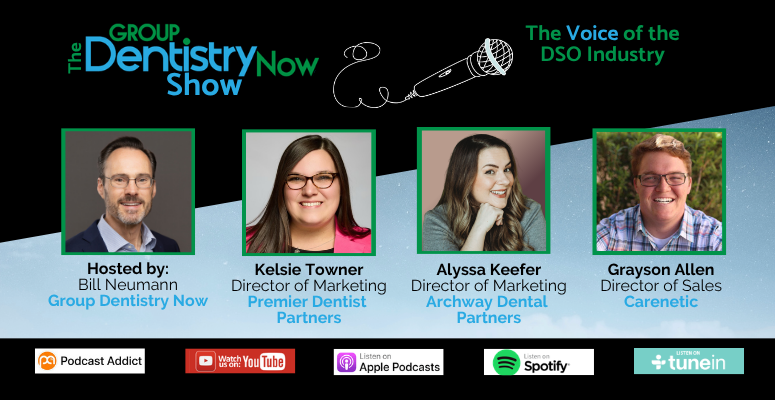
Alyssa Keefer, Director of Marketing for Archway Dental Partners, Kelsie Towner, Director of Marketing for Premier Dentist Partners & Grayson Allen, Director of Sales for Carenetic Digital discuss:
- Website compliance & security
- Online scheduling struggle
- Specialized vs. all-in-one
To learn more about Carenetic visit: https://careneticdigital.com/ or email Grayson at: grayson@careneticdigital.com
Contact Alyssa Keefer: https://www.linkedin.com/in/alyssakeefer/ To learn more about Archway Dental Partners visit: https://archway.dental/
Contact Kelsie Towner: https://www.linkedin.com/in/kelsie-towner/ To learn more about Premier Dentist Partners visit: https://premierdentistpartners.com/
Subscribe to our channel for more episodes and stay updated on the latest DSO news, insights, and events!
If you like our podcast, please give us a ⭐⭐⭐⭐⭐ review on iTunes https://apple.co/2Nejsfa and a Thumbs Up on YouTube.
Choose your favorite listening app below and subscribe today so you don’t miss an episode! Full transcript is also provided below. See all of our podcasts HERE.
 |
 |
 |
 |
 |
 |
DSO Podcast Transcript – Website Mastery for Multi-Location Dental Groups: Security, AI, and Best Practices in 2026.
Bill Neumann (00:12):
Hey everyone. Welcome to the Group Dentistry Now Show. I’m Bill Neumann and as always, we appreciate you tuning in. Always have a lot of fun with these conversations. We’ve done podcasts on marketing in the past. We’re going to get really specific here and we’re going to talk about the importance of your website. We’re in the middle of 2026. It seems like things are moving more quickly than ever. It’s hard to keep up with changes when it comes to technology and AI and best practices, but we’re going to do our best to address the best practices now in the middle of 2026 when it comes to your website. So we have with us Grayson Allen, director of CareNetic Digital. He’s director of sales there. Grayson was kind enough to sponsor this. We’ve been talking for, boy, I think we met probably a year ago, so it’s good to have you on Grayson.
Grayson Allen (01:10):
Yeah, that’s probably right. Thanks for having me.
Bill Neumann (01:13):
Yeah. And we actually have Kelsie Towner. She is the director of marketing at Premier Dentist Partners. Kelsey, thank you for being here.
Kelsie Towner (01:22):
Yeah, thank you for having me. Happy to be here.
Bill Neumann (01:24):
And Alyssa Keefer, she’s the director of marketing at Archway Dental Partners. Archway was an emerging dental groups to watch award winner probably about four or five years ago. Yep. And Alyssa’s a veteran in the industry. She’s been around for a while. It’s good to have you on, Alyssa. It’s the first time on.
Alyssa Keefer (01:44):
Yeah, thanks so much. I know, I can’t believe it. Of all the times we’ve engaged and interacted, this is my first time on the podcast. I’m thrilled to be here. Thanks.
Bill Neumann (01:51):
I know. Shame on me, but it’s good
Grayson Allen (01:53):
To have you. Have they moved from being emerged to now they’ve emerged? Emerging from emerged? Oh
Alyssa Keefer (01:59):
Yeah, I would say Bill. We’ve definitely emerged for sure. We’re like a butterfly now, right? We’ve come out of our cocoon. We’re a butterfly now. We’re taking over New England.
Bill Neumann (02:09):
Well, you were Dental Associates of Connecticut when you won. So you’ve had the name change and have had it on. Yeah, new
Alyssa Keefer (02:17):
Branding, a beautiful website.
Bill Neumann (02:21):
There you go. Perfect lead-in. I love it. So we are going to focus on websites today and the importance of them. And like I said, there is so much change, and we’ll talk about it from your roles as directors of marketing. Is AI just a buzzword or are you using it in any way meaningful? We’ll definitely cover that. But Grayson, why don’t we first start off with introductions, a little bit about your backgrounds. And Grayson, you get to start off since you’re sponsoring this. A little bit about your background and talk a little bit about CareNetic and what you do there, CareNetic Digital.
Grayson Allen (02:59):
Yeah. So yeah, I run sales for CareNetic and CareNetic started originally an industry agnostic WordPress developer basically for the better part of 18 years. And then we decided we liked the healthcare side and we definitely liked the multi-location and we didn’t think anyone was solving the problem that well. And so we ended up going all in on that a few years ago and haven’t looked back and it’s been great ever since. So I like to say the way to position us is actually what we don’t do. We don’t touch the ongoing PPC, SEO, strategy, paid, all that stuff. We are happy to help those efforts in empowering those people to do it. But I think being great at websites from build to design to compliance to content is its own hard problem. And doing that with a bunch of different brands and a bunch of different locations is a whole can of worms.
(03:56):
So we try to be good at that one thing.
Bill Neumann (04:00):
And we’re going to talk about that one thing today. Kelsey, over to you. A little bit about your background and tell us a little bit about Premier Dentist Partners. Love to learn a little bit more about the model.
Kelsie Towner (04:14):
Yeah, of course. So I have been in the DSO space for going on 10 years now. I think this is my fourth DSO that I’ve been partnered with. So really excited to be with PDP. We’re a mid-sized DSO in the Midwest and Northeast. I’ve been with the company for about a year. Most of our providers are mostly general dentistry, but we do have some specialty as well. So it’s been really fun this past year getting in and partnering with different vendors like Grayson and CareNetic and figuring out where we can plug in the gaps and just really build the right stack for PDP.
Bill Neumann (04:53):
Thank you, Kelsey. And Alyssa, a little bit about your background. You’ve been in the industry a while and now you’re over at Archway Dental Partners, Adam and his team there.
Alyssa Keefer (05:05):
Yeah, absolutely. So I’ve been in dentistry about 15, 16 years now. I started as a sterilization tech, worked my way up through the ranks, creating job manuals on how to do the job that dentists need done in the background. And that just kind of transpired into technology and marketing over the course of the last decade. I’m currently with Archway Dental Partners. As you mentioned, we are a collective inside of New England. We are the largest DSO in Connecticut, but we have started to branch out into New York and soon to be Massachusetts, which we’re super stoked about. As you mentioned, we started as Dental Associates of Connecticut. There are seven, what we call our legacy practices that started in 1971. So our dentists and our team have been around for quite some time. We are made up of a full collective of the entire scope of dentistry from general dentistry all the way to endodontics, periodontics, prosthodontics.
(05:54):
We want to make sure that we are giving our patients the best ability to have that one-stop shop care with great providers. And so I think we’ve mastered that over the last few years. I’ve only been with Archway the last year or so, which has been a wild ride. We’ll get to this as we talk about how I actually engaged with Grayson and CareNetic by bringing our entire marketing in-house with the use of just a few select and premier vendors. Beyond that, I think that covers what I’m doing here at Archway.
Bill Neumann (06:25):
Yep. Sounds good. And we’ll dig deeper into what you do there exactly as we get further into the conversation. Grayson, you mentioned something during your introduction. You were talking a little bit about what CareNetic does. There are a lot of agencies out there that do pretty much everything, soup to nuts. You really are focused just on the website itself or the websites as a collective if you’re in a group practice, you’ve got multiple websites. Why should someone that has multiple locations want someone focused just on their website when maybe an agency could do that and a bunch of other things?
Grayson Allen (07:10):
Yeah, I think to be clear, there’s plenty of agencies that probably can do this and they do okay. Most of them probably won’t tell you they don’t want to that badly. It’s usually not a fun time for them. They want to get to the other stuff. And I think one of the reasons you go with someone like us is you don’t want to deal with all the different vendors. The moment a practice comes to you with a change or a doctor leaves or you got to get a new pixel or rescheduling software or whatever. And if your first thing is like, I don’t even know what the login is, that’s crazy to me. You don’t have a key to the kingdom at the very least, or you got to figure out who to even ask to go make changes and stuff like that. And that’s just so much time wasted for these marketing leaders to have way better things to do, frankly.
(08:03):
So we try to be really good at being responsive, getting things right the first time, and being sort of that “web guy” that is the one place to go for all of them. We can answer whatever question you need. We can parish you did whatever expert needs to be there for what you’re asking. So I think it’s just a different experience service-wise. And I think also things like compliance are changing really fast with privacy, HIPAA, accessibility. And we have people in-house that keep up to date on all that stuff to try to be proactive around that. So yeah, I think it’s just generally a better experience.
Bill Neumann (08:43):
Well, I appreciate that. And that leads into the topic of this changing landscape. It’s not just marketing, it’s everything with technology. You feel like you figure something out and then the technology advances and you have to figure it all out again. So I think things are moving pretty quickly. Start with you, Kelsey. Just from a marketing perspective, how are you managing this changing landscape? And we can talk in general, in marketing in general, and then with websites as well because it’s impacting website, how people get information now. We’ve got AI, we’ve got privacy roles.
Kelsie Towner (09:26):
Yeah, definitely. So I’m going to build on what Grayson was saying. And my big thing is leaning on our vendor partners who specialize in these things. It’s next to impossible, at least for me as a one-woman show for the marketing here at PDP. It’s hard to be an expert in every single discipline, every single aspect of marketing. So I find myself trying to filter through things that are going to provide us with good outcomes rather than just fancy features. And then partnering with vendors that I really trust and that I’ve worked with previously who are going to make those recommendations and who are going to help steer me in the right direction. So I think for me, it’s all about those partnerships and making sure that you’re getting the right assets on your team. I mentioned I’m a one-woman show, but I feel like I have more of a team than that because we do have the right partners in place.
(10:20):
So it makes a big difference.
Bill Neumann (10:23):
Thanks, Kelsey. Alyssa.
Alyssa Keefer (10:25):
Yeah, to echo off to Kelsey, I’m with you. The one-woman show, let me tell you, I feel like that’s become the norm in our industry is running these marketing teams lean because we do provide a lot of expertise and I think we do a great job of managing vendors. But with you, it’s nice to know that I don’t have to be the expert. I just need to know enough and the right people, and hopefully they’re smarter than me so that they can bring the right things to the table to really help accelerate what we’re doing in our departments.
Bill Neumann (10:54):
I’m kind of curious, you talk about having lean marketing departments now, and do you think that that’s because there’s an assumption that with technology you can do more with less, which I don’t think is always the case?
Alyssa Keefer (11:09):
I think it’s a great point and absolutely. I think that with the way the world is going, the level of AI, maybe our operations teams aren’t huge fans of it, but I know that with us in marketing, it definitely makes life easier. And so you can, I think, outsource some of those things to AI. But again, there’s also those select vendors that really make up that marketing department for you without having to bring on additional headcount.
Bill Neumann (11:36):
Let’s talk about 2026 and dental websites. Grayson, what do you see as really important right now when it comes to a practice website design?
Grayson Allen (11:51):
For one, I think you should own it. That’s my general thesis. I think the days of running websites should end personally. And I think you should treat it as a proper design asset because I think it’s oftentimes, probably most of the time, if we’re being honest, the thing people, the first impression they make on your practice. They’ll probably see a Google My Business listing or something like that. They might see a picture there, but they’re probably jumping on at least the homepage to go see, get the phone number, get directions and things like that. And if it’s just outdated and hot garbage, there’s probably no direct metrics for that, but it’s got to be something. It’s just first impressions matter a lot. And if you say you’re premium and service, all that kind of stuff, but your digital front door doesn’t reflect that, that’s a tough look.
Kelsie Towner (12:49):
I kind of tie that back to that risk of the all-in-one agency that we were chatting about because so often I feel like the website becomes the afterthought. If you go with one of those all-in agencies, the first thing they’re going to focus on is the website. We’re going to get it right how we want it to be in that moment and everything is going to be great. But then we’re going to go into SEO and we’re going to talk about SEM and all of the other things that this agency may offer. And a lot of the times I’ll find myself a year into the relationship and I’m like, “Hey, we haven’t made any changes to the website.” So I think that really highlights why it is so important to find the right partner and prioritize the website as its own entity and not let it fall behind the other channels.
Bill Neumann (13:38):
Yeah. Archway and Premier, you’re non-branded, right? So your practices all have different brands that exist.
Alyssa Keefer (13:48):
Yeah, house of brands. Yep.
Bill Neumann (13:50):
So how does that work? I mean, is each individual website, is there some similarities with the websites with the different brands or are they all different? And how do you manage that? How do you make the decision to have maybe one practice as a website that looks this way and another that looks a different way? Alyssa, if you want to start.
Alyssa Keefer (14:14):
Yeah, for sure. So with us, because we do have such a broad level of offering as far as we have peds, we have endodontics, we have periodontists, like I mentioned, we have prostonants. We try to, and especially in the course of bringing everything in-house in the last year, we’ve tried to make sure that the practice websites are similar in structure, but maybe not in design. And so we try to make sure that all of our specialty websites are similar, that they have the same types of CTAs, that we really try to remove the barriers for both patients and referring providers. That’s a big thing for specialty is making sure that it’s easy for any doctor who wants to refer to us to be able to click a quick button in the header versus trying to scroll through and find all the information. When it comes to our general practices and even the dental associates site, it needs a huge overhaul, which we’re currently underway of doing.
(14:58):
But most of our sites, we generally try to make sure that they have a similar style of wireframing, knowing what will help to convert and get people’s eyes where they need to go efficiently without them having to scroll too far.
Bill Neumann (15:10):
Kelsey?
Kelsie Towner (15:11):
Yeah, I couldn’t agree with that. I couldn’t agree with that more, Alyssa. We’re very much the same way. And it’s a little bit more simplified for us with having mostly the general providers, but definitely making sure that the CTAs are in place. For us, online scheduling is huge right now and just making sure that all of our offices and providers have access to that. So ensuring that their website is set up with an online scheduler and that that’s working properly and auditing the scheduler to make sure it’s showing their true availability I think is a big thing for us. So yeah, I’d say having the differentiating websites, but keeping those main core things in place across all of them.
Bill Neumann (15:53):
The online scheduling is pretty fascinating because it’s something that we know patients want. We want to be able to access everything online. A lot of times we don’t want to talk to anybody, we just want to be able to do it. But it can be pretty challenging to get the scheduling right. So your point, Kelsey, is we’ve got an online scheduler, but is it right? Does it actually reflect the availability of our providers? Is online scheduling getting better? Because it seems like there’s still a lot of practices and groups that don’t have any online scheduling right now. But Kelsey, since you brought it up, I’d love to get your thoughts on it.
Kelsie Towner (16:41):
Yeah, I think as a tool itself, online scheduling is great, but I think it’s still very dependent on the practice itself and how they’re utilizing it within their system. So operationally from the enterprise level, I think we do a really good job of setting up templates and guidelines for the online schedulers to read. But I think if at the office level things are getting booked over or maybe we’re really busy this day, so we’re going to block over an appointment for the online scheduler, there’s still those little tweaks that I feel like that we could all be better at. So I do think it’s getting better and I like the tools where you’re able to directly integrate to your PMS. I think those are the ones where I’ve seen the strongest results.
Bill Neumann (17:33):
Alyssa?
Alyssa Keefer (17:35):
Yeah, so we’re actually one of those DSOs that doesn’t use a lot of online scheduling. It’s just something we’ve started implementing in the last few months. We have over a hundred providers in our organization, and I know many of you who are listening or watching, you may be one of those dentists, but everyone likes their schedule the way they like their schedule. And so we have some doctors who we do what we call the hygiene split. So they do the consult in their column, but they do the cleaning in the other with the prophy and the hygienist and navigating that and online scheduling is a whirlwind. And then we have other doctors who are like, “I don’t care, put the patient wherever just get them in.” And then I have others who have used, we have a multitude of online appointments and softwares and things like that in our industry, especially those that are emerging and things like that.
(18:19):
And like Kelsey said, it’s great to have someone that integrates directly and we use Dentrix to send, so they are very particular about who can and cannot access the right way. And so we run into that a lot where we’ve had providers who are like, “Well, can we use this software and this software?” And then we have others who are like, “Hey, I don’t want to do that. They need to call.” And as a millennial, I’m thinking, “I’m your target audience. I’m a mom. I’m the decision maker in my household who’s going to pick the dentist. And if I have to call someone and talk to them, done, we’re not doing it. I’ve moved on to the next person.” So I definitely think that online scheduling is such a pivotal thing to have. And I know that we probably could get into a further discussion about the actual show rate of that too.
(18:58):
I think that’s the other real big clause there. But I think that when it comes to Archway especially, we’re starting to integrate that and really see that work. And like Counsel said, it’s also very much operationally dependent.
Bill Neumann (19:10):
Grayson, what do you see when it comes to online scheduling? And what are some best practices around that?
Grayson Allen (19:19):
Yeah, the first one is I think integrating with the PMS is basically the non-negotiable at this point.You’re just creating an operational problem nightmare probably at that point. The tricky part is, but what they’ve both talked about is that just starts dipping into operations and it’s got to go smoothly or else they’re just going to be super upset at the marketing group. The other one though, while they were talking, I was thinking about an example of recently a client that does a bunch of ortho. They actually got rid of their online scheduling briefly because they were frustrated. The office was frustrated that people kept booking the wrong type of appointment. They were like, “Well, they’re a new patient, but they used the existing one and got the problem or the time they wanted and they shut up and we weren’t ready for them and all that kind of stuff.” And that presents an operational challenge, but it also sort of feels like a winner’s problem because while their online scheduling was gone, their appointments dipped significantly.
(20:14):
And so clearly the users wanted to use it and they needed some iteration and innovation around either teaching them or working with that from an operations perspective. But it clearly got worse and they were just like, “Well, we just don’t want to. They did the wrong one.” I was like, “It feels like a simple phone call clears it up. It’s harder than that. I’m simplifying it. Please don’t get mad at me in the comments.” But I’ve seen it go both ways where you’re like, “Hey, they want this and it works pretty well.” But I think integrating with EHR, non-negotiable.
Bill Neumann (20:50):
Yeah. Any idea, Grayson or Alyssa, Kelsey, market penetration? Are we just at the. I think we’re at the forefront of online scheduling. I think because a lot of the solutions don’t work perfectly, that’s part of the problem. But are we looking at 10% of the practices are using online scheduling? 20? It seems like a relatively new phenomenon. So I don’t know if we’ve got any data out there.
Kelsie Towner (21:22):
I don’t know across the whole space, but I know for PDP, we have about 85% of our practices with online scheduling capabilities.
Bill Neumann (21:33):
Wow. Okay.
Alyssa Keefer (21:36):
Yeah, that’s tough to be. That’s amazing. Kudos to you girl.
Kelsie Towner (21:39):
Thank you. It is not easy. We can talk to you
Alyssa Keefer (21:42):
Hard way.
Kelsie Towner (21:44):
Thank you.
Alyssa Keefer (21:45):
One of the things I think, in one of my previous DSOs, Caroline Incentis, we were one of the first early adopters of online scheduling. And back when there was maybe two or three, if we were lucky in the entire market, now you have 10 to 15 to choose from. I would say that based on the other clients that I’ve worked with and my colleagues in the industry, I would say we’re probably at about a 50 or 60% adoption rate as far as getting it and making it available to their patients. I think that there are some that are still just holding tight and they’re like, “No way, I’m not going to do that.” And there’s also the few that I think that there’s so much to choose from because everything.
(22:21):
You used to be able just to have an online scheduler, but now you’ve got to have the entire package. You’ve got to have the patient communications, the online scheduling, you’ve got to have the analytics, you’ve got to have the phone call tracking. And I think that’s really overwhelming, especially when you look at DSOs, especially of we can avoid it, want to add additional tech to our teams at the practice level. We already know in marketing we are the black sheet or the golden bullet either way, but we don’t want to add any more frustration or complexity to what they’re doing. And so it’s like, how do we make this as easy as possible by just doing it in the background for them? And so finding that I think where we’re at today with the software you have available does become a little bit tricky too.
Bill Neumann (23:01):
So let’s talk about AI because that’s what everybody talks about now is AI. How are you using it in your practices or your group right now when it comes to marketing? We can talk high level marketing. I know we use it here a lot for graphic design. It makes a lot of things easier. Not as easy as you think sometimes. Sometimes it’s not super smart, but other times it does make things easier. But from just a perspective at Archway, what are you using AI for that’s working well? And do you use it from a website perspective? Do you have a chatbot or anything like that that may be helpful?
Alyssa Keefer (23:46):
Yeah, great question. So we use AI a ton. I’m sure Kelsey does as well. Again, being lean teams, we’ve had to really lean into AI. And so do we have subscriptions to everything imaginable? Claude, AI, Gemini, things like that. We use it throughout all of our stuff. So one of the things we have noticed though in the last few months, and I’m sure you guys have seen the posts on social media about the AI flyer fatigue that everyone’s going through. And so what we try to do is we get AI to help us to create maybe the framework of what we want to build, knowing in our minds we’re becoming these prompt engineers training our AI on what we’re looking for. So hopefully your ChatGPT or your claude knows exactly what you’re looking for. We use it to help build that wireframe or the frameworks of what we’re looking to build.
(24:30):
And then we still take it over to things like Canva or Adobe to build this so that it doesn’t look as AI as some of these other flyers or ads or images you see. Just trying to make sure that we’re not falling into that because I look at what consumers are saying and they say immediately no. And we don’t want that with dentistry. We’re already one of the top hated things when people don’t want to come to you. And so how do we make sure that we can at least convince them and show them beautiful graphics and things like that? Beyond that, we do use things like Codex and we use that for things like what we’re running on our desktops and making sure that it’s helping to run some processes like email services, creating copy for us based on certain campaigns that we have.
(25:06):
So we have that strategically outlined for the entire year. And it helps us a ton. I’m a team of two. We can only do so much for 45 plus practices, and so we use that a ton. Beyond that, we do use it for a lot of our reporting. So we put a lot of that into things like Gemini to help us generate reports that make it easy for our operations team to better understand what marketing is doing. I think that’s a question that comes up a lot. They don’t see us a whole lot. They just know things are cranking out, but we’re trying to make it so that we can help them to be more data-driven based on what we’re providing. And so I think that’s a good generalization of what we’re using it for. There’s a ton more behind the scenes I could go into, but I’d love to know how Kelsey’s using it at PDP.
Kelsie Towner (25:45):
Yeah, you explained that really well. I think we’re working in really similar ways, Alyssa. I love to hear it. But yeah, I think in addition to the things that you mentioned, we’re also really using it as a tool. I think so much in this space, AI is either, it can be a threat or people are afraid of it. They’re like, “We’re not touching that,” or they’re really utilizing it and accepting it and utilizing it for all it can do. So in addition to the things that you mentioned from a copy and design standpoint, we’re also getting a little bit more into having it do some of the work for us from a marketing standpoint. So last week I used Claude to scrape all of our 40 plus Google Business profiles and tell me the number of reviews that each of them had had in the last year.
(26:30):
That would’ve taken me a ton of time and I don’t have a team to delegate to or ask for help. So I think remembering that we can actually use it as almost an extension of our team is a really great resource as well.
Bill Neumann (26:44):
Yeah. Yeah, absolutely. Grayson, from a website perspective, how do you see AI being helpful?
Grayson Allen (26:54):
Oh my gosh, it’s night and day. If we would’ve had this conversation in December, I’d have been like, “Yeah, it’s okay.” And now it’s part of basically every part of the website build process. And it has to be. I think everyone in the industry has this general AIs here, things should be a little cheaper, a little bit better, but no one really knows what that means. They’re all just like, “This should be better, I think.” And we’re trying to leave that and figure that out on our own as well. But yeah, I think a lot of stuff that previously would’ve cost a lot of money on a website is not really that way anymore. A lot of tedious things like schema and FAQs and content loading and alt text and accessibility requirements and all this kind of stuff, custom functionality around ROI calculators and all this kind of stuff, that would’ve been thousands of dollars to add on.
(27:49):
And now it’s just not. It takes some effort. There’s QA involved because at the end of the day, our name’s on it. If someone says they don’t like a thing, we can’t be like, “Well, Kloub did it. So it’s us.” And so we have to put our name on it and we have to be responsible for that. And so I think we’ve had to index towards having good taste, being responsible for the work. It is your name on it at the end of the day and being personable. I think having the human elements of this happens a lot in behavioral health or in pediatric dental care and things like that of how are these people feeling? This is something they want to do, they might be scared of. And yeah, I think that’s just a different vibe and approach than maybe we had to provide before around building the website.
(28:39):
So it’s a big deal. It’s allowed us to offer better, more interesting performance around the website itself for much more affordable situation. And I think customization at scale is a lot more doable. We used to have to very much follow a template approach. That was the only way to make it affordable. And now that’s not really the case anymore. You can have a.
(29:05):
Picky is maybe the cynical way to say opinionated, I don’t know, a doctor who knows what they want or thinks they know what they want, and you can listen to them and actually implement that and that kind of thing. And they’re not necessarily going to blow up a scope of work. So it’s affected us massively. And I’m very, very proud of my team for taking that on head first instead of just like, “Let’s see what happens.” No, they’re experimenting constantly to make sure that we’re providing the best product.
Bill Neumann (29:37):
Curious as we talk. Go ahead, Kelsey, you’re going to say something.
Kelsie Towner (29:43):
I was just going to add to what Grayson was saying and go back to our discussion earlier and that this is why I think it’s so important, the people that you’re partnering with and working with, because AI for a website is still only going to function as good as the users that are you Using the AI. So if I were going to go to Claude and try to build a website, it’s not going to look anything like what the CareNetic team is going to put together for us because I’m not an expert at web design like they are. So I think it’s just so important to remember that AI can do anything, but it’s not going to do it great unless you still have the right person utilizing the tool to create what you’re trying to create.
Bill Neumann (30:26):
That’s actually a good lead into a topic I wanted to talk about next. So Kelsey, what’s the relationship with CareNetic Digital and what were things like prior to working with them as well? Because it is unique, I think, in this day and age where you’ve got somebody that is now, you’re just focused on websites. A lot of people want to go, let’s go with an agency, they’ll do everything for us. Or I know somebody that builds websites, and so that’s kind of the other. And maybe they build websites for daycare and they build up, but they don’t necessarily focus on healthcare. So Kelsey, a little bit about what that relationship looks like.
Kelsie Towner (31:13):
Yeah, sure. So CareNetic does more for us than just build websites. We actually partner with them for hosting for all of our sites, support and maintenance across the entire enterprise. So they’ve been a great partner, I’ll say that till my face turns blue because of all of the time that has been freed up for me in the partnership. So we worked together at my last DSO as well. So I had already kind of gone through this before with the CareNetic team and just seeing how difficult and time-consuming it can be to try to track down who owns 40 plus different websites, where they’re hosted, do they have any of that information or have they not touched it in five years? It’s just a lot that goes into it. So when I joined PDP, I think CareNetic was probably the first vendor that I called and I was like, “Hey, we have to partner together again,” because it was the same scenario.
(32:11):
So I truly, I work with Hannah at CareNetic. I hope it’s okay that I’m name-dropping her, but I almost feel like she is on my team. She steps in in ways that I don’t even ask sometimes. And I think that’s what makes a good partner too, is almost anticipating the thing that you’re going to need before you even need it. So I think our partnership has been very much an extension of my team. I truly think of Grayson and everyone that I work with at CareNetic as a true partner and an extension of PDP.
Bill Neumann (32:45):
Alyssa.
Alyssa Keefer (32:47):
Yeah, so to piggyback off of that, I feel the same way. So I hope it’s okay to say this, but when Grayson and I first met, we were talking all things marketing and how to help CareNetic. And he came to me with this wild idea and said, “Hey, I got this AI thing I want to test out. How do you feel about that?” And you think about, okay, do I have the capacity to go through a project? And what if it totally bombs? Because those things can happen during a beta. And we had this new acquisition, a very prestigious doctor who will say very opinionated and knew exactly what they wanted. They loved their existing site, but it needed to come into our fold. We needed to have ownership and control over it, whereas another vendor was never going to give it to us if we ever tried.
(33:30):
So we had to recreate it. And I think that the CareNetic team made that so seamless. I hope it’s okay to also say that it took probably about a quarter of the time it would normally take for a website to be built, which was phenomenal to me as someone who’s at the time was bringing in 40 additional sites. And we had a site built in less than six weeks, fully 22, 23 pages content hosted with very little issue. It was fantastic. And so from that, that just spurred our relationship. And I have found that, like Kelsey said, it’s an extension of the two people I have here on my team, it’s just me and my other manager, and they’re so quick. It’s like I can message them and it’s done within an hour or two. Whereas any other vendor I’ve worked with, and I’ve worked with many and I have many friends who run agencies, it’s usually a 24-hour business turnaround if I’m lucky to get that change.
(34:21):
And so that’s really changed things. And obviously it’s really set the bar pretty high. And initially you do want that all in one, they can do everything. But when you look behind the curtain of some of those, it’s kind of like they’re really good at this one thing and they are okay at this. But it’s easier when you have a partner who’s really good at that one thing that actually takes up probably the most time. And I’m sure Kelsey could agree, it’s like every single day you’re getting 10 to 20 requests to make a change or add a doctor or updated title or, Hey, we need a blog for this, or hey, can you add a banner? And CareNetic just really makes that easy to manage.
Kelsie Towner (34:57):
Yeah, I couldn’t agree more.
Bill Neumann (34:59):
I was just going to ask the question, but I think your answered it, Alyssa. So you’re getting that amount of requests to make modifications to websites every day?
Alyssa Keefer (35:11):
That’s an understatement. Absolutely. I’m sure Kelsey can agree as well. And they drop it in chat, they drop it in email, the user marketing request form, but there are consistent changes all the time. And I have found in my experience, and again, don’t berate me in the comments, but it’s like when they have downtime, they’re like, let me look at my website. What’s not working? Let me let marketing know when it needs to be changed. And we’re willing and able to do that. But again, when you have a very lean team, it’s great to know that you have a partner who can hop right in and do it. They have a platform that makes it very easy to make some of those changes yourself, which is really nice without having to have, whether we have full WordPress experience or not, their platform makes it so easy to just hop in and make copy changes or, “Hey, I want to swap out this image.” It makes it so meticulously easy.
Kelsie Towner (35:56):
Yeah, I agree. Also dropping in photos and then I’ll pass it over to Grayson. I love that because we get updated content a lot if we’re lucky. And so having it just be really easy to drop in updated photos is really nice.
Bill Neumann (36:09):
Yeah. Grayson, so how do you manage that at CareNetic Digital? Because some of that I guess you handle internally. You have access to the website. So if it’s some basic things, I’m sure Alyssa and Kelsey, you can handle it, but there are some other things that you can’t do. And so that’s when it gets kicked over to CareNetic Digital to handle.
Grayson Allen (36:32):
Yeah. And there’s various levels of that. Some people love being hands-on and they love, “Hey, let me do it.” Or they have people on staff, that’s fine. “Don’t use our support. It’s fine with us. We’re good with that. “And others are very reliant on it, and that’s also just fine. I think it’s very common for people, if they’re relying on our support, they’ll just throw it over the fence. They’ll just forward us the email with no context. We’ll just be like,” All right. Guilty. I’m
Bill Neumann (37:00):
Guilty of that a lot.
Grayson Allen (37:02):
And I don’t think that’s even a bad thing.That’s what we’re told to do. But we’re like, “Yeah, sure. Let’s get it done.” And that is basically the whole team gig. I actually think this is maybe one of the better kept secrets, which isn’t a good thing from a marketing perspective of working with us. We’ve talked about it’s fun to think about new websites and they’re sexy and sleek and AI and all this kind of stuff. But our bread and butter is honestly just consolidating everything and don’t rebuild them if you don’t need to, but at least have someone who is responsible for all of them. And that way you can just send something over the fence and it gets done.You don’t have to worry about where to log in. Is the doctor going to be upset or whatever? It just is done. And so internally, the team has built tools and all that stuff to triage requests and a bunch of monitoring tools and all that kind of stuff that they’re very, very fast at it.
(37:55):
Sometimes crazy. I’m like, “Hey, go eat lunch. You got to slow down.” But they’re really great. So like I said, one of the better kept secrets, which I should be better at not making it a secret.
Bill Neumann (38:11):
Well, let’s get a little bit more detailed here. Because Kelsey brought this up. It’s not just about website design. There’s so much more. You talked about the hosting and things like security, which are a huge issue right now. We see, and it’s not necessarily the websites that get hacked, although they can, but we see a breach or some ransomware issue at dental practices, it seems like on a weekly basis at least. So there’s a lot of things when it comes to security. Let’s talk a little bit about that, Grayson. When you look at the opportunity to help some of these groups with their websites, talk about maybe some best practices when it comes to hosting and security. And then we’ve got you add privacy and HIPAA because it’s healthcare. There’s a lot going on and a lot of responsibility that the DSOs really have now when it comes to protecting patient information and providing a great resource at the same time.
Grayson Allen (39:20):
Yeah, massive. When we take on a website, we do a full out of everything and basically tell them all the red flags of, “Hey, here’s what’s got to get fixed.” Nearly batten a thousand on plugins out of date, which means that there’s security vulnerability literally published online. That’s why they updated it is because they had to fix something. And yeah, that’s super common they take care of. Moving over to HIPAA forms is a big deal. A lot of people are not being HIPAA compliant in that sense. What pixels we have on your site most have no clue. And they just have pixels harvesting information that they have no idea was even there. And they didn’t know for various reasons. I’ll just leave it at that. But then you pile on privacy lawsuits are becoming more and more common. I’m not even saying that from a fear-based perspective.
(40:16):
Literally clients of ours have gotten surf stuff and we’re like, no, you have this, you’re good. And I’m not the lawyer in the room, please don’t misinterpret that. But it’s far more common for people to. They have these AI tools themselves and can scrape websites just the same as everyone else and can see that you have non-HIPAA forms or you’re out of the compliance for accessibility or you have Metapixel installed. So they’ll send the sick, we’ll call it a predatory lawsuit or some say it’s a fair lawsuit, and they’ll just see if they can settle stuff.That’s becoming far more common. And so things that used to be frankly throwaway scope items like, “Hey, you should care about CCPA GDPR, you need cookie consent on your site. You need to be accessible to level A. You need to be AA because you accept federal funding.” There’s so much more to it than putting your address and phone number on a location page.
(41:16):
These 80s is far more. And I think people are waking up to that, and it’s hard to know all the boxes to check for what makes a good site. Yeah, that’s like I said, again, I guess is my response right now. This one of the better kept secrets of the stuff we do. So yeah, that’s all the stuff that’s really boring and not very sexy to talk about, but it’s got to be done.
Bill Neumann (41:45):
Well, I mean, it’s one of the first places that people really get to know a practice well. Yes, they can Google reviews and they can go to chat and get some basics, but they’re more than likely going to end up at the website to do a little bit more research, learn about the doctors, the type of dentistry that you do before they do the online scheduling or they reach out and call to schedule an appointment. So we start to wrap things up here in a really great conversation. I love the fact that we just focused in on websites because if they really are still so important, they’re not going away anytime soon.
(42:26):
And it’s multiple dimension. It’s not just about having a pretty website or being seen on the first page of Google. We talked a lot about the security and now you layer in privacy issues and you talked about the pixels and people don’t even know what the heck’s on their website. So there’s a lot to consider. So Kelsey, some kind of final thoughts about you. So our audience is made up of a lot of smaller groups out there and we’ve got some larger ones as well, but just maybe final thoughts you could share with people in the audience that have a couple, 10, 15 locations, what they should be looking for in a partner and maybe what they should even be evaluating with their own websites now. What should I look at and look for?
Kelsie Towner (43:18):
Yeah. So definitely for me, I think one big telltale sign is always if you personally know more about the status of a project than your partner, your vendor partner does, that’s usually a telltale sign that maybe you should look for another partner. I think if you’re the integration layer between your vendors, that’s just never going to work. Like I mentioned earlier, you just need partners that can act as an extension of your team so that we as a director of marketing can focus on strategy at each of our practices and we can let the experts that are our partner and vendors focus on the things that we partnered with them for. So I think that’s the biggest thing in my opinion is just making sure that, again, you’re partnering with the right people so that you can be the most successful.
Bill Neumann (44:09):
Kelsey, what’s the best way for people to get in touch with you if they want to connect with you?
Kelsie Towner (44:14):
Yeah, LinkedIn is great. I’m on LinkedIn all the time. Email, I’m really an open book. I think my favorite thing is building relationships. So you can reach out to me for anything, even if you just want to say hello.
Bill Neumann (44:28):
We’ll put your LinkedIn handle in the show notes. And it’s premierdentistpartners.com is the website. Correct. One of the websites.
Kelsie Towner (44:39):
Newly refreshed with CareNetix, so check it out.
Bill Neumann (44:42):
Oh, there you go. Yeah, it looks good. I’m looking at it right now. Thank you. Alyssa, final thoughts from you and best way to get in touch with you.
Alyssa Keefer (44:52):
Yeah, absolutely. To echo off of Kelsey, picking the right. It’s not just a vendor, it’s a partner and being able to make sure that you have the level of transparency. I think that’s a big thing when we decided to work with CareNetic across when we mentioned or worked with other vendors in the past, that level of transparency that’s missing, we need that when we are the sole heads of marketing in our organizations. We need to make sure that we have a partner, like Kelsey said, that we can trust. It’s not only going to do the things we’re asking, but go above and beyond to do the things that need to be done that we’re not even thinking about because we’ve got strategy, we’ve got a social media, we’ve got operations saying, “Hey, we go have enough new patients, what’s happening?” So we need a partner that’s going to be able to do that for us.
(45:31):
And I think working with someone like CareNetic has been so ideal for us. As far as reaching out, you can reach me on LinkedIn, also on Instagram. Again, like Kelsey, that’s how Kelsey and I connected over a year ago is on LinkedIn. I’m an open book. I’m a huge resource for most people. I love to connect to find ways to help people with their marketing because we are doing this. It feels a lot of times siloed and it doesn’t have to be that way in this industry.
Bill Neumann (45:56):
Yeah, absolutely. And we’ll put your LinkedIn handle in the show notes as well. And it’s archway.dental. So that’s an easy one. Archway.dental. Super
Alyssa Keefer (46:05):
Simple.
Bill Neumann (46:06):
Yep. And your website looks great too. I’m looking at it right now. 2023 Emerging Groups to Watch by Group Dentistry Now, that’s running right across the top of it. Love it. Website. And finally, Grace, thank you for sponsoring this and your input. I’d love to get final thoughts. And if there’s anyone in the audience that says, “Hey, gosh, we need a website audit. We might have some of these problems here.” Or what’s online scheduling? What’s the best way to get in touch with you? And just some final thoughts on what people in the audience should be looking for in their next partner, website partner.
Grayson Allen (46:44):
Yeah. Ask, I’ll tell you. I’ll tell your baby’s ugly. No, I’m just kidding. But I think the biggest misconception is that you don’t have to change a lot to make this better. We are more than happy to work with your in-house team, performance marketing team, and make them look brilliant. So keep what’s working. We can consolidate some vendors for you and make life a lot easier from a communication standpoint. But if you’re wasting time on websites, that just is not needed anymore. We can rebuild them if you want to. That is sometimes a small nightmare for people because they have all this time and they’ve had bad experiences in the past. We hope ours was a good one, but if you don’t want to, then don’t. So I think you can solve this problem for pretty small amount of friction for a decent chunk of game.
(47:41):
And yeah, if you want us to be a neutral third party as well, and you’re wondering about accessibility or compliance or design or CRO or whatever, yeah, I’ll give you our opinion on stuff. And even if you don’t hire us, at least you know what you know. So all good.
Bill Neumann (47:58):
And it’s careneticdigital.com. Grayson, can you shout out your email address?
Grayson Allen (48:04):
Yeah. Grayson@careneticdigital.com.
Bill Neumann (48:06):
Excellent. Well, thank you everybody. Great conversation. It was a lot of fun. I appreciate Kelsey, Alyssa, and Grayson for having this conversation. And thank you everybody for watching the Roop Dentistry Now Show. Until next time, I’m Bill Newman. Thank you.