
Ranked the #1 DSO Podcast!
Welcome to The Group Dentistry Now Show: The Voice of the DSO Industry!
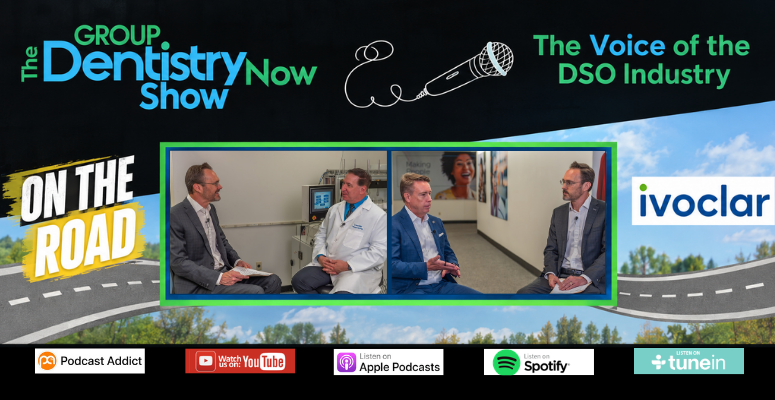
Inside Ivoclar HQ: Partnership, Innovation, and the Science Behind Dental Excellence. Part 1
Join GDN as we go on the road with Ivoclar. Chet Spivey, Chief Commercial Officer & President & Dr. Tom Hill, Manager of Scientific Services share their thoughts on:
- The future of aesthetic materials
- Value over price
- Applying Disney’s customer service approach
- Much more
Visit Ivoclar’s Instagram page to learn more here: https://www.instagram.com/ivoclar.na/
Tune in next week for part two of Inside Ivoclar HQ with guests, Angela Severance, Training & Education Manager for Group Dentistry Solutions at Ivoclar and Dr. Rich Rosenblatt, Director of Community & Culture at Imagen Dental Partners.
Subscribe to our channel for more episodes and stay updated on the latest DSO news, insights, and events!
If you like our podcast, please give us a ⭐⭐⭐⭐⭐ review on iTunes https://apple.co/2Nejsfa and a Thumbs Up on YouTube.
Inside Ivoclar HQ: Partnership, Innovation, and the Science Behind Dental Excellence. Part 1 Transcript:
Bill Neumann (00:00):
Welcome everyone to the Group Dentistry Now Show. I’m Bill Neumann, and as you can tell, this is a little bit different. We are on the road. We’re here in Amherst, New York, or right outside of Buffalo at Ivoclar’s North American headquarters. It’s a great place to be. And we’re here for the Ivoclar HQ experience. The team of 12 doctors from Imagine Dental Partners is also here, and we’re going to experience with them just what they see and feel here over the next couple of days. They’re going to network, they’re going to explore new technologies, new products, new solutions, do some hands-on, get to explore the facility here, get to see Niagara Falls, have a little bit of fun as well. And we also have four guests on the podcast with us. So we’ll have Chet Spivey, who’s the chief commercial officer. He’s also the president of Ivoclar North America.
(00:53):
We’ll have Angela Severance on the podcast, Dr. Tom Hill. And then we’ll actually hear from Dr. Rich Rosenblatt. Rich is with Imagine Dental Partners. He’s going to talk about the experience that he has here over the next couple of days. So with that, I’ll also look for the QR code that we’re going to have in the podcast. So we’d ask that you follow Ivoclar’s Instagram channel so you can keep up to date on what Ivoclar’s doing, whether it’s here at their North American headquarters or at the different dental shows and keep up to date on new products and solutions. But sit back and enjoy the Ivoclar HQ experience. Hey everybody, and welcome back. We are of course at Ivoclar and I’m here with Chet Spivey. He is the chief commercial officer and president of Ivoclar North America. Chet, it’s great to see you again and thanks for taking out some little bit of your day for spend talking with us.
Chet Spivey (01:44):
Oh, thanks for having me and thanks for coming to Ivoclar.
Bill Neumann (01:47):
Yeah. So Chet, you’ve been in the industry, I was looking at your bio, you’ve been in the industry for 35 years. That’s
Chet Spivey (01:53):
Correct.
Bill Neumann (01:54):
So I’ve met you maybe for about 15 or 20 of those anyway, so quite a while.
Chet Spivey (01:59):
Right.
Bill Neumann (02:02):
I’d like to get to know you a little bit more. So maybe talk about how you started out in the industry and also, I know you’re a big fan of Disney, so we have to talk a little bit about that.
Chet Spivey (02:12):
Yeah, we always do. Okay.
Bill Neumann (02:14):
So yeah, just introduce yourself
Chet Spivey (02:15):
To the
Bill Neumann (02:15):
Audience.
Chet Spivey (02:16):
I started in 1991, September of 91. I was hired by Densupply and I became a sales rep and I covered the Southern California and Southern Nevada territory. I was then recruited by Dr. Bill Dickerson. So I ran into Bill Dickerson at a trade show and lo and behold, I have family in Las Vegas and he was their dentist. And so he was looking for somebody to run his marketing at the Las Vegas Institute for Advanced Dental Studies. And so we joined forces. I worked for Bill for about a year. Ivoclar was a huge sponsor, still is a sponsor to this day of LVI and met up with Ivoclar and the next thing you know, I had moved from California to Las Vegas and I think I was that one guy that was then moving continuing east to Buffalo, New York. I thought I’d be here for about two years.
(03:09):
And as of actually Monday of this week, I’ve been here 28 years.
Bill Neumann (03:13):
So that leads me back to what I mentioned earlier about you and your wife are both big fans of Disney. So where did that start and tell us a little bit about that?
Chet Spivey (03:24):
Well, I was born and raised in Southern California, so I grew up about an hour and 40 minutes from Disneyland and we didn’t have a lot growing up. My dad, he was a pipe fitter, a welder. And so once a year we would have this big trip down to Anaheim where the Southern California gas company would buy out Disneyland for a night. And so that was our big trip and that was the one night nothing else mattered in the world. We were a family unit and we just had so much fun at Disney. Of course, I like all the Disney characters and all that kind of stuff, but it was more special than that for me. And then while I was in college in the summer months, I actually would work at Disneyland. So I was what they call a casual temporary because I would come and go when my schedule permitted.
(04:16):
And I grew up not only going to Disneyland, but working for Disneyland, fell in love with everything Disney. And probably what makes it so special is, and what I brought into my professional career is the customer service, the customer experience and the focus on at Disney, we would say the guest, but you just carry that forward. And I think that’s something that’s really unique and special about Ivoclar. And one of the reasons I’m still with Ivoclar, we’re a family-owned company and yes, we want to make money and sell a lot of products, but it’s really about serving the customer and being there for the customer.
Bill Neumann (04:53):
Right. And we’re here and it’s focused on the VIP experience and the education and the training that you all provide and having conversations with Dr. Hill and Angela about just everything that you provide. And it’s not just about the clinical solution. Ivoclare is known for having some of the best clinical solutions in the world, but it’s a lot more than just the product itself. And you talk about the customer service, which you brought over a little bit of that from Disney, but then also that training and education component, which is so I think important. Talk about partnership. Partnership is a term that gets thrown around a lot and means different things to different people, but what does it mean when you partner with a group practice or a DSO? What does that relationship or commitment look like?
Chet Spivey (05:49):
Yeah, no, that’s great. Great question. I mean, our definition of partnership is more than a product for sure. It’s really a comprehensive approach to growing with the DSO or growing with any customer for that matter. But we look at, of course we make products and we’re here to sell products and workflows, but we take it beyond that in a sense that a true partner, we want to grow with our DSO partners or our DSO customers at their pace. And we also look and realize, we learned that early on, that every DSO is unique. So there’s no cookie cutter approach, if you will, to a DSO. So it’s really about starting with meetings with them, listening to them, understanding where their vision is, where they want to go, and then looking into what we can offer, not just from a product or from a workflow, but from training and education, from collaboration on business, on how to really just grow the business and maybe serve through the DSO, the market better, the consumer better, the patient better.
(06:59):
And so it’s really all encompassing, right?
Bill Neumann (07:02):
Yeah, for sure. I mean, I agree. And you’re right, when you see in one DSO, you’ve seen one DSO. So I think it’s really important to have that conversation ahead of time and not make assumptions because they all are uniquely different, which is its own set of challenges for sure. Why did you decide? Because everybody, I think on the manufacturer and distribution side of things, the industry side, the industry’s kind of adapted to the consolidation with providers, the growth of DSOs, a lot of emerging groups out there, a lot of these private equity backed DSOs and everything in between. You’ve really doubled down and have focused a lot on DSOs and made big investments in people and of course the training and education. Why did you determine that this was a good path for Ivoclar?
Chet Spivey (07:50):
Right. Well, obviously it is a big. I think in the North American market, we’re probably the fastest growing market for DSOs. So it’s definitely a direction that the market is going. So we definitely wanted to be in there from a business perspective, but more so what we realized is we learn a lot from DSOs. We don’t just go in and partner and try to support and help DSOs grow or grow with the DSO, but we learn at the same time because we can really try different things in collaboration, of course, with the DSO and scale up. And whether it’s standardizing different processes or how to really improve efficiencies, productivity, and ultimately profitability for the DSO, but we can also take that to the independent dental practice and they can learn from that as well. But DSOs give us that opportunity to learn as much as we serve and support and collaborate.
Bill Neumann (08:48):
This ties in with something Dr. Hill talked about when working with key opinion leaders and really talking to them when you’re developing products and doing R&D, that’s important, but you’re talking about almost taking it a step further when you’re talking about scaling up solutions and when you’re rolling something out to not just one location, but to somebody that might have 50 or 100 clinicians, it’s a different ballgame. So one other thing that happens in the industry is you’re talking with DSOs, they look at manufacturers and a lot of similar products, and so you go, “Well, so-and-so offers this bonding agent or this type of solution.” How do you see yourself differently than maybe some of the other manufacturers? And again, I think the educational component’s huge, but beyond that, how do you separate yourself from the others?
Chet Spivey (09:49):
Yeah, I think it’s twofold. First, it’s listening. We really do listen. We don’t come in with an agenda. We come in first to really listen and understand where that ownership, at whatever level it might be, want to take the DSO. We really try to do that. And we know that price is always a topic and a conversation, but we also are there to educate and talk a little bit more about business or not the practice of dentistry clinically, but the practice of running a dental business. I had one experience, it was many years ago, it’s a very large DSO today, very successful. Who shall we remain nameless? Yes. But they were looking for a cement solution. And at the time we had a $5 application solution and a $15 application solution. And we all figured that we’re probably going to walk out of the meeting.
(10:51):
Happily, we’ll get the business photo probably with a $5 solution. But what we were able to show through data as well, not just what we said, but through data, that by utilizing the $15 application, the odds of that patient coming back and sitting in that chair for a remake or a reseat were almost nil and the savings were far outweigh than going with the $5 one and having people come back. And so it’s having those kinds of discussions, and it’s really interesting. We don’t come in saying, “What kind of a handling do you like on your filling material?” It’s more conversations like how much time do you reserve for a two surface posterior composite or things like that. We really talk as much business as we do product because of that experience that we have and that opportunity that we have also being a privately held company so we can take our time with our customers and really move at their pace.
Bill Neumann (11:53):
You work with a lot of different groups, big, small, like you said, some of the biggest out there, largest DSOs globally actually, but certainly here in the US, which is a giant chunk of the market now or growing portion of the market. You also work with a lot of emerging groups. What are some of the challenges that you hear from your customers? Is it hearing things about HR, inflation, patient, house recall? What do all those things look like? Because it seems like there’s a lot of uncertainty right now in the market.
Chet Spivey (12:29):
Right, right. I mean, what we hear, staffing is a challenge throughout the DSO, not just clinical staffing, but staffing seems to be a challenge. Though I would say the wide variance in skillset between. I mean, there’s dentists of all levels of skill in DSOs, some have been around, some that are just coming into their profession, but training and education seems to be the number one. So we say, “What can we do to help you?” And education, okay, but I don’t have time for education. So it’s kind of like a challenge. So what we do is we built this company in North America. I think a great part of our success was built purely on education. And so we take what we know, what we do well, and we offer all forms of education, whether it’s on-demand education, online education, in-person education, and we really start there trying to help the practices have education available for their new hires, but also standardizing those processes so we can get repeatable, predictable results in the practice.
(13:43):
And depending on how a DSO wants to work, we will build a standardized procedure to meet their needs.
Bill Neumann (13:52):
Chet, if you could leave any of the DSO leaders in the audience with one final message, what would that be?
Chet Spivey (14:01):
I would kind of take it back to my Disney days, and I would say everything we do at Ivoclar, we have one really major goal, and that’s to create a memory. And we believe that as leaders of dental service organizations, you have that same opportunity to create a memory, but most importantly, make an impact on your patients. And that’s really what we do here, and I would invite anybody to align with us, and we’d happy to create great memories with you.
Bill Neumann (14:32):
That’s great. Thanks, Chet.
Chet Spivey (14:33):
Thank you.
Bill Neumann (14:35):
Hey, everyone. We are here at Ivoclar in Amherst, New York, and I am with Dr. Tom Hill. He is the manager of scientific services at Ivoclar. And Thomas, it’s great to see you, and appreciate you inviting us here into your laboratory. Tell us a little bit about the room we’re in and then what you and your team do here.
Dr. Tom Hill (14:59):
Well, we do a lot of research for the company. We do evaluations of all the products that are in the industry, so we know where the Ivoclar products stand with, how we can make them better, and where we stand up to these products that are out on the market today. We’re always going through development and innovation to try to produce products that move the industry forward. And so this is what we call the ATC, the Applied Testing Center. So there’s two rooms here. We have probably outside of the main corporation, we are definitely the largest subsidiary, meaning that we’ve got more equipment here than most universities that are doing testing. And I’m very blessed and privileged to have all the equipment and things and the different types of testing that we do here. So it’s fun, but it’s chaotic some days, and we go through and we test a multitude.
(15:56):
There’s so many different types of properties that we test here when we’re developing materials.
Bill Neumann (16:01):
Well, there’s a lot going on here right now. I wouldn’t say it’s chaotic, but it’s definitely busy. What’s this machine behind you?
Dr. Tom Hill (16:08):
Behind me is what we call the chewing simulator, Meltronics chewing simulator.
Bill Neumann (16:13):
Chewing
Dr. Tom Hill (16:13):
Simulator. So we use it for a variety of different things. We will do it for fatigue of materials. We’ll make crown restorations, and basically we will hammer it in a cyclic fatigue. We also use it for doing wear. One of the specimens that are in here behind me right now are designed to do denture wear specifically. And what we will do is we will take antagonists that we preformed in a specific shape and we’ll run them over flat specimens. And then what we will do is we’ll determine the number or the amount, volume, depth of wear that you have during a certain cycling period. And what we usually do is we have control materials that have a historical relevance in the market. We know what those are, and then we compare those to the new material and we find out how much wear compares to say a previous denture material that’s out on the market.
(17:08):
And it’s been quite interesting to see, especially with all of the different types of processes that are now coming out on the market with things like that. So you have milled materials, you have conventional techniques that have been around for years, and that’s what our baseline is. And then of course you have the new type of methodology of printing materials, which is becoming extremely popular.
Bill Neumann (17:31):
So you’re testing a lot of different products here.
Dr. Tom Hill (17:34):
Yeah.
Bill Neumann (17:36):
Beyond this machine, you’ve got some others that are off camera here. So what other type of testing do you do?
Dr. Tom Hill (17:41):
Behind you over there, we have a toothbrush abrasion machine. We do that a lot for gloss of restorations. You want to know when you put in a new composite or a new denture material, you want to see, hey, how long does that gloss last in there? And we do that, and that’s a big one. We also have outside this room a thing called an Instron. It’s a universal testing machine. I like to say it’s a pushy-pully, brakey type of machine. It’s a single load to failure type of restoration. We also have an SCM, which has EDEX capabilities, meaning that theoretically we can go up to over 10,000 X and look at the microstructure of different things. We also, the EDAX is a semi-quantitative chemical analysis, so we can see what elements it has in there. I always say that it doesn’t do three elements, hydrogen, helium, and lithium.
(18:38):
So you can imagine what a pain that is for a person who works for a company whose primary product is lithium dicilicate. But there’s definitely a lot of pieces of equipment in the lab here.
Bill Neumann (18:51):
So let’s talk about you for a second. A little bit about your background. You’re a doctor. Tell us a little bit about your education and what you do on a day in and day out basis. You do a lot of speaking as well too. Actually, you’re going to be speaking in front of the team from Imagine. So we’ll talk maybe a little bit about that, but a little bit about your background and then they call you the commissioner, so I want to try and understand that a little bit.
Dr. Tom Hill (19:24):
I’ve got a lot of names and the commissioner, yeah, that’s because I do fantasy.
Bill Neumann (19:29):
Doctor, commissioner?
Dr. Tom Hill (19:30):
No, no, no. I wish I had all the good names out there. Probably my background, I was, for a lack of better term, I was groomed for this position. I know that a lot of people go through school and especially upper degrees and things like that, and you come out and you find the job. I couldn’t have been trained more for a job than the one that I have here today. My background was I was in biomaterials engineering with a specialty in ceramics, in ceramic material engineering, and I got lucky enough to be put on a training grant for dental. So I was actually paid by the dental industry to go to school for a while in the area that I am working in. And I worked for a gentleman named Ken Anasavas who basically wrote the book on dental materials. He was working on a material I knew at the time as Empress3.
(20:28):
I would say the industry knows it today as EMAX. So I’ve been along for the wave of that ride ever since it was before it ever got to dentist out there. And we worked and analyzed it there when I finally did. I enjoyed my time at school, but when I finally did graduate, I was lucky enough that the timing worked out that there was an opening here at Ibaclar. And so I came in and I started working here more as a specialist in ceramics as time has evolved.
(21:03):
I guess my responsibilities have grown over the time, so now I do run the lab here. I also am, as you said, the manager of scientific service. And what that entails also is running the clinical trials in the US. I have a great team over in Lichtenstein, which really do a really good job because we have everything worldwide and we combine all that data together. But I do work with a lot of different universities to do clinical trials and to evaluate materials both clinically and in vitro and bring all that information together before we ever launch a product. Hopefully sometimes timelines don’t work out the way you want to and they speed up and they slow down, but we do hours and hours of research before we ever launch a product.
Bill Neumann (21:54):
And what about the commissioner?
Dr. Tom Hill (21:56):
The commissioner. So I am the commissioner of the Fantasy Football League, the Ivoclar Fantasy Football League, and I’ve been running that for 24 years, even though I’ve been here for 25. Someone else ran it the first year. And it’s been an interesting ride. I wish I could say I’m the best one in the league, but there are a lot of other good people in here. I don’t charge too much money. It’s more about bragging rights and walking through the halls and having fun with your coworkers here. Actually, even these days, I let my son draft for me because hopefully he’ll never see this. He’s better at it, but it’s a fun league that combines all of us and brings us all together.
Bill Neumann (22:41):
So let’s talk, so Ivoclar has been around for over a hundred years now. Amazing. So can you take us through a little bit about the innovation from maybe the early days? We weren’t around then, but talk a little bit about the innovation at Ivoclar and what that looks like. And I mean, I know being in the industry about 25 years that there’s been drastic changes in the industry, the way things are done. You talked a little bit about printing, but just especially I’d say in the last five to 10 years, there’s been dramatic shifts in technology and materials. But talk a little bit about the innovation and what Ivoclar as a company does to invest in that R&D and continuing to make better products.
Dr. Tom Hill (23:27):
Well, I don’t know for certain. I do know that we are one of the largest companies as far as research in the industry. We put more money in there than almost any other company in dentistry or in dental materials. As far as innovation, it’s one of the things that has always drawn me towards Ivoclar. I don’t ever know what I’m going to be doing that day when I come into work because you never know what the project is that will hit you next. And starting with eMAX, I mean, that was a game changer in this industry. It really did change how people view products and view restorative materials. I used to say that there are four properties that a dentist looks in a restorative material. One is cost, can’t get around that. Aesthetics is another one. The ease of use, how easy is it for a person to use?
(24:26):
And the final one was reliability. And before eMAX, it was reliability could always be questioned when you go back to Empress, which was a great material. I mean, it ushered in the aesthetic revolution in dentistry of pressing materials and things like that. And then you go through and now you have eMAX comes in and with that in Zirconia, which is now storming the market and really is taking over, you really don’t worry about reliability of your products. They just work. And if it doesn’t work, now you’re surprised. Now it’s not really the material’s fault anymore. Something must occurred along the process that went wrong. So innovations like that, but we’ve gone across the board, probably one of the things that has really, even to this day, I still get is, I don’t know if you know about the ivotion puck. The Ivocean puck is one that puts the pink and white and mills out.
(25:24):
And the first time they told me, “No, you can mill the teeth and the gingiva out of the same puck.” And I’m like, “No, you can’t.” And there is a process in that interface between the two that allows, and so being able to mill it all out in one. And we’ve always tried to stay on the cutting edge of what’s coming out next, whether it be something that’s a biological material and interfacing, meaning do you put different types of fillers in that can hopefully resist any biological attack and things like that. Or if we’re looking into the future of printing, we’re working on printing materials here. There’s a lot of things in there. So it’s one of these things that really from a company standpoint, you really don’t know what you’re walking into one day to the next, but I know that we’re going to do things that change.
(26:20):
We have a curing light that cures in three seconds. Actually, I’ve seen ones that have cured in one before. And really, a lot of times you got to wait for the industry to catch up. As we were speaking about earlier, like our new zirconia, the eMax zirconia that’s out on the market now, some of the times I have a problem because you got a lab that wants to fire in a shorter amount of time and we give it to them and they’re like, “Well, no, I don’t quite believe you.” So that trust has to be grown in there. And the same thing with eMax, looking back at the beginning of that, the first year, two years of it, that product didn’t sell that well. It took a while to actually gain its name, and we’re still here 20 years later, and it is probably the most tested material in the market ever.
Bill Neumann (27:09):
Yeah. Well, it makes sense. So you go back to the curing lights that you secure in 30 second time, and then you come down to the ones that are three second and doctors still wanted to cure 30 seconds or 10 seconds because they just were like, “Well, I’m just not sure.” Yes. So it does take time for, I think, the industry or clinicians to catch up with the technology, which is understandable.
Chet Spivey (27:31):
Right.
Bill Neumann (27:32):
So let’s talk about your R&D team here. So when there’s a new product that’s being developed or maybe even an improvement on an existing product, what’s the role that you and your team play?
Dr. Tom Hill (27:44):
We are, as I said, our official name’s the ATC, so the Applied Testing Center. I guess we’re the guardians of the R&D department. What will happen is twofold A, we understand and know what’s out in the industry. So we do a lot of competitor testing, as I stated before. Beyond that though, when a new product is launched or is being developed, we are in that process. So they will develop it, and while it’s still in the phase where we can make alterations to it, they will give it to us. You need to give it to an outside entity so that processes and handling don’t come into play. You almost need to have someone who’s going to mess it up. What you want to do is you want to put it through its paces and make sure that it works in everybody’s hands. And if it doesn’t, you want to know the strengths and weaknesses so you can interact with the dentist or with the lab and tell them, okay, you can do this, but if you do this, you need to be careful.
(28:47):
And there are so many, I guess, techniques that are given in the industry that sometimes when they interrelate, meaning when you put one technique with another technique, then you can start to have some issues out there. So that’s our job is to make sure that it’s going to be successful in your hands.
Bill Neumann (29:06):
From a perspective of clinician influence, you’ve got key opinion leaders out there, you have a lot of clinicians as customers. So how do you work with them when it comes to the R&D and just the feedback that they give you?
Dr. Tom Hill (29:21):
I am very blessed in the industry. I’m sure you know a lot of the people that I do in this industry, and we call them key opinion leaders. I call them friends. I’ve worked with a lot of these guys in the industry at universities who’ve been around for many, many years. And what happens is that we have these interactions, we listen to them, we go to them because they know the industry. A, first of all, it’s nice to have, and we were having a brief conversation before this, about understanding the history or background, where we’ve come from. And when you do that, then you can understand where we’re going a lot of times. And a lot of that we do. So we bring them in, we bring input and feed, and I’ll give you one specific example. We used to bring in a gentleman who’s at another company now and a guy who was a dean at a dental school, and they were our bonding people.
(30:15):
And whenever we would develop a new adhesive, we’d bring them in here. And the first group of specimens that they ran, we said, “Okay, run them according to the instructions for use and make sure that it does work how Ivoclaris set it up.” And then we basically gave them 90% of the specimens for them to do bonding. We said, “Bastardize the process. Do what you think a dentist. How will they do this? Will they go short? Will they go long? Will they not cure it as long? Will they cure it for too long?” And to understand what happens when those things occur. So we do try to incorporate dentists at every step along the way before it goes out. And then we bring in, we have groups and we ask them, “What properties are you looking for? What’s the next thing? What’s your biggest challenge in a practice today?”
Bill Neumann (31:10):
So our audience is made up of group practices, both large and small. So there’s a lot of focus on clinical efficiencies. I think there’s probably a lot of things that are changing now with technology when it comes to workflow. So there’s some changes there. And of course, you still want that clinical outcome as well, the best possible clinical outcome. So can you talk a little bit about things like efficiency when it comes to your thought process when you’re doing R&D and when you’re developing products? I mean, do you see a focus more on solutions like that? And also ease of use is another thing as well.
Dr. Tom Hill (31:49):
I think it all goes in together. I think what you’re trying to do is help the dentist be the most successful that they can be, but in the most efficient methodology. From my standpoint, you don’t want to make something faster just to make it faster. I think at the end of the day that the dentist and the relationship with their patient is probably the primary one because if you make a mistake, if you have a crown fallout, that’s probably the worst thing that can happen to a dentist. And if you’re doing that to save five or 10 seconds, it makes no sense. But yes, as time’s gone along, even when I say we made a curing light that can cure in three seconds, what a lot of people don’t see is behind that, there was a lot of chemistry that was done that we created a new initiator that allowed the composites that cure in three seconds to work properly, that did cure fully and did that.
(32:49):
So there’s a lot of things that go on underneath the surface when you’re talking about that. But yeah, you always want to make things more streamlined, more smooth, easier for the dentist, and that can come in a lot of different forms. But at the end of the day, we will never, I guess, take any compromise on quality and making sure that number one thing is that the patient is getting a high quality restoration that’s going to last for a long time. Because as I said, last thing you want to do is have a unhappy patient and you want to make sure that it does so. I think it’s all integrated in there and efficiency is one of those things. I mean, that’s why CAD/CAM has just really taken off is a one visit appointment is probably the patient’s biggest joy because you come in, you do it and you’re done.
Bill Neumann (33:48):
So is there anything here, we talked about a lot, is there anything that you’re working on right now that you’re allowed to talk about that you’re really excited about?
Dr. Tom Hill (33:58):
That first question was, so when are you going to have a multi-emax? Everybody likes the reliability of that. And even at the beginning I was like, “Well, I’m told that it’s coming. I’m told that it’s coming.” So I have seen some of it and I think it’s on the horizon. And really what it does is it kind of builds the best of both worlds. Ever since eMax was launched, I always got, “Well, the aesthetics are really good, but they’re not Empress.” And so this new material should really put us on that cutting edge of having a high aesthetic material that you can use for high aesthetic veneers and situations and really improve that without losing any of the strength, any of the toughness, any of the mechanical properties, but you gain this advantage of having this where it’s going to have a transition and translucency and other effects that go in there to make it look more lifelike.
Bill Neumann (34:58):
Excellent. Well, great. Well, wonderful conversation. Thank you, Dr. Hill. No, thank you very
Dr. Tom Hill (35:01):
Much. It’s always good to talk and get someone who’s been in the industry for a while.
Bill Neumann (35:05):
Thanks. Join us next week for part two of Ivoclar’s headquarters experience where we sit down with Angela Severance, Ivoclar’s Group Dentistry Solutions training and education manager, and also with Dr. Rich Rosenblatt, Imagine Dental’s director of community and culture. We’ll dive into the role of training and education in driving clinical success, explore how Ivoclar supports group practices beyond the products, and hear firsthand about Imagine Dental’s experience partnering with Ivoclar. Don’t miss part two, coming next week.