

Sponsored Content
Walk into any general dental practice across your DSO network, and you will find it: patients with crowded teeth, gaps, bite issues, or a desire for a straighter smile. The clinical need is real. The patient interest is there. But in the vast majority of DSO locations today, that revenue walks right out the door, referred to an orthodontist down the street, or worse, never identified at all.
That referral is one of the most expensive transactions in a DSO’s revenue model. You have already acquired the patient, built the relationship, and earned their trust. Then you give away the most profitable, most scalable specialty service in dentistry.
This article focuses on the financial case for in-house orthodontics, the access opportunity DSOs are uniquely positioned to fill, and what a successful real-world launch actually looks like.
The Numbers Are Hiding in Plain Sight
The orthodontics market represents a $5+ billion opportunity already embedded within the general dentistry ecosystem. The patients are in the chair. The need exists. The revenue is simply going uncaptured.
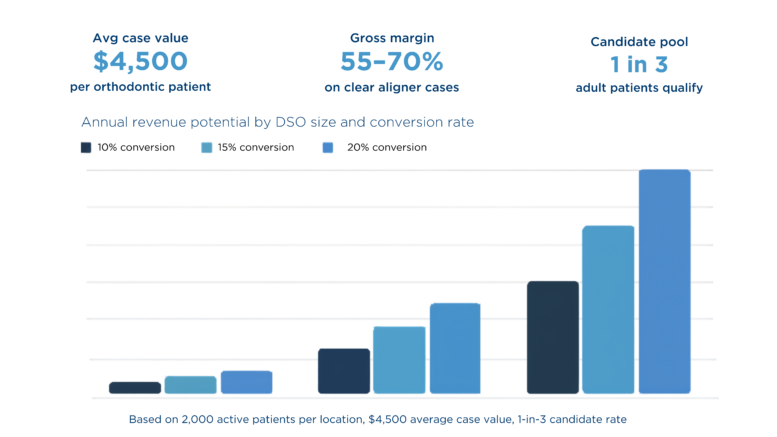
Consider a straightforward baseline: a healthy general dental practice has roughly 2,000 active patients. Research consistently shows that approximately 1 in 3 adult dental patients are orthodontic candidates. That means each location carries an untapped pool of around 660 potential cases, with no additional marketing, no new patient acquisition costs, and no new chair time required.
At a conservative 10% conversion rate and an average case value of $4,500, that single location generates approximately $297,000 in annual orthodontic revenue. Across a 20-location DSO, that is nearly $6 million per year currently being referred away.
DSOs with active patient communication strategies and trained teams routinely achieve 15 to 20% conversion rates. At 15%, that same 20-location organization generates over $9 million annually. The revenue is not hypothetical. It is sitting in your patients’ records right now.
Orthodontic clear aligner cases carry gross margins in the 55 to 70% range, among the highest of any service line in general dentistry. This is not a niche add-on. It is one of the most significant untapped revenue opportunities in the DSO space today.
Beyond Revenue: The Access Imperative
For DSOs with locations outside major metropolitan markets, orthodontics is not just a revenue opportunity. It is an access gap that is growing wider every year.
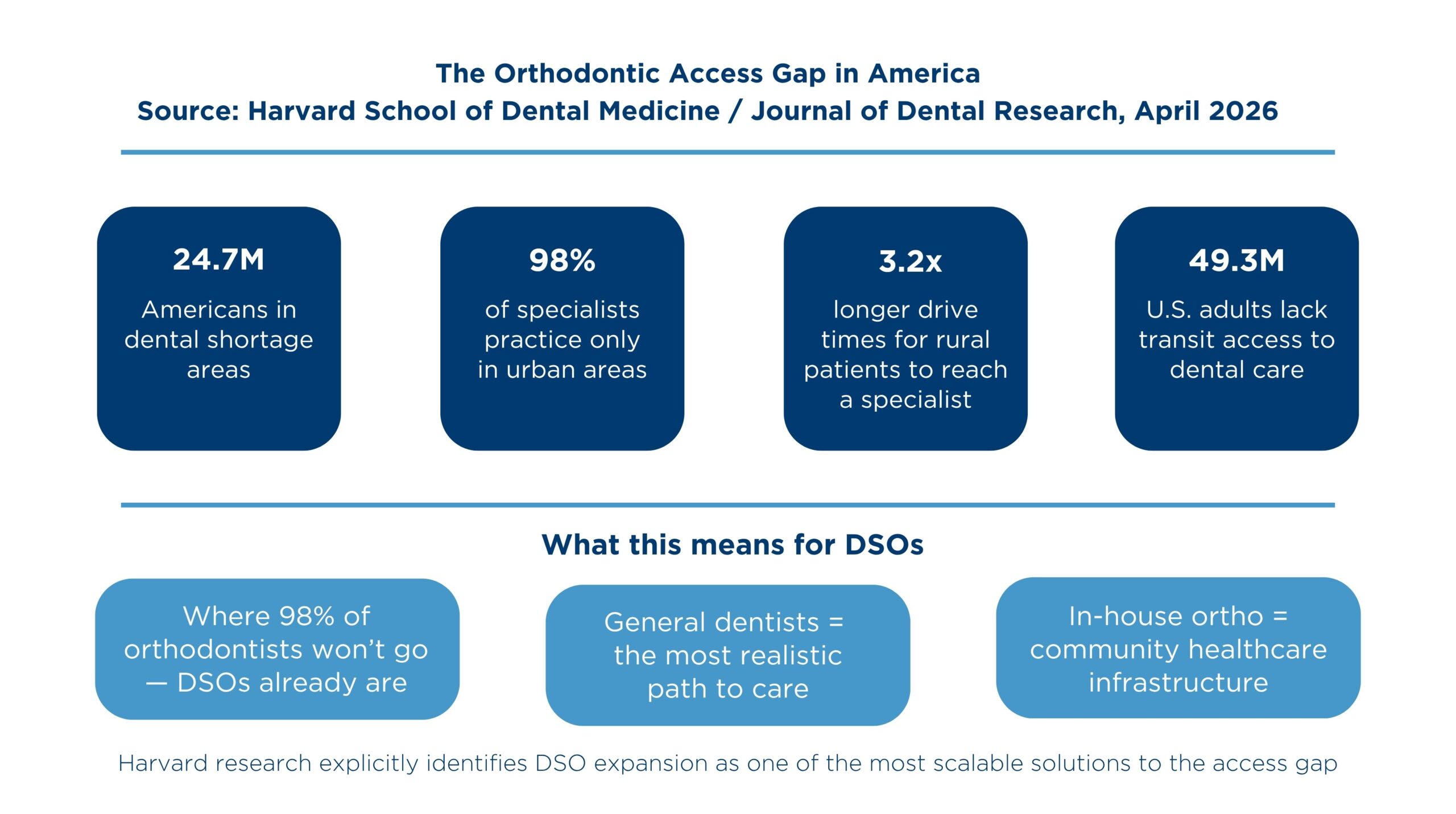
New research from the Harvard School of Dental Medicine, published in the Journal of Dental Research in April 2026, quantifies the scale of the orthodontic access crisis in America: 24.7 million Americans live in dental care shortage areas, 98% of dental specialists practice exclusively in urban areas, and rural patients face average drive times to specialty dental care that are 3.2 times longer than their urban counterparts. In states like Montana, Nevada, and North Dakota, average drive times to a dental specialist routinely exceed one hour. For many patients, that means no care at all.
The Harvard research explicitly identifies the expansion of orthodontic services within general dentistry as one of the most scalable solutions to the specialty access gap. For DSOs, this reframes the conversation entirely. Adding orthodontics is not just a revenue decision. It is a positioning decision that shapes the DSO’s role in the communities it serves.
DSOs that provide orthodontic care in markets where no specialist is available become essential to the community healthcare infrastructure. That drives patient loyalty, referral volume, and long-term retention at a level no marketing campaign can match.
The Right Infrastructure Makes the Difference
Most DSOs have attempted to add orthodontics at some point. The reasons programs underperform are well-understood clinical confidence gaps among general dentists, the cost of staffing specialists across locations, and workflow friction that stalls adoption before it gains momentum.
The solution is not a new aligner brand or another technology platform. It is a fully integrated clinical and operational system built around the general dentist, one that provides orthodontist oversight for every case, removes workflow friction, and gives DSO leadership real-time visibility across all locations.
Specifically, a scalable orthodontic model requires four things:
- A licensed orthodontist reviews and approves every treatment plan, regardless of whether a specialist is physically present
- AI-assisted case identification that surfaces candidates proactively within existing patient record workflows
- Dedicated human concierge support that actively manages cases and coaches providers beyond initial onboarding
- A real-time enterprise dashboard giving leadership visibility into case volume, conversion rates, and revenue by location
From Agreement to First Case in 30 Days
One of the most common reasons DSOs delay orthodontic expansion is the perceived operational burden. Launching a new service line feels like a multi-quarter project. It does not have to be.
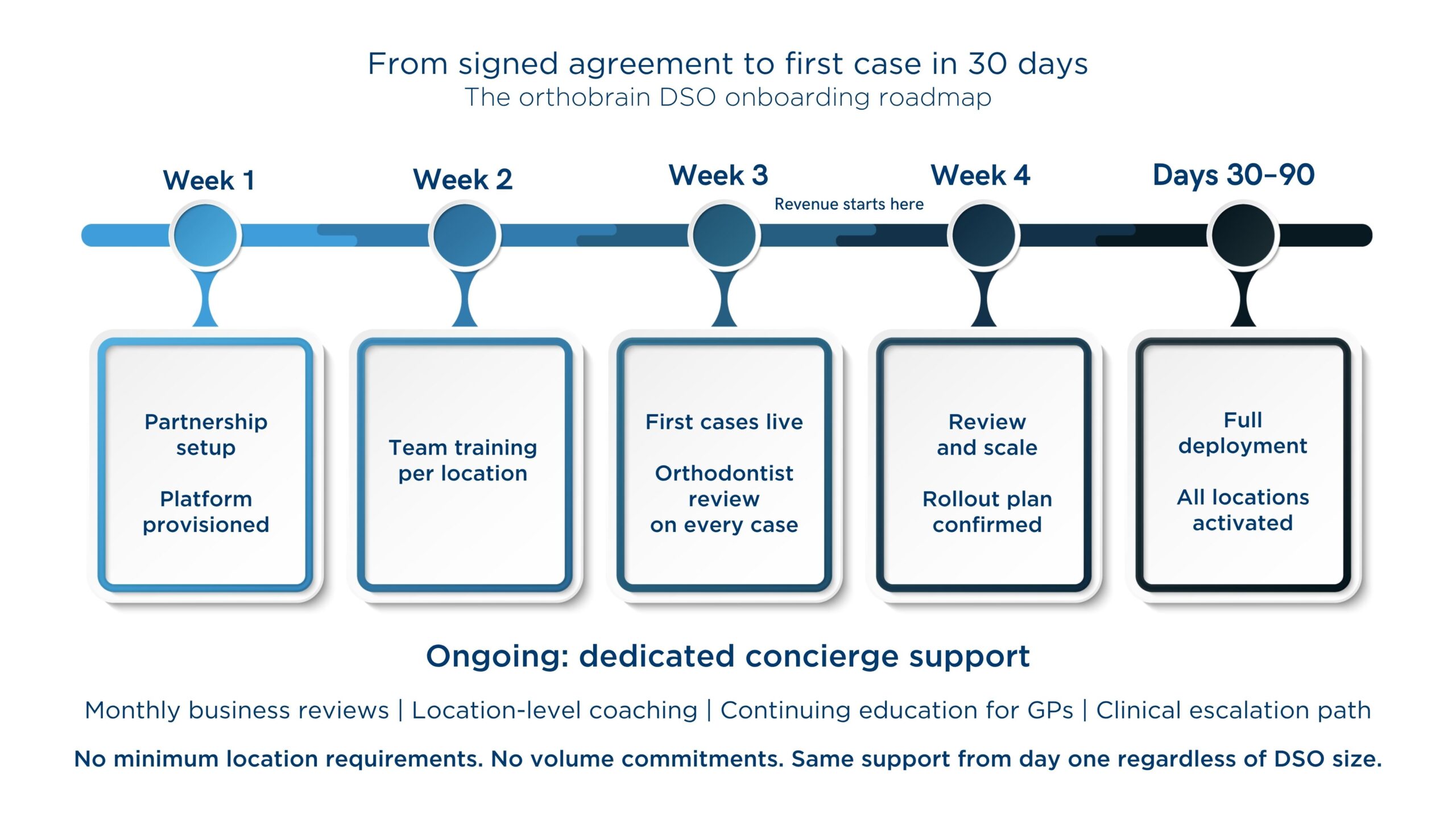
With the right infrastructure, the onboarding process looks like this:
- Week 1: Agreement executed, platform provisioned, dedicated concierge team introduced and briefed on your locations and goals
- Week 2: GPs, hygienists, and front desk staff trained on case identification, patient communication, and the platform, typically completed in a single full or half-day session with no disruption to patient schedules
- Week 3: Pilot location goes live, first cases submitted and reviewed by a licensed orthobrain orthodontist, with a detailed treatment plan returned before moving forward
- Week 4: Performance review with DSO leadership, rollout calendar confirmed for remaining locations
- Days 30 to 90: All locations activated, enterprise dashboard configured, orthodontics functioning as a revenue-generating service line
The program is generating revenue before the quarter is over. The operational lift is a single half-day per location.
A Real-World Proof Point: Franklin Street Dentistry
Franklin Street Dentistry in Evansville, Indiana, offers a compelling example of what happens when a practice fully commits to an aligned orthodontic launch model.
The practice’s four doctors participated in a structured, single-day orthodontic enrollment event, with the entire team coordinated around patient identification, education, and enrollment. The result was the most productive single day in the practice’s history and a record-breaking number of orthodontic cases started in one day.
What drove that outcome was doctor buy-in, coordinated team execution, and a clinical support infrastructure that removed every operational barrier so the practice could focus entirely on patients.
This kind of structured, high-impact orthodontic event is repeatable and scalable, deployable across every location in a DSO network. It is the difference between an orthodontic program that exists on paper and one that drives measurable revenue month after month.
“This is what orthobrain was built to do: give General Practitioners the education, the workflows, and the support to make orthodontics a real, thriving part of their practice, simple, predictable, and profitable.” — Richard Uria, President, orthobrain
What the Industry Is Already Saying
The orthodontics opportunity is not a contrarian thesis. It is aligned with the strategic priorities DSO industry analysts are actively tracking. The Benesch Dental/DSO Industry Newsletter identified three defining trends shaping DSO growth in 2026:
- Same-store growth and service-line expansion are the top DSO priorities heading into 2026
- The emphasis is shifting from how fast to add locations to how well to integrate, standardize, and operate at scale
- AI is emerging as a labor-shortage pressure valve, not a replacement for clinical roles, but a way to reduce burden and support consistent outcomes
Orthodontics, built on the right infrastructure, addresses all three simultaneously. It is the service line for same-store growth, a vehicle for standardization at scale, and a direct beneficiary of AI-assisted case identification and treatment planning.
Are You Doing It Now? The ROI Question Worth Asking
Some DSOs already have an orthodontic program in place. If that is you, the right question is not whether you are offering orthodontics. It is whether your program is actually profitable, and whether it is delivering increasing returns over time.
Many in-house programs generate cases but leave a significant margin on the table. The culprits are predictable: too much chair time per case, high refinement rates that extend treatment and consume clinical resources, inconsistent case acceptance across locations, and no visibility into which practices are performing and which are not.
The right infrastructure changes each of these dynamics. Orthodontist-reviewed treatment plans produce more predictable tooth movement, which means fewer refinements, shorter treatment timelines, and less chair time per case. AI-assisted case identification increases the top of the funnel without adding clinical burden. And enterprise-level dashboards give leadership the visibility to identify underperforming locations and course-correct before small gaps become large ones.
The result is a program that does not just generate orthodontic revenue. It generates increasingly efficient orthodontic revenue, with higher margins, better outcomes, and stronger patient satisfaction over time. That is the difference between an orthodontic line item on a P&L and a true growth pillar.
Three Reasons the Window Is Now
- Patient demand is at an all-time high. Post-pandemic aesthetic awareness has driven adult orthodontic interest to record levels. Patients are already asking about teeth straightening, and if you are not offering it, they are finding it somewhere else.
- Clear aligner technology has matured. The clinical reliability of modern clear aligner systems, when managed with proper orthodontic oversight, now rivals traditional braces across a wide range of cases. The clinical risk of launching an orthodontic program today is lower than it has ever been.
- The competitive DSO landscape is consolidating. As DSOs scale and compete for patient volume, comprehensive in-house care is becoming a key differentiator. Orthodontics is one of the highest-value services a patient will purchase in their lifetime. DSOs that offer it retain patients. DSOs that do not, lose them.
The Opportunity Is Already Inside Your Practices
The case for DSO orthodontics has never been stronger, and the operational barriers have never been lower. The patients are there. The margin is there. The infrastructure to deliver it reliably, at scale, across every location now exists.
The DSOs that move decisively now will establish orthodontics as a core revenue pillar and build the patient experience around it. Those that wait will find themselves entering a maturing internal ortho market from a position of disadvantage.
The orthodontic revenue you are looking for is not somewhere else. It is already sitting in your dental chair. The question is simply whether you are going to capture it.
Ready to build your orthodontic revenue pillar?