

Ranked the #1 DSO Podcast!
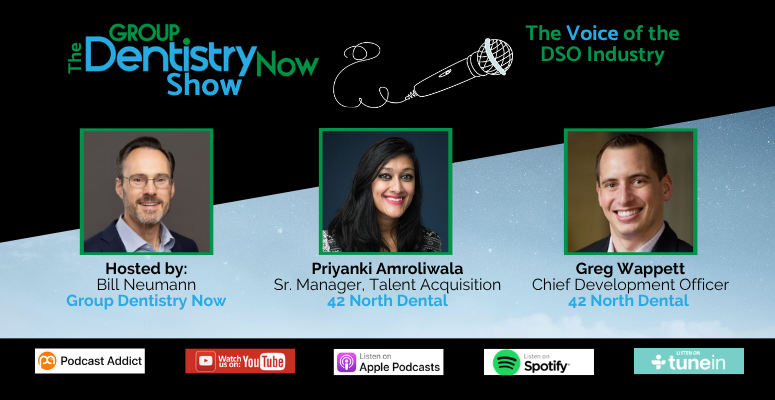
Welcome to The Group Dentistry Now Show: The Voice of the DSO Industry!
Building the Future of Group Dentistry: Recruitment Strategies and Strategic Growth at 42 North Dental
Priyanki Amroliwala, Senior Manager of Talent Acquisition & Greg Wappett, Chief Development Officer of 42 North Dental share their thoughts and strategies on:
- Doctor recruitment in 2026
- Acquisition realities & strategies
- Strategic growth initiatives
Learn how the recruitment & acquisition teams work together at 42 North Dental.
You can learn more about 42 North Dental: https://www.42northdental.com/
If you are a dental student or dentist looking for a change, contact Priyanki: https://www.linkedin.com/in/priyanki/
Selling your practice or small group? Contact Greg: https://www.linkedin.com/in/greg-wappett/
Subscribe to our channel for more episodes and stay updated on the latest DSO news, insights, and events!
If you like our podcast, please give us a ⭐⭐⭐⭐⭐ review on iTunes https://apple.co/2Nejsfa and a Thumbs Up on YouTube.
Choose your favorite listening app below and subscribe today so you don’t miss an episode! Full transcript is also provided below. See all of our podcasts HERE.
 |
 |
 |
 |
 |
 |
DSO Podcast Transcript – Building the Future of Group Dentistry: Recruitment Strategies and Strategic Growth at 42 North Dental
Welcome to the Group Dentistry Now Show, the voice of the DSO industry. Join us as we talk with industry leaders about their challenges, successes, and the future of group dentistry. With over 200 episodes and listeners in over 100 countries, we’re proud to be ranked the number one DSO podcast. For the latest DSO news, analysis and events and to subscribe to our DSO weekly e-newsletter, visit groupdentistrynow.com. We hope you enjoy today’s show.
Bill Neumann (00:38):
Hey, everyone. Welcome back to the Group Dentistry Now Show. I’m Bill Neumann and as always, we appreciate you tuning in. I’m excited to have these two guests on the show from 42 North Dental. We have Priyanki who’s been on the podcast at least one time. She’ll correct me. It might be twice. I know I was looking back through the archives. Twice? Okay. All right. I look back. Well, the last time I think was about four or five years ago. It’s been a while, right?
Priyanki Amroliwala (01:09):
Yes.
Bill Neumann (01:10):
So you have some big updates for us.
Priyanki Amroliwala (01:13):
For sure. For sure.
Bill Neumann (01:15):
Well, good. And Greg, we have not had you on the podcast before. It’s kind of an interesting story. Priyanki Amroliwala is the senior manager of talent acquisition of 42 North and Greg Wapit is the chief development officer at 42 North. And Greg’s got an interesting story because he was previously at 42 North. Actually was out of the industry for a while and came back. So we brought him on to talk about why he’s back at 42 North and what 42 North is doing a little bit differently that they haven’t been doing in the past couple years. Priyanki’s going to give us an update on recruiting, what her strategies are, what she’s seeing with younger clinicians and everything in between. So we’re going to talk about affiliations and acquisitions and we’re going to talk about recruiting doctors and what that looks like in 2026. So thank you both for being on.
(02:08):
I think this will be a really enjoyable podcast. And I think for people in the audience, you’re going to get some really good direction from what Priyanki’s doing on the recruiting side and Greg and 42 North’s focus on the acquisition and affiliation side. You may know Priyanki, you may know Greg, you may not. So I’m going to let them do some introductions. Priyanki, a little bit about your background. You’ve been at 42 North for what, 11 years or so? Quite a while. So a little bit about your background and then your role at 42 North.
Priyanki Amroliwala (02:45):
Yeah, that’s correct. I’m actually going to be celebrating my 11-year anniversary this October, so I’m excited about that. So yeah, I’ve been with the organization for 11 years. My title officially is a Senior Manager of Talent Acquisition. 42 North Dental, I think for those of you that don’t know, we are technically a New England-based dental support organization. We’ve got about a hundred plus practices all across nine different states. Although the bread and butter of our business is right here in New England, if that makes sense. So we are technically in Massachusetts, New Hampshire, Connecticut, Maine, Pennsylvania, Michigan, Indiana, New York, New Jersey. And Greg, please correct me if I’m missing a single state because that happens every once in a while. But my role here is really to help grow the organization through doctor recruitment. So as we all know, a dental practice really can’t survive without any of the staff, but really we can’t survive obviously without the doctor that’s there.
(03:49):
So in- house, trying to hire in- house doctors and specialists to grow the practice is essentially my role within the organization. So we’ve got a great department that’s working with us as well. So it’s not just myself anymore. I think that’s the biggest change from when we probably spoke about five years ago or so, Bill. So we’ve got a great team and a great department where essentially we have different roles spread out in our division just to essentially build the pipeline for doctor recruitment. So anything and everything that we can do to bring quality doctors, great doctors into the organization that will last here for a long time is really my priority.
Bill Neumann (04:29):
Thanks, Priyanki. And Greg, welcome to the show and welcome back to the industry.
Greg Wappett (04:36):
Thank you, Bill. Jokingly, a lot of people have said when I rejoined that no one ever truly leaves dentistry. They always find their way back home. So good to be here. Just a quick introduction of myself. So I spent about the first half of my professional career as an investment banker working for a boutique firm that really specialized in helping privately owned businesses as they explored either private equity deals as themselves as a platform or joining larger private equity backed organizations. A large bulk of the work that I did was across the physician practice management spectrum. So think of dentistry, but think of it in other different verticals such as ophthalmology, such as women’s health, such as dialysis, physical therapy, et cetera, et cetera. That kind of multi-site healthcare organization, physician owned and led concept was an area that I really learned the ropes of the industry, learned how private equity thinks about these consolidation trends and such.
(05:35):
And then I joined 42 North Dental back in 2016 and spent just about five years spearheading the corporate development initiatives. Just to quickly piggyback off of what Priyanki gave about the history of the organization, 42 North has actually been around for close to 50 years at this point. We’ve gone through a lot of evolution over that 50 year period. We were originally founded and known as Gentle Dental and General Dental Partners over a period of time. So up until about 2014, the organization had been privately held and owned just by our doctors and everything that we had done to get to the point of where they were, which is around 30 locations at the time, had all been de novo single branded locations. No acquisitions were done. It was all building one new location every 12 to 18 months or so and promoting from within to really find that next lead clinician and doctor to take over the new office.
(06:29):
And then 2014 we went through the iteration of bringing in private equity capital and the first kind of 12 to 18 months or so of that was really spent just kind of building up the infrastructure of the organization because we knew that we wanted to grow and add acquisitions into our playbook, but we needed to make sure that we were ready to do that. So we didn’t really start making acquisitions until close to 2016, which is when I joined and started to spearhead that initiative. I spent 2016 through 2021 with the organization helping us grow from those mid 30 locations up to close to a hundred across seven states. Priyanka, you did get the number of states or you did get the states right at least at that time because we weren’t in the Midwest. So we’re really focused on the northeast corridor. They’re Maine down to the tri-state area.
(07:21):
So it’s kind of New England plus. We went through a successful liquidity recapitalization event at the very end of 2020. So when I left in 2021, it was kind of a reset of the clock. I then spent the next five years as the chief development officer for both a private equity backed ophthalmology business and a woman’s health business. And I know we’re going to get into a litle bit, but I just rejoined the organization a few months ago and I’m excited to spearhead our next wave of growth in the next step of evolution of 482 North.
Bill Neumann (07:52):
Yeah. Well, might as well kick it off with that. So you came back to the organization and so I guess it was you coming back because 42 North was looking to kickstart this the acquisitions again. So there was a pretty long pause where 42 North was like a lot of groups out there. I think if you look at when you left, which was right around the end of 2021, interest rates started to climb. We started to see the cost of acquisitions, cost of everything going up. So I think we saw a slowdown in the industry as far as numbers of acquisitions, especially for DSOs and a focus more on, “Hey, what did we buy? Let’s look at making the most out of each location that we have, focusing probably a little more on doctor recruitment and retention and things like that. ” And now we’re starting to see more groups start to acquire, but in maybe a different way.
(08:57):
So you joined the organization, Greg, and what’s the strategy look like now from the affiliation acquisition standpoint?
Greg Wappett (09:05):
Yeah, no, I appreciate that, Bill. So I think it makes sense maybe just to discuss a little bit quickly or give some insight a little bit into that pause period there. So the bulk of our acquisition strategies were from 2016 to around 2022 and we added a whole bunch of locations, 45 plus locations, probably close to 50 locations across that stretch of time. And I would say probably about 50% of those include some level of succession planning with the selling dentists, whether it’s two partners and one of them was 60, one of them was 45, or whether it was a 60 something year old looking to that next level of their career and kind of writing the last chapters of their career. So a chunk of the acquisitions that we did over that period of time had succession planning involved with that. And we, and I would assume most other groups, we had open dialogue, very good open dialogue with our seller partners over that period of time.
(10:04):
And we wanted to always plan that out. We understand that transitioning practices is part of the business that we’re in. It’s a significant part of the business that we’re in, but it’s not as simple as dentists aren’t just chess pieces you move around a board. It takes time to find the right dentist, to bring them in, to groom them into that practice because there is a split kind of culture both between the practice and the DSO level. So it takes some time, it takes teamwork to accomplish this. COVID really threw a wrench in everyone’s system. Of those 50% or so of the practices that the succession planning was part of it, all of those timelines all of a sudden escalated pretty quickly. We had a lot of dentists that were in there kind of early to mid 60s that still thought they had a few years left in them and then COVID hit and all of a sudden people were scrambling a little bit, people were slow to come back to the office.
(10:53):
There were health concerns both of the individual doctors as well as spouses and family and other things. So all of a sudden we got hit with a wave of earlier than expected either slowdowns or departures from our provider base. So that’s kind of like step one of a three prongs process that really hit us as well as the industry. The second piece was, as you mentioned, inflation really started to rise. As inflation rose, the cost of doing business just got more expensive. It’s not just as simple as the supplies and things you buy off the shelf, equipment, things of that nature. A lot of it had to do with staffing. All of a sudden, workers in the healthcare industry had a higher demand of compensation and benefits and the staffing of our dental practices and our home office space, they probably make up more than a third of our expense line items on our P&L when you remove the doctors.
(11:48):
So when all of a sudden these things are rising in cost, revenue’s not rising along with them, those things have an impact on the financial results of the industry and especially our organization. And the third piece to that is interest rates in and of themselves. They followed along with the inflationary trends. Inflation rates rose from nearly zero to where we kind of are at today. I think everyone can … Inflation is a word that people understand a whole lot better now than they probably did back then. You kind of put those things all together and it made it for a really challenging time for organizations like ours to really continue to acquire. When we go and buy practices and when we go through private equity recapitalizations, there is a component of financing there that is debt oriented and any homeowner or people that have been homeowners before will kind of know this a little bit more just to give a sense.
(12:41):
We basically have adjustable rate mortgages for our debt burdens. And as those interest rates rise, so do our debt payments. And as our debt payments rise, the cost of doing business rises and our revenue probably took either a hit or it stagnated due to our providers, which are this primary source of revenue declining, it led 42 North to really take a strong quick pause of instead of spending our capital going out and to continue to grow recklessly, we realized that this was the right time to focus our initiatives and our thoughts internally, make sure that we’re focusing on our efficiencies and how we’re supporting our practices, making sure that we’re providing them the tools to still provide the appropriate care for our patients. How can we grow within the four walls of our practices as opposed to just going out and trying to find ways to finance more acquisitions.
(13:32):
So that was really what kind of led to the slowdown and pause I would say is the right terminology there. And then up until recently, after we spent a few years looking in the mirror and self-reflecting and fixing a lot of these issues and really bettering the organization, we as a company got better. We were able to bootstrap ourselves, figure out better ways to do things, not adding 10, 12 practices a year gives your teams an opportunity to digest all of that growth and do a little bit of self-reflection of what could we have done better? How do we operate things better going forward? And as we got to that point, we also went through just recently a refinancing event. So going back to the mortgage concept, we were able to just in the last few months refinance our entire balance sheet, which included a significant investment of additional capital for growth, which certainly corresponded with 42 North bringing me back on board to help kind of restart the acquisition initiatives because we’re a healthy company, not that we were never a healthy company, but we’re back being strong again.
(14:40):
We’re growing both organically, we’re ready to grow inorganically and now we’ve got the balance sheet that’s appropriately structured for today’s environment. And the hope is, obviously, I think everyone has this hope that interest rates aren’t going to continue to rise much above where they are. They might stagnate. The industry itself has gone through a lot of bumps along the way here. So we do believe that now is a great time for us to really get back in the market and start partnering with really good practices because we do feel like we’re a great home for certain types of profiles of practices and providers, but we need to do it in a disciplined fashion and we needed to make sure that when they do join our organization, we’re solvent and we’re capitally capable of supporting them and we’re not just buying for the sake of buying.
Bill Neumann (15:31):
That’s great insight. And yeah, I think there’s a lot that can be said for taking that pause and there are a lot of organizations out there that have, and I think now you’re in a better position than many and looking forward to kind of dive in a little bit deeper there. I want to switch over to Priyanki. I was thinking a little bit about this when I saw that you had been at the organization for almost 11 years. I’d love to get your thoughts, Priyanki, on how recruiting doctors has changed since you first started.
Priyanki Amroliwala (16:06):
I will tell you, I thought it was hard back then and I wish I could tell you it got easier, but I most certainly did not. Each year I find the market to get more and more challenging just due to, I think everyone here that’s listening already knows there’s a massive, massive, massive shortage on dental talent, be it a dentist or a specialist, a hygienist, a dental assistant, essentially anything and everything where you need to be licensed or go to a specific school to do the entire industry is suffering. So it’s not just a 42 North thing. It is something that the entire industry sees just because of the fact that there’s very limited amounts of dental schools or hygiene schools. And I was just having a conversation with someone in the industry recently. These dental school students just coming right out of dental school, they have at least 300 to 400K of loans and then that doesn’t include some of their undergrad stuff.
(17:04):
And then if they want to get into specialty, it’s a whole different game. So a lot of these people are coming out of school having at least minimum 300 to 400K worth of loans, which is massive. So a lot of people are just in general not trying to get into the industry because the dental schools are just so expensive. They’re very expensive, number one. And then number two, there’s very few of them. So it’s just a very, very difficult market. But having said that, Bill, even though this is the case, these are things that we can’t change. I know that there are some DSOs that are working on working together to create more dental schools and more opportunities for people to enter into the dental workforce, which is great. But for right now, we’re just kind of working with the talent that we have. So here at 42 North, we’re working on strategies with how we can build better programs with our dental schools.
(18:01):
We are lucky that we’re based out of Boston and we’ve got three awesome dental schools, as I like to call it in my backyard. So we’ve got BU, we’ve got Harvard, we’ve got Tufts all within just a few miles outside of our home office in Waltham, Massachusetts. So I think it’s great to have these schools that are here. So anyone that’s listening, I would just say try to do the most that you can with whatever talent that you have. So I talk to a lot of executives that are like, well, the dental schools, they’re not giving me talent immediately. They’re giving me talent four years down the line. So I understand those situations. But having said that, the more that you build a robust program into these dental schools and the more that you are intricated in and the more that you are able to support the community, the bigger your talent’s going to be, if that makes sense.
Bill Neumann (18:57):
Yeah, it sure does. Priyanki, one more question.
Priyanki Amroliwala (19:02):
Sure.
Bill Neumann (19:02):
So you’re dealing with a lot of younger clinicians, some of them still in school. So you’ve got clinicians that maybe don’t have a lot of experience. So what are you doing at 42 North from a clinical mentorship education standpoint to kind of get them ready for your practices? And what are you seeing as far as the talent that’s coming out of dental school now? I mean, are they looking for clinical assistance?
Priyanki Amroliwala (19:33):
Oh yeah. Each year as a DSO or even as a private practice, every single person is facing the staffing challenges as unfortunately the dental schools are also facing these staffing challenges and they’re also facing challenges where they’re not getting enough patients similar to the story that we hear in the private practice and the DSL land as well. So having said that, the students that are going to dental schools these days, they are getting fewer and fewer patients and fewer and fewer support, less and less support. So having said that, when they come out of dental school, their education is a lot different or their training I would say is a lot different than how it was even just up to like 15 years ago, 10 to 15 years ago. So the students in dental schools right now are seeing less patients and they’re getting less support just due to staffing shortages or whatnot.
(20:27):
So these students are in more need than they ever have been for support coming right out of dental school. And we have case by case examples about how each year things are just getting worse. Having said that, I will tell you that we have a massive mentorship program. So number one is we technically have what we call a director of a practice, which is like a lead doctor in the practice. So one of their responsibilities is really to work closely with the associate and work with them on mentorship or whatever the case might be. So the good thing is all of our practices are multiple doctor practices. So they’re never single doctor practices. So if there was someone that’s coming right out of dental school, they are technically working with a lead doctor as we call it a director of the practice. On top of that, we technically have specialists in house as well.
(21:24):
So if that new associate wants to go in and build a good relationship with a specialist that’s in house, learn from them, shadow them, that opportunity is there as well. Plus what we now have is what we call regional clinical directors. So regional clinical director Bill is essentially one of our internal experienced doctors that might not be working clinically anymore or might be. Some are still practicing, some are not. And their responsibility is to work with helping me in hiring a brand new doctors, number one. Number two is once the doctor comes on board, they’re heavily involved with what we call 30, 60, and 90-day check-ins. So if I’m the new grad that just got hired, not only do I go through this thorough interview process with the regional clinical director and the team at the practice level, but then on top of that, once I get hired, it’s not just “throwing someone in the fire.” I would say at some point I’ve seen a lot of DSOs that are doing that, but it’s not the case here.
(22:29):
Over here, what we do is we have these consistent check-ins directly from not only the director of the practice, so the doctor that they’re working with, but also from the regional clinical director that’s able to go in and add additional support and mentorship whenever and wherever needed. So we are trying our best to really support these new grads because, like I said, it is very, very, very difficult to bring them on board, number one. And then number two is to get them actually coming in and getting them up and running and getting them productive.
Bill Neumann (23:03):
Why don’t we change the subject to misconceptions and both of you, I’m sure you talked to both a lot of docs. You’ve got the docs that own practices and you’ve got the clinicians that are looking to work for a group practice or a DS. So Priyanki, what are some of the misconceptions, things that you continuously hear from docs during your interviews that are, maybe they have some thoughts about DSOs. We know that sometimes DSOs can be vilified. I don’t think it’s a secret, unfortunately, but Priyanki, what do you run into?
Priyanki Amroliwala (23:42):
Definitely not a secret. Unfortunately, good or bad, I’m very heavily involved in a lot of the dental schools and unfortunately the dental schools, a lot of the clinical instructors, sometimes it could be the dean, but they are really telling the students to either A, stay away from DSOs because we have these high production goals and we have this churn and burn environment and we don’t care about the patients. And there’s a whole plethora list of things that we can go through, but that’s essentially the same. And as you said, it’s really not a secret. It is still the same impression that we are getting from the dental school. So a lot of the dental school students are taught to stay away from DSOs or because now we are such a massive presence, their clinical instructors are telling them, “You know what? Go ahead and work for a DSO, make your mistakes there, and then go in once you’re done making your mistakes, then go in and go into private practice.” So that’s really what they’re being taught.
(24:52):
Unfortunately, it’s just something that is really, really sad. But having said that, what I have noticed, Bill, is that students now are more and more open to DSOs even though they’re being taught to not be part of a DSO or that so on and so forth. It’s not a good place. I’ve noticed that a majority of students these days are willing to take the conversations with the DSOs, whether or not they sign, that’s a whole different story, but they are willing to take those conversations, which is very helpful. And I think that’s also because the private practice land is suffering just like how the dental industry right now, as Greg had mentioned, has been suffering too for so many years. So post COVID, the staffing costs have gone sky high so people are not able to keep up with their private practice as they used to.
(25:45):
So the private practice are doing less and less hiring and fortunately or unfortunately, these students are really coming to DSOs because these are the places where the opportunities are at.
Bill Neumann (25:59):
Greg, what are the misconceptions or that those common questions that you get on your side for the docs that are potentially looking to sell?
Greg Wappett (26:11):
I think certainly Branky nailed the one area that I think is one of the things that we always cringe at when we hear about is that we set these sorts of crazy production goals or things of that nature that we’re kind of Big Brother looking over everyone’s shoulder to make sure they’re meeting all of these sorts of metrics that big corporate and big private equity really put on the table. I chuckle at that when I hear about it because we see this in private practices that we look at all the time for affiliations where it’ll be a doctor that’s got a big practice and all of a sudden you see they’ve been to two associates in the last four years and you ask them what’s the reason for the turnover of the associates? And they’ll say, “Well, they wanted a $300,000 base salary and then three years later they’re only producing $400,000 worth of dentistry.
(27:02):
So we’re paying them like 80%. So we made the decision to get rid of them and focus on someone new.” You could claim that that’s also a production goal. We don’t put those sorts of guidelines out there. We’re not tracking everyone’s individual treatment plans and things of that nature. The way that we do approach it is we try to provide our providers and our offices with as much information as possible so that they can truly understand what’s going on within their practice, that their clinical director can truly mentor their associates and understand what’s going on with their associates and how are they growing in their career and their trajectory as a professional. Likewise, with the hygiene programs in the offices, what sort of hygiene program are you operating? Is it efficient? Are we seeing the same sorts of metrics that we see? The good thing is we have a hundred different basis points of how practices operate.
(27:54):
Not every practice is the same and we don’t try to make them the same, but it is helpful for provider or for both clinical directors, sellers that lean in as well as the leadership staff of the offices, it’s helpful for them to understand what else is going on out there and having more information so that they can react accordingly. At the end of the day, all of our doctors and all of our office managers and all of our offices in general, they do have a level of competitiveness to them in the sense that they want to do well. They want to be economically strong because that just means that they are able to then be able to give their staff raises at the end of each year. They’re able to meet certain goals that private practices across the country have goals every year. It’s not like this is some new concept, it’s just more demonized because we’re larger organizations.
(28:44):
I think that’s one. I think the second one is just how much we change the way, especially from a seller perspective. I think we kind of hit the associate side. From a seller perspective, there’s a definite misconception about what we do and don’t do as a partner from a DSO perspective. Yes, we’re very heavily involved. We’re going to take over certain pieces of the practice that are just easily brought into the back office side of things. So managing HR benefits, managing the accounting side of things, managing insurance contract negotiations, how do we consolidate supply spending and lab spending so that we’re able to try to minimize our expenses on those things a little bit? Those definitely happen all day long and we don’t really get much pushback on things like that, but people take that thought process to the next level of, well, are you going to try to cut costs all across the board?
(29:38):
My hygiene program is really strong but I’ve paid my hygienists really well. We’re not going to mess with that. And if we do, if there’s a reason to change it, it’s going to be a conversation that we have with the lead dentist at the office and the office manager because it’s not a cookie cutter approach. Every practice is different. I had one the other day that told me that It was a broker that told me that they refused to show me a listing of theirs because their seller believes that a DSO is just going to come in and make them take all sorts of insurances, stuff two new associates down their throat, minimize their personal chair time and they don’t want that. They believe that they’re a fee-for-service practice and they’re a high-end practice and they don’t think that they can partner with us. We have multiple fee-for-service practices and we’ve never looked to change them.
(30:27):
Everything’s kind of a little unique and we take that approach. There are some certain areas that are a little bit more rigid in what we need to do. I think the biggest change that happens in an affiliation process, at least within our organization, is we do switch over the practice management system from whatever they’re on to what we utilize across the organization. And that’s more from a business intelligence and business management perspective. You can’t have a hundred different practice management systems operating under one umbrella and hope that some sort of IT patch is going to be able to give you the information consistently that you need to oversee the organization, the business, and be able to, more importantly, bring that information back to the offices and the leaders so that they can utilize that information accordingly. So I think there’s a lot of misconception about yes, do we provide a lot of information and business analytics and things of that nature to our dentists and to our offices?
(31:24):
Absolutely. And if that’s something that you don’t care about and don’t want to ever see, then it’s probably not the right thing to join a larger DSO that’s focused on these sorts of things, but it’s not like we force them to change their habits or their ways. It’s more of just an educational tool because we have practices all the time that realize, I didn’t realize that was going on with my practice. Why is that? Let me go talk to one of your other practices that’s doing things a litle bit differently because that practice on paper and just by culture and personalities looks exactly like ours, but why do they have this ratio of conversions and we have this or whatever the metric is, there’s usually a commonality there. So we always preach and really support the idea of you don’t just join a DSO like 42 North simply for a financial transaction.
(32:11):
We’re not interested in that. We’re interested in people joining our partnership and to take advantage of that partnership, which means you’ve got a hundred plus offices with multiple providers across each one of them that you can leverage best practices. You can learn from one another. It’s kind of like a continued education within how to manage your dental practice as opposed to someone telling you how to do it.
Bill Neumann (32:34):
Thanks, Greg. Priyanki, when you’re doing these interviews, what do you typically look for when you’re interviewing a potential candidate, doctor? So what are maybe some of the criteria that you’re looking for and then what questions should they be asking you or any group out there as they, because it’s a two-way interview, right? You’re interviewing them, they’re interviewing you. So talk about it from both sides. What questions should they be asking and what questions or what are you typically looking for?
Priyanki Amroliwala (33:05):
Sure. So I’m going to answer in two ways. Number one is an experienced doctor. So when we’re looking for an experienced dentist or as I had mentioned earlier, we call them directors of our practice, they’re equity shareholders into the organization. The whole recruitment game and recruitment proces becomes very different when we’re looking for a director. I would think that a director … Or not I would think, I would say that a director is definitely the lead of the practice. I would like to call them the captain of the ship. And essentially when we look for a director bill, we’re really looking for someone that’s got several years of experience. So we won’t typically even accept one or two years of experience, minimum of three plus years of experience working in really a fee-for-service or a PPO world, because I think, I don’t know if anyone knows this here, but most of our practices are really just fee-for-service and PPO accepting patients.
(33:58):
So when we look for directors, we’re looking for people with that type of experience versus that’s someone that comes from the Medicaid world because the skills just aren’t easily transferable, if that makes sense, number one. Number two is what we’re looking for is, yes, we obviously want a great dentist that’s got that great experience that we’re looking for, but then ultimately we want the softer skills. So we want a dentist that not only is going to be able to connect with patients, that’s obviously most important, that’s kind of a given in the role, but we really want someone that’s going to be a great, great partner. And when I say a great partner, I mean a great partner to the practice. So working directly with the hygienist of the practice, the dental assistants, the front desk team, the practice manager, working well with them, building a good rapport, not being a negative person, being a very positive team player.
(34:53):
I think that’s very important. And mostly we’re looking for someone that’s got what we call the growth mindset. So we want someone that will really be able to have an open mindset, a growth mindset where they want to hire other associates and work with other doctors. They want to work with in- house specialists. I’ll give an example. Whenever someone says, “Oh, I want to be the only doctor in the practice,” that’s already a red flag for us because they’re just not the right fit. As I mentioned earlier, all of our practices have multiple doctors. They have a minimum of two general dentists and then they typically have in- house specialists. So anyone that kind of tells us during the interview process that they really want to be the only doctor, that is a massive red flag for us. So we really want someone that’s got that growth mindset and the growth mentality where they believe that they can do good dentistry, there will be enough patients and there will be enough patients that they can share and essentially grow the practice.
(35:50):
And once someone has that right mentality, that would be the right fit for us. So that’s really what we’re looking for when it comes to a director. And obviously directors for us need to work for us full-time. We don’t want someone that can come in on a part-time basis and that has, I don’t know, something like another private practice that they’re working at or another DSO and then they’re going to want to try before you buy. And that’s what a lot of other doctors are doing these days, but that’s not what we’re looking for when it comes to directorship positions. But having said that, when it comes to associateship, that’s a whole different ballgame. So for associateship, that’s where we are hiring the new grads that we talked about earlier. And then for associateship, we do obviously love to hire experienced doctors. A lot of experienced doctors, as I’ve mentioned, they are looking to come on board part-time.
(36:43):
So what I’ve realized over the past few years is that most of these experienced doctors, they are not willing to come on board full-time. They’re typically wanting to stay at their current practice. Let’s just say if they’re working at their current practice four days a week, then they’re looking to cut back for two or three days and start with us for a day or two. So they really want to just do what I like to call a try before you buy model and just come in to see how things are going. So a lot of the doctors, the experienced doctors that are looking for associate opportunities are looking for places where they want to see what the culture is like and then what the practice is like and if they have a good patient base and if they’re able to be productive, then they switch on to full-time.
(37:28):
So that’s one of also been the biggest shift market changes. A lot of the doctors are not willing to do full-time these days. And then we talked about, like I said, associate dentists that are coming right out of dental school. Obviously those people are mostly looking to do full-time. A lot of these people are open to doing part-time and two different practices as well. And the main priority that a lot of the new grads are looking for is mainly just they’re looking for a lot of mentorship and then they’re looking for, I would say, a base pay that they can really work with. So that’s also another thing. A lot of these doctors these days that are coming out, they’re caring less and less about the collections and they’re caring more and more about the per diems because that’s what the essential market is looking like.
(38:14):
So a lot of these people are looking to get a permanent salary or get a permanent per diem and then come on board, which I’m sure people listening here know what I’m talking about, but when it comes to an organization like 42 North Dental or another private practice down the street, whatever it is, we really want to hire great quality doctors, but we also really want to hire great quality doctors that are going to do well with the patients, truly give the care that the patients need. And when I say give the care that the patients need, give them a good diagnosis and whatever treatment plans that they are required to get and not rely solely just on a per diem. We really want doctors to produce the per diem and really work on a collections model. That’s the biggest goal and that’s the way that the company is going to do well or else we have a lot of doctors that might be on per diems that aren’t even out producing it and that essentially becomes an issue for an organization.
Bill Neumann (39:17):
Greg, I’ll ask you a similar question on your side. What do you typically look for from an acquisition affiliation standpoint? What is the certain number of operatories? Is there a certain number of years you want the doctor to stay on or engaged? Is it a certain type of practice that you’re looking for? Is it general dentistry? Is it specialty? Is it a combination? Is it multi-specialty? So maybe some of the criteria and then what are some questions that the docs looking to sell their practices should be asking not just 42 North, but other DSOs when they go out there to interview them as well to find if they’re the right fit?
Greg Wappett (40:02):
Yeah, no, I’ll quickly hit the 42 North criteria and every DSO is different. And so other people are going to have different criteria that is the right fit for them and it might not be the right fit for us. We understand that and I think everyone should understand that. Not all DSOs are equal, not all of us have the same strategies. Our basic strategy is we are a GP focused organization. So we only have two locations throughout the entire portfolio that are specialty focused, one pediatric and one oral surgery and those are unique in their own rights. So the balance, I’d say 95 plus percent of our practices are rooted in general dentistry. As Priyanki mentioned, we always have at least two GPs in the practice. So to accomplish that, you almost need six chairs or have the ability to get to six plus chairs from an economic perspective like the revenue adjusted EBITDA, I’d say 1.5 is probably the low watermark for us on a revenue.
(41:07):
300 to 350 is probably the low watermark for us on an EBITDA basis. Everything else is kind of above that. The next piece for us that’s really important is just the ability to grow the practice and the willingness to grow the practice. The first is more binary. We can look at the number of chairs, we can look at the office hours, the staff, the number of patients flowing through and really understand what are the levers that we have to really grow this practice over the next one to three years? Do we need another associate, either full-time or part-time? How much specialty work are they referring out the door and are we able to accommodate a specialist to be in- house either on a full-time or part-time basis to help bring that, keep that specialty in- house? We’ve always been big believers that in most instances, not all, but in most instances it’s a better treatment plan for the patient that they can have all of their dental care needs serviced at the place that they kind of call the home of their dental needs, which is the same office they’ve been going to probably for their whole life, if not for generations of their family and they’re going to continue to go to for years going out.
(42:16):
Specialty is obviously a little bit of a different animal because sometimes you do need to go to an oral surgeon office. Sometimes you do need to go somewhere else. But if we’re able to keep those patients in the four walls of their current practice and working and having this specialist work side by side with the general dentist, it just makes for A, a better patient experience but be a better standard of care. So the two providers can truly stand over the patient and collaborate and talk through, here’s the history of the patient, here’s what we know Mrs. Smith has been experiencing, here’s where we first started the issue two years ago, this is how it’s evolved. And then once the treatment plan is done or the specialty treatment’s done, now we’re monitoring it in real time and if something arises, that’s the same specialist that’s been in the office that they can pop in and check out what’s going on and provide some insight to it.
(43:06):
So the ability to grow both the GP and the specialty and also the hygiene program. A lot of hygienists, certain practices, they don’t do prophy treatments. They’re all about the bloody prophies. There’s certain things that we want to be able to institute within our offices to help them grow and increase the standard of care for our patients. So having that lever is important to us. And really the last piece is really just that willingness to grow. There’s a lot of dentists that, as Priyanki said, certain dentists just want to be the king of their fiefdom and the only king in town and they just want to be a solo practitioner with four or six support staff underneath them that are helping them do their day-to-day work and that’s it. And that’s a fine model. It’s just not our model. Our model is much more collaborative with multiple providers with larger practices that are busier, that we’re seeing more patients and that we’re really treating as many as we can in the community within the right guardrails.
(44:08):
Specific to 42 North, what are the things that we look for? To me, one of the most important things right out of the gate is what is the motivation for a seller looking to partner with a DSO or sell their practice in general? Are they looking to strictly retire? If so, what’s their time horizon? And then you kind of almost have to ask that again, what’s your realistic time horizon? I think most dentists either know or they’re coached by their advisors or brokers that someone like myself is going to ask for a minimum of five years commitment. So they’ll say that out loud, but the reality is we need to understand what that means. That doesn’t mean that you show up to work five days a week for year one, four days a week for year two. And by the time we get to year five, you’re working one day a week.
(44:50):
We need to make sure that we’re on the same page because going into partnerships under false pretenses is the wrong way to think about this. If you’re looking strictly for a financial transaction and you don’t want anyone to touch your office or touch how you guys do business or anything like that, you just want to basically cash out, work for the next three years and kind of have your succession plan essentially etched out in stone so that when your three-year anniversary is up, you can walk away having taken care of the sale of your practice in advance. It’s not for us, but there’s groups out there that focus on those sorts of things and probably with shorter time horizons. There’s definitely groups out there that their business strategy is buy a solo doctor practice and have them out within the first six to 12 months because they believe strongly that they can bring in a new dentist and that’s going to reinvigorate the practice and grow.
(45:43):
It’s not 42s model, but it’s a different model. But to me, it’s way more about having an honest conversation with the seller and the seller having an honest conversation with themselves about what are they truly looking for out of a partnership? What do they want to see out of it? What do they not want to see out of it? Do they want someone that’s going to start bringing in new technologies or start talking to them about implementing AI into their practice or working with their hygiene program to maybe change things around a little bit because they’ve been doing the same sorts of procedures and the same strategies for the last 25, 30 years when there’s been changes in evolution in treatment plans and how cases should be handled. The other piece that’s really important for a seller to understand is at the end of the day, you’re selling your practice and that means that you’re no longer the business owner of those four walls, which means certain decisions, they at least warrant a conversation and the decision making process is more than just you as a sole business owner.
(46:43):
And that’s a tough pill for certain dentists to swallow. They’ve been in often cases that the ruler of their practice for the last few decades and making this sort of change when they feel like they’re only a few years away from slowing down and retiring, that’s a massive change in how their mentality works when they show up to the office every day. So they need to be mentally prepared for that and we’ll help them along the way. It’s not like it’s a binary sort of situation where it’s we flip the switch and it’s our practice now, not yours doctor, so do what we tell you. It’s more of just the camaraderie to it. Decisions need to be made collaboratively. We look for people that are open-minded in the idea of partnership and partnership can mean a lot of different things. If it’s a 45-year-old that sells their practice to us and they want to stick around for the next 15, 20 plus years, that’s a partnership that we’re going to need to build the trust and build a long-term relationship here for, because those 15 or 20 years, they’re not just going to be rainbows and sunshine.
(47:40):
There’s going to be hurdles along the way, especially if we’re looking to grow the practice where growth doesn’t come in a hockey stick format, growth comes in kind of a zigzag to a certain extent. So we got to make sure that the partnership is there and the motivations and the personalities align to make this successful. Same way as if someone approaches us and says, “Hey, it’s me and my partner. He wants to stay on for five plus years. I would love to retire in three years, but I’m willing to work full boreth at three years. And over that course of that three years, we need to bring in a new associate and mentor them up so that they can be my equal if not greater replacement so the practice doesn’t see a decline when I walk out the door.” That’s a partnership in and of its own right because now we need to work together to recruit the right provider.
(48:29):
Priyanka needs to understand what the culture of that practice is, what sort of patient population that practice services, what sort of personalities exist in that office so that we can bring the right candidates to the equation so that we can help the practice find the next right person there and then ingratiate them into the practice and work hand in hand with that departing dentist over time to really have a smooth baton pass and transition from that one leader to the next. So to me, it’s really a lot of this, there’s numbers and KPIs and things that we certainly look at all day long, but at the end of the day, the affiliations and partnerships that are the most successful for us and we’re diligent and by the day even more diligent about this is really just making sure that we’re aligned with the sellers and vice versa about what this truly looks like.
(49:20):
Open kimono style, let’s have the conversations, make sure all chips are on the table because when things don’t go well, you’re going to need to be able to work together to get through them. And if you can’t work together, that’s a really messy situation. And it’s kind of the old mantra of like if you’re in a family with five children and there’s always that one problem child that sucks out 90% of the energy in the room all the time, you just don’t want that practice. So we need to avoid those hurdles because those are the ones that they can really set an organization back and cause a lot of problems that diminishes our ability to spend time and energy and focus on more of the positive stories that we’d love to spend our time and energy on. We got to avoid the negative ones. So that to me is way more important than the economics, the price, the structure, the transaction, et cetera.
(50:10):
It’s more about the commitment to partnership.
Bill Neumann (50:16):
Well, as we wrap things up here, I think it’s been a great in- depth conversation for sure. It’s nice. It’s been what, five years for you, Priyanki and Greg, it’s nice to get your feedback because we always just got it from the recruitment and side of things and now we get it from the business acquisition side or the practice acquisition side. As we wrap things up, let’s get some final thoughts. Priyanki, we can start with you. Just final thoughts and then if people want to reach out, if there are any doctors in the audience that might be interested in whether it’s a director role or whether it’s an associate role, they want to talk to you a little bit more, how do they do so?
Priyanki Amroliwala (50:56):
Great. Well, first of all, Bill, thank you so much for having us today. It’s always a pleasure to connect with you and I’m sorry it’s taken us five years to reconnect. We’ll make sure that doesn’t happen again. Second of all, I want to shout out to my awesome colleague, Greg. It’s been a pleasure to have him back and I always like to say he’s my partner in crime. When we go out to a lot of these events, he’s usually the person that’s there with me. So the good thing is I’ve got a great friend of the organization that goes to these events with me and he’s got a great personality that people are able to connect with him on. So if anyone wants to reach out to me, if you’re looking for a career change or whatever the case is, the best way to reach out is just via LinkedIn.
(51:46):
And Bill, if you want to obviously put out my contact information, my email will be completely fine. And last parting thoughts is anyone and everyone that’s listening, whenever you’re looking for a job, definitely keep an open mind, keep an open mind about the location that you want to go to. I always tell the students that I’m speaking with or even experienced doctors, the best opportunities are the ones that are away from the big cities. And when I say away just like 45 minutes to an hour away, if you can go from, let’s just say a Boston, Massachusetts to a Worcester, Massachusetts, which is about an hour outside of Boston, there will be a massive, massive difference in your patient base and then ultimately that will affect your earning potential just because it’s less saturated and lots of opportunities for these doctors, whether you’re a brand new grad or an experienced doctor.
(52:43):
So I always continue to say that I will continue to say that. The more that you have an open mind, the better it is. And as I’d mentioned earlier, we really want to hire doctors that have the growth mindset and I’m pretty sure it’s not just a 42 North thing. I’m pretty sure it’s even a private practice owner or be it another DSO. We really want people that are going to come on board that are going to be really good team players. We trust that the dentistry is good and the dentistry will get there. Your clinical ability and skill will always improve over time. But the biggest thing is the soft skills is something that we can’t change. So we’re really looking for people that have a good personality that can become a good team player and really do well within the organization and ultimately that will affect our culture.
(53:39):
The culture can be great for someone like myself. I can be awesome, but who am I if we’re not hiring awesome people? So that’s my biggest takeaway.
Bill Neumann (53:48):
Thanks, Priyanki. And I failed to mention that Priyanki’s also on our editorial board and she’s written a bunch of great articles. So we’ll make sure we drop some links to those as well as your LinkedIn handle in the show notes so people can reach out to you and read some of the content that you’ve written over the years. Greg, final thoughts and best way to contact you?
Greg Wappett (54:10):
Yeah, absolutely. Well, first, thank you, Bill, for having us on here. It’s great to make the debut. And likewise, I’d like to echo Priyanki’s thoughts. I mean, not only just do I get along really well with Priyanki, I’d say it kind of goes back to the initial question of what enticed me to come back to the organization. I will say there’s a really unique aspect to our organization and it’s not just the leadership team. I mean, it made it a no-brainer to come back on board with Jeff Legebell as our CEO, Dr. Mike Shalaba is our chief medical officer and COO, working with folks like Priyanki. I mean, this organization’s been around for a long time and there’s a lot of really great tenured people that work on the support side of things. Even more so though, that was really nice to hear and it was really exciting was the feedback that I got and the outreaches that I got from a lot of the dentists that were part of the first wave of affiliations that I was part of over my first tenure here.
(55:08):
And I’ve maintained a lot of those relationships over the years. I’m actually a patient at one of our offices and have been since we acquired it, as is my entire family. So I see certain of our doctors along the way, but it really is a unique group of individuals and professionals both on the business side and the clinical side that creates a really good team function. So similar to Priyanki’s, I’d say any dentist out there that owns their practice as a partner at a practice, or if you just think that your practice could really benefit from a partnership with a group like ours, we love to have the conversations. We’re the first ones to always say, not every practice is for us and we’re not for every practice, but it always starts with a conversation. And even just in the last few months coming back on board, it’s a little comical to see the number of conversations I’ve had with dentists I was talking to five, eight, 10 years or so ago about this concept.
(56:02):
Nothing ever transacted and there’s still private practice now, but the conversation’s picked right back up like an old friend and at some point in time their mindset will change, their timing changes. For us, it’s really more about building the relationships over time. Certainly a number of our affiliations come with a little bit more of a snap decision where a broker is bringing us an opportunity or someone calls us saying, “Okay, I’m ready to sell my practice. Let me introduce myself.” A lot of these come from years worth of conversations and building that relationship and trust and knowledge exchange. So similar to Priyanki, certainly feel free to reach out to me on LinkedIn if you have that and I’m sure Bill will put the contact information up there. It’s relatively simple our email addresses. It’s just first.lastname@foretnorthdental.com. But again, thank you guys all for the time and hope this was helpful and educational.
Bill Neumann (56:51):
Thanks again, Greg and Priyanki and thank you everybody for watching or listening in today. Until next time, this is The Group Dentistry Now Show.
Thank you for joining us today. Don’t forget to subscribe to the podcast to stay up to date on the latest DSO News, insights, and events. Also, subscribe to our DSO weekly e-newsletter at groupdentistrynow.com.