
Sponsored Content
The dental year runs on a predictable cycle, and the groups that plan for it operate differently from the ones that take each quarter as it comes.
By Cory Pinegar
From what we see across the dental groups we work with, December brings a particular kind of crunch. Patients with benefits left on plans that reset at the end of the year start calling at once, right when providers and front-office staff are out for the holidays and the practice has fewer days to work with. Demand climbs while capacity falls, and someone has to decide which patients get the slots that remain.
In a group with five locations, or fifty, each office works through that math on its own, with whoever happens to be at the desk that week. From the group level, that’s the same problem handled a different way in every building, which is where variance comes from. How a group gets through December says a lot about whether its operation is reactive or resilient.
The calendar is not the variable
In my experience, the end-of-year crunch tracks the insurance calendar closely, which makes it one of the most foreseeable stretches of the dental year. When one group gets through December calmly and another spends the month firefighting, the difference comes from how each one runs its year.
The clearest way I’ve found to tell a reactive operation from a resilient one is to look at when the work gets done. A reactive group handles each quarter’s bottleneck the moment it shows up, with barely enough time to absorb it. The resilient groups we work with use the weeks before a peak to get ahead, so by the time the rush hits, the schedule is already partly filled.
We started this series by arguing that the front office has stopped being a place and become a set of patient operations that follow the patient over time. Applied to the calendar, that idea means the year has a shape, and the first practical step is describing that shape clearly enough to plan around it.
Every peak has a window
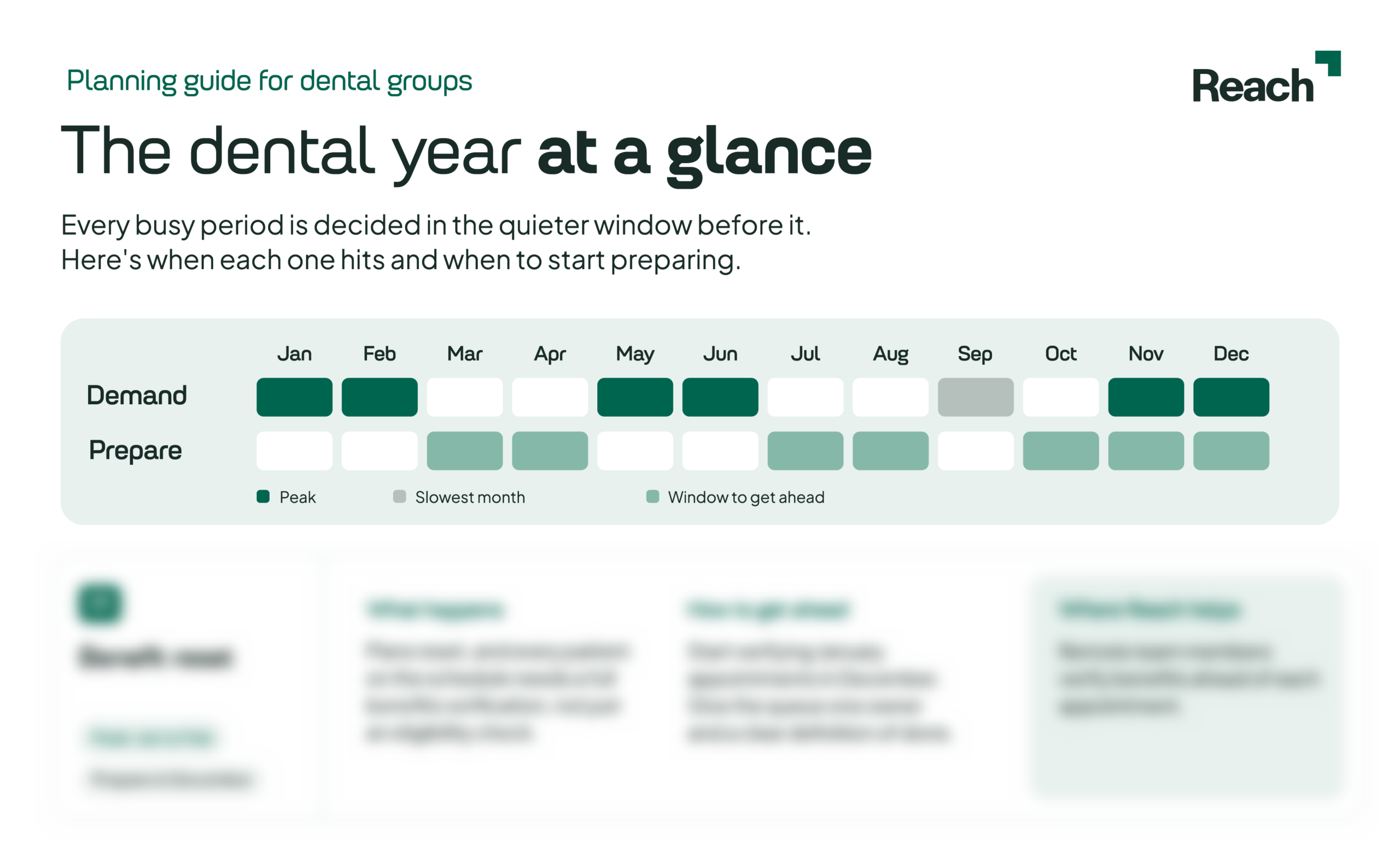
The shape is not complicated, and it repeats. The dental year has three busy periods and one deep slow stretch, all set by the insurance calendar. The peaks come with benefit renewal at the start of the year for the many plans that reset then, the end of the school year, and the year-end rush to use expiring coverage, and the low point lands in early fall.
Each peak is preceded by a quieter window, and that window decides the outcome. What a practice can handle in December depends on the work done in November, and a full September schedule gets built in July and August.
Because the calendar is the same for every practice and every group, none of this is hidden. The pattern is knowable a year in advance, which makes it a planning problem. A group that treats the cycle as information can decide ahead of time where to put its capacity, while a group that meets each quarter only as it comes ends up reacting to a schedule it could have read months earlier. So, for a multi-location group, one question is worth putting on the table. Is that reading happening by design, or by whoever is at the desk when the quarter turns?
Click here to download the full planning guide to see when to start preparing,
how to prepare, and how a dedicated remote team member can support your team.
How the year plays out
The year opens with insurance verification. For the many plans that reset at year end, an eligibility check isn’t enough. Each patient needs a full benefits verification, because coverage on paper doesn’t tell you what the plan will pay. That work is slow, and it all lands in the first weeks of January. The groups that handle January well treat verification as its own task with a clear finish line.
Late spring brings new patients, and calls peak in May and June once school lets out. A missed call costs more then than at any other time of year, because a new caller has no history with your office and will just try the next practice on the list. Dental Economics reports that practices miss 30% to 38% of inbound calls during business hours, and in spring, those are the calls you can least afford to lose.
Then the floor drops. September is the slowest month of the year, once kids are back in school, and its schedule gets built in July and August through recare outreach to overdue patients. That only works when someone owns the queue and keeps it moving, which is a decision you make months before the slow period arrives. It’s also where multi-location groups tend to slip. Henry Schein One’s 2026 Catalyst Index found that groups with eight or more locations bring back 58% of their active patients within 18 months, while the best-performing 10% of groups bring back 90%, and it points to inconsistent recall from one location to the next as one of the reasons.
The year closes under pressure again, with benefits about to expire. In November, a practice can reach the patients who still have coverage and show them what their plan will pay before it resets. When that happens early, it fills December, and when it slips into December, it runs into holiday schedules and an overloaded phone. A hybrid model keeps that outreach going while local staffing dips for the holidays. The patient never sees any of this. They just get a call back, a clear answer on their benefits, and an appointment that works for them.
The structure that makes it repeatable
Working ahead in a single quarter is possible on effort alone. Doing it in all four, at every location, is a different problem. That kind of individual push does not run on a schedule, and it does not copy cleanly from one building to the next. A group that wants the same readiness everywhere, every quarter, has to build it into how the work is governed.
In practice that comes down to a few things. Each queue, whether verification, recare, or benefit outreach, has a named owner, measured by whether the request reaches a finished outcome. Each type of request has a definition of done, so a benefit call is finished when the patient is scheduled or a clear next step is recorded, not when a voicemail has been left. Cases that need local judgment route to a named owner in the building. And leadership tracks the leading indicators, the outreach going out inside each window, alongside the lagging ones like a half empty September, so a gap is visible while there is still time to close it.
One caution belongs here. Distributing this work doesn’t mean taking it away from your in-person team. Check-in, check-out, and the relationships built face to face stay with the people at the front desk. What gets distributed is the repeatable administrative work behind those moments (verification, outreach, documentation), which gives your local team room for the parts of the job that can only happen in person.
A benefit list is only the starting point. It turns into booked care when someone verifies the benefits, reaches the patient, records the result, and schedules the appointment, and governance is what makes sure every one of those steps gets done.
What holds up through turnover and growth
Build that structure and it earns its keep at the two moments that break a reactive group, when people leave and when the group adds locations.
Turnover in the front office is constant, and in a reactive group every departure carries institutional memory out the door. The person who understood how January verification worked moves on, and the understanding goes with them. Governed work holds up better, because the owner, the definition of done, and the scorecard keep the standard in the system after the individual is gone. A new hire walks into a defined job instead of a set of habits nobody wrote down.
Growth works the same way. The seasonal cycle doesn’t get easier as a group adds locations. It multiplies with every new site. A group that has turned the cycle into a repeatable system runs that same system at each new office, and the year looks roughly the same everywhere. When each location has to figure out the cycle on its own, the variance grows, and that’s what breaks a forecast. For a leadership team thinking about expansion, this is the practical argument. Predictable production and steadier same-store performance make growth financeable, because they let you forecast with confidence without counting on every location’s staffing to hold.
The window that is open now
The next window is already open. The January verification peak is only a few weeks away, and the capacity to handle it is being set right now. A group focused only on getting through the holiday rush will hit that load in January at full volume with no time to prepare, while the groups that plan this way are working on it this month, even with the year-end rush still going.
If your group isn’t running the year this way yet, you don’t need to build the whole system at once. Start with the window in front of you, which right now is January verification, use what’s left of December to get ahead of it, and build from there one window at a time.
If you want help getting ahead of the January verification peak, Reach places dedicated remote team members who take on verification, recall, and benefit outreach for dental groups, so your local team can stay focused on patients.
You can book a short discovery call at getreach.co/gdn.
About the author:
 Cory Pinegar is the CEO of Reach, a fast-growing company redefining virtual staffing for dental practices across the U.S. Since acquiring the company at 22, he has scaled Reach to support thousands of clinics while cultivating a culture of clarity, accountability, and purpose. A passionate advocate for sustainable growth and human-first leadership, Cory also serves on the boards of Veriffic and the Parkinson’s Foundation.

Cory’s other content:
- Missed Calls, Missed Revenue: The Leak Hiding in Plain Sight
- The Dental Front Office Has Left the Building
- Scale Without the Chaos: The Hybrid Model That Protects Patient Experience
- AI Will Not Save Your Call Center: Why the Future of DSOs is Hybrid
- Why DSOs Must Play Different in a High-Interest Rate Economy
- The Group Dentistry Now Show: The Voice of the DSO Industry – Episode 228
Sources
Dental Economics, “The economics of missed calls,” August 15, 2026. Henry Schein One, “2026 Catalyst Index,” May 2026.