
Ranked the #1 DSO Podcast!
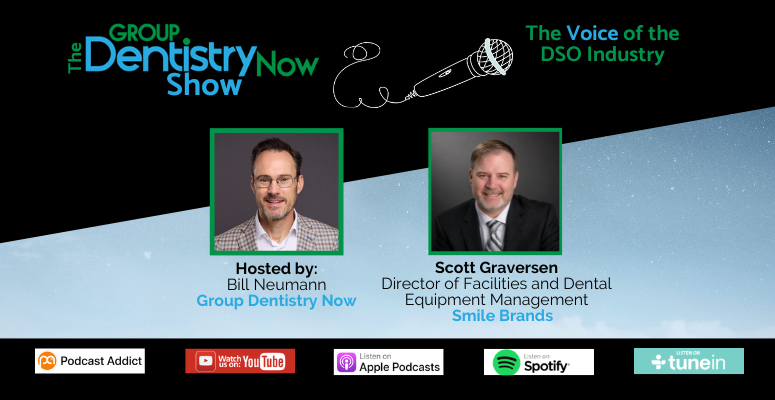
Welcome to The Group Dentistry Now Show: The Voice of the DSO Industry!
Building the Backbone: DSO Facilities Management Across 600 Locations.
Scott Graversen, Director of Facility & Dental Equipment Management of Smile Brands shares his insights on:
- Update on Smile Brands
- Managing facilities and equipment at scale
- Procurement & vendor partner strategies
To learn more about Smile Brands visit: https://smilebrands.com/
You can connect with Scott Graversen on LinkedIn here: https://www.linkedin.com/in/scott-graversen/
Subscribe to our channel for more episodes an
Subscribe to our channel for more episodes and stay updated on the latest DSO news, insights, and events!
If you like our podcast, please give us a ⭐⭐⭐⭐⭐ review on iTunes https://apple.co/2Nejsfa and a Thumbs Up on YouTube.
Choose your favorite listening app below and subscribe today so you don’t miss an episode! Full transcript is also provided below. See all of our podcasts HERE.
 |
 |
 |
 |
 |
 |
DSO Podcast Transcript – Building the Backbone: DSO Facilities Management Across 600 Locations.
Welcome to the Group Dentistry Now Show, the voice of the DSO industry. Join us as we talk with industry leaders about their challenges, successes, and the future of group dentistry. With over 200 episodes and listeners in over 100 countries, we’re proud to be ranked the number one DSO podcast. For the latest DSO news, analysis and events and to subscribe to our DSO weekly e-newsletter, visit groupdentistrynow.com. We hope you enjoy today’s show.
Bill Neumann (00:38):
Welcome everyone to the Group Dentistry Now Show. I’m Bill Neumann, and thanks for joining us as always. We really appreciate you watching or listening in. This one’s going to be a lot of fun. I mean, they all are, but this one in particular, I’ve got a good friend of mine on Scott Graversen. I’ve known Scott. I’m just trying to think back when we met, but we’ve known each other for a long time. I remember when Scott was at Henry Schein. He is now the director of facility and dental equipment at Smile Brands, a topic that we don’t talk much about facilities management. So we’re going to talk a lot about that, but I’m really happy to have you on, Scott. It’s good to see you.
Scott Graversen (01:22):
Yeah, thank you, Bill. It’s an honor to be here. And again, I’ve been looking forward to this conversation because at first and foremost, I feel like you and I have … We generally have a friendship and we just happen to be in the dental industry at the same time. So always enjoyable to spend time with you.
Bill Neumann (01:39):
Yeah. No, I don’t get to see as much as I used to because you are managing, what is it, over 600 locations at Smile Brands?
Scott Graversen (01:50):
Correct. Yeah. I’ve got the privilege of going from a vendor to Smile Brands as a national account manager role at Henry Schein. And over the course of years of my roles changing at Henry Shine through promotions and advancement, I went from being assigned to the account to managing the team that managed the account and then leaving Shine, but always genuinely stayed connected to the organization. Steve Bilt, our CEO, Brad Schmidt, our CFO, and Bill McCarthy, who’s our vice president of real estate and procurement, so just genuinely good guys and we always stayed in touch and had an opportunity where Bill McCarthy called me after I’d left Shine and said, “Hey, can I get you to advise on something we’re working on related to dental equipment?” And I said, “Yeah, yeah, let me noodle on this idea and come back with a business plan.” And it was just genuine.
(02:47):
We were friends and we’d reach out once or twice a year and worked on this project for Bill. I wouldn’t even call it consulting project. It was just Bill calling as a friend like you would. And at the end of it, when I made my recommendation, Bill’s like, “We don’t really have anybody with your unique knowledge about supply chain and procurement and facility design. You’d be interested in joining our group? Can we create something?” And hey, long story short, I joined the group and just shy of five years ago and it’s been a fun ride learning, bringing my dental equipment and procurement background from the dealer side, knowing the cards that the dealer holds and the manufacturers hold to a DSO, but then also getting the opportunity to learn the facility side supporting 600 plus dental practices. And the facility side is equally complex and interesting as anything I’ve ever been a part of.
Bill Neumann (03:49):
You spent about two decades at Shine. So you were there quite a long time and then you spent a little bit of time at Scott’s Dental Supply in an executive role.
Scott Graversen (04:02):
Correct. Yeah. It was interesting. After I left, I left Shine on great terms right before COVID didn’t really have an exit strategy. It was just kind of my time was done and I needed to go find something new to challenge myself. And then that was January of 2020 and then COVID hit a few weeks later and the world changed really quickly. And later part of 2020, I got a call to join Scott’s Dental Supply. Most people don’t really know Scott’s, but Scott Bigler is the owner of that business. And Scott interestingly hired me into dental originally in 2001. And he had a family business, it was under a different name, but it was a company that Shine ultimately bought. So I didn’t work with … He hired me in 2001. We only worked together for about a year, but I’d known Scott and his family since junior high, so going back far longer than I wanted to acknowledge, but got a chance to go work for Scott and it was just a litle bit of alignment of the universe.
(05:11):
One of his brothers, who I also knew had a brain injury within a month of me being there. And it was almost like the universe brought us back together. It was like Scott had to check out. He’s like, “Hey, my brother had a major injury, he’s out of state.” Graver said, “I know you. I trust you. Can you just take things and run with it with the business?” So that was, again, kind of back to the universe pulling us together. I got a chance to work with Scott for a couple of years and then when the opportunity from Smile Brands presented itself, once it was again, the universe speaking to me like, “This is where you need to go.
Bill Neumann (05:50):
” So let’s talk a little bit about, we talked briefly about Smile Brands is probably one of the oldest, most tenured DSOs before they were called DSOs, group practices, been around for a long time. Steve Bild has been there for quite a while. He was gone for a little bit and then was back again. So there’s been a lot of continuity at Smile Brands. Can you give us a little bit of an idea? We’ve talked about 600 locations, but can you talk a little bit about what the model looks like at Smile Brands and do you have specialty there? As far as geography goes, what does that look like?
Scott Graversen (06:37):
Yeah, absolutely. Yeah, you’re right. Our leadership team is very well established. Brad and Steve started what today is known as Smile Brands 27, 28 years ago approximately. And they’re still just as passionate about the business as today as they were then. And for me, it’s been pretty awesome in the sense of being able to watch the evolution of the business. And when I started supporting Smile Brands in fall of 2005 for Henry Schein on the dental equipment side of the business, they’re a very different organization. I think they were 260, 280 locations in a big de novo growth at private equity funding behind them. And so it was fun to go through those growth years and then back then we were still known as BrightNow, but we had these other brands under the umbrella, Castle Dental and Newport Dental and Monarch Dental and Steve made the bold decision to rebrand the company because it was always kind of like this, if you weren’t a BrightNow office, I don’t know if people ever said it this way, but there was this perception like you’re redheaded stepchat.
(07:57):
The BrightNow people are treated differently. So Steve said, “Hey, no brand or region or group of team members is any more valuable than anybody else.” And he’s like, “So you created this Smiles umbrella and to unify everybody, it’s kind of like General Motors. You’re not going to find a General Motors car, but they’ve got the different brands. They’ve got Cadillac and GMC trucks and Chevy cars and trucks.” And so Smile Brands became that unifying umbrella. Steve made the bold step not just to rebrand the company, but really give us a mission statement and a purpose and our service platform to operate from, which for us we call it smiles for everyone. It’s how we approach our work. We want to deliver smiles to patients. We want to provide smiles to providers and we can only deliver those smiles if we treat our coworkers well, if we treat our vendors well, we engage them and really honor that mission of delivering smiles for everyone.
(09:00):
And we do it through our service platform, we call it the G3 platform of greeting, guiding and gratitude. And that’s kind of like how we approach our work, acknowledging people, where they’re at, giving them guidance after we’ve listened to them, coaching them and giving them direction. And that’s part of our patient conversation of, here’s where you are in your health continuum, we want to guide you down this. And then obviously we want to express gratitude in every aspect of the interactions we have with all stakeholders. So the opportunity to see Smile Brands from an outsider and then to an insider, it’s very consistent in how the organization has embraced the cultural piece. I think it’s clearly one of our competitive advantages. As you know, Bill, each GSO has its own kind of personality and they’ve got their niche. But down to the field level, our operators, each dental practice, it’s still a local business.
(10:14):
It still comes down to that doctor sitting knee to knee with the patient, building that relationship, sitting with that dental assistant and the hygiene team, talking about needs of the patients and how they’re going to collaborate and run their practice together. Our job is just to augment and take away the distractions of the “the business” side of it so they can focus on the patient part, which is by far the most important piece. But our portfolio of offices, it’s a mix, but it’s mostly general practice in nature, but we’ve got some specialty practices. Our specialty programs are growing leaps and bounds. Our leadership team is evolving as well. Smile Brands historically has been fantastic on the operational side and I want to give a shout out to Dr. Cerna, who’s our chief dental officer. We partnered with him in the very successful group he created on the Chicagoland decision one and he really brought in more of a balance for us in being not only great operational leaders, but he’s really brought in that clinical support piece, setting that and articulating the vision and speaking to what are our clinical standards?
(11:44):
What is our standard of care and what’s the outer limits of our licenses as clinicians that they can practice to? Nobody wants to be a mid-pack dentist. So he’s really challenged our clinical teams, but as an organization has got everyone much more aware and mindful leaning more into the clinical why, which has added a lot of clarity to our business and we’re seeing it in the financial results. It’s helping us recruit. It’s helping us retain. It’s helping us get the right business support people like myself that are not just fixing plug toilets and trying to paint walls and fix air compressors that aren’t working properly. Everything we do is about that patient experience. What can we do to minimize disruption to the practice, keep doctors productive, make patients have a great experience. So threw a lot at you there, but I hope you can sense like the company from what I saw as an outsider now as an insider, they definitely walk the walk, which is really cool to see and it makes it easy to come to work when you’re working with people that are aligned and on the same sheet of music.
Bill Neumann (13:02):
Yeah. No, thanks for that background. That’s super helpful. And your position there is unique and I want to spend time to talk about exactly what it is you do because you said this was almost a position that was created for you. Smile Brands knew that there was a need as they reached out to you for some advice and then brought you in, but kind of really almost created this role. It is so important when you think about the practice, you need the equipment. You talked about the compressor, you don’t have a compressor, you can’t see patients. So it’s so critical that you maintain the facilities and you talked about it’s not just about keeping the compressors working, but it’s also the patient experience. So it’s like, what does the practice look like? Are things where they’re supposed to be? Do the clinicians like the way things are laid out and do they have everything that’s going to help them perform the best to give the patients the best experience?
(14:16):
So talk a little bit about what your role is there, the day-to-day, what you oversee things just before we started to record, you said, “Well, it’s that time of year we’re dealing with air conditioning problems.” So just some of the things you may encounter and what you handle.
Scott Graversen (14:36):
Yeah, absolutely. So high level, myself and the team that I support, which includes three regional facility managers and then our manager of office refresh projects. So there’s five of us in total high level, we’re responsible for the break fix. Our offices put in collectively a little over 24,000 service work orders a year just related to facilities and dental equipment. That could be anything from a handpiece that’s not working to a plugged patient restroom toilet, could be a leaky roof, air conditioner not working, kind of all those day-to-day things that happen when you manage, which amazes me, but a couple million square feet of lease space.
(15:31):
These work orders come in and we’ve got great automations with a work order management platform where a lot of the work is auto dispatched to our vendors. So for example, if an office puts in a work order, they go from the dropdown menu and say, “Hey, it’s a plumbing issue, it’s the patient restroom, it’s clogged.” And the system’s smart enough, it’ll have a popup that says, “Hey, have you tried the plunger?” And they go, “Oh yeah, plunger. Great. That worked. I don’t need a plumber out here now.” And ticket automatically closes without dispatching anyone. We’ve given them that guidance, but other times they’ll be like, “Hey, tried that, still not working, need a plumber out. ” Plumber automatically gets an email, it comes into them, they get a description of the work, office location, all that, and they also get a not to exceed limit.
(16:26):
So we’ll say for a plumber going out, we have it predetermined by the trade and they’ll say, “Okay, plumber, please go out and diagnose and fix whatever needs to be fixed. And if it’s under 500 bucks, just send us an invoice. If it’s over 500 bucks, please send us a proposal.” And as long as the plumber goes out and they go, “Oh yeah, that was a quick fix. Here’s your invoice for 240 bucks.” They send us an invoice, it auto reconciles and we don’t even touch it. But where we do tend to touch things are, I’ll give you an example just from this week, we had an office that was an area that had a big rain event and for whatever reason, the sump pump in the basement wasn’t working and the basement flooded and it grenaded the electronics on the dental vacuum and the dental air compressor.
(17:17):
So we get that message and it’s one of the things I’ve done since being at small brands is we built out an inventory of our critical equipment, things that we know can shut down a dental practice. Do I have an inventory of every delivery unit across our organization? I don’t. I wish I did, but I do have an inventory of our air compressors, our vacuums, our sterilizers, those big pieces of equipment that when those are down, you’re not doing dentistry. So when we got the call from this office and the initial diagnosis from the dental tech from Henry Schein saying, “Hey, you need new vacuum compressor.” We looked in our inventory, we knew what we had. We’ve got the replacements already pre-identified, so I don’t even have to ask the dealer for like, “Hey, send me a quote.” I don’t need a quote. I already know what model I’m going to buy.
(18:05):
We’ve got contracted pricing because we buy this models frequently. So we just cut a PO. And so within 24 hours we’ve got equipment shipped in, shines installed. So those are the types of things that my team focus on when a practice is down and kind of at a higher level, every work order I see is somebody else’s problem. I refer to them as work opportunities because it’s an opportunity to serve. Every work order that comes in is somebody else’s problem. So we focus keenly on what can we do to minimize work order duration, whether it’s from having our ticketing system that auto dispatches doesn’t need a person to intervene, it’ll auto dispatch, whether it’s having our inventory and predetermining what our replacements are going to be so we can cut that PO faster. Any little input that we can do to kind of streamline is one of the unique things that I’ve brought to small brands, just understanding supply chain, understanding how the dealers work, understanding how their service networks work and taking the time to learn how the facility trades work as well, plumbers, electricians, HVAC specialists.
(19:22):
It’s about 35 core trades that we support. So that’s kind of the day-to-day break/fix. And the example I shared about a flooded mechanical room, those types of things happen. We’ve had office fires from lightning strikes and we experience probably close to about six car strikes of buildings a year. It happens more common than people think, but if you talk with other facility managers, it happens more than we would like. Thankfully, we haven’t had any injuries in my years at Smile Brands from these vehicle strikes, but all of a sudden you’re dealing with emergency board ups and structural reviews and working with our real estate colleagues so they can notify landlords and collaborating like, “Okay, let’s look at the lease. Who’s responsible for what? How quickly can we do this?
(20:21):
” I mentioned the hurricane or HVACs this time of year, but we’re also getting ready to go into hurricane season. So we’ve got hurricane, natural disaster emergency response protocol and there’s kind of two types of disasters that occur. It’s those that you know that are coming and those that you don’t know are coming, like a lightning strike, you don’t get a warning. Hurricane, you get a pretty good warning. You watch the weather, you talk to the operation partners like, “Hey, what are you hearing on the ground in Florida right now? What’s the sense for the local team?” “Oh, we think this is going to be a real water. “”No, this is just going to be a bunch of rain.” And we’ve got a whole playbook of things that we go through of protocols that I work on documenting kind of the best practices of what do you do before the event?
(21:14):
What do you do during the event? What do you do after? Because a lot of these become pretty complex projects too. I think one thing that I didn’t realize until I got into this role was how central facility teams are in a DSO because we kind of touch everything, every department of the business. If an office is putting in a new cone beam x-ray, which is great, we’re going to expand access to care, enhanced diagnostics. We love doing those types of initiatives, but also it’s like it’s not just us putting a PO in the computer system. It’s like, I have a contractor go out and check for backing and make sure the low voltage is where it needs to be. And we have to contact the IT team like, “Hey, we need some computers with updated video drivers and we need you to help connect the software when Shine’s there to do the install.” Or if somebody, the landscaper’s mowing out front and their line trimmer flicks a rock up and cracks the window and it busts the window and we’ve got to replace the window graphics.
(22:22):
I got to call, get in touch with the marketing team and loop them in so they can order new graphics if it’s a bigger event, mold fire, any kind of big water event I’m working with our risk management and our legal team and then sometimes our accounting team, if we’re trying to account for loss of business like, “Hey, the practice is down. We need to calculate what those losses are so we can try and claim a business interruption claim.” So that’s one of the pieces I actually like most about the facility role is you really get to know the entire business and all the stakeholders in it very well. And we try to approach our work in a very welcoming way. The big organization of smiles is we’ve got close to 7,000 employees constantly there’s district managers and vice presidents and even office managers. And we just remind people, if you don’t know where to go, come to facility team.
(23:24):
There’s no stupid question for the facilities team. We may not know the answer, but we’ll direct you to a solution as best we can.
Bill Neumann (23:34):
You’ve worked when you were at Henry Schein, you worked with a lot of different groups. How unique is the director of facility and dental equipment position? We’ll talk about it a little later in the podcast, you do have some counterparts, people doing very, very similar things at some of the larger DSOs. This is something I’m guessing at a smaller group would be probably under an operations title if they have maybe fewer locations, operations would be handling this and a lot of other things too. But at what point do you feel like whether it’s a practice number in number of locations or I don’t know, a revenue number, when does it make sense for a group to bring in somebody just dedicated to facilities and dental equipment?
Scott Graversen (24:27):
Great question. There’s no perfect answer to it as far as what size is a little bit of economics of when do you bring that role in? It’s kind of like when you’re a small DSO, when do you bring on a full CFO versus a fractional CFO? All those first big role hires, it’s always like question of like, “Oh man, am I really committed to this? We think we’re going to go from 10 to 20 X time.” It’s kind of the same thing with the facility manager role. The answer to that’s going to depend a little bit on what your facilities look like.
(25:08):
One answer might be like, “Hey, we’re leasing all the spaces and the landlord’s responsible for the roof. The landlord’s responsible for the snow removal in the winter months and all the exterior things around the envelope that you might be able to not have as much involvement, but if you also own the real estate and you’re responsible for all those things and you’re doing the construction of the building, you may bring that person in sooner. But if most of your lease spaces are leased, truly leased, then I think the sweet spot of bringing in a full-time facility person is probably, you’re starting to think about it definitely at 50 locations and by the time you get about 70 locations, I think it’s a very vital role and that person’s probably going to wear a lot of hats. That person’s probably going to be inputting the purchase orders when you buy the dental equipment.
(26:02):
Yo may or may not be on a work order management system yet. They may still be managing things via email. They don’t have some of those scale tools that you’ll get that you can afford when you get to a larger scale. They might be kind of wearing multi-hats being a “project manager,” like construction manager as well. And that’s where some organizations have a tough time of defining where they want facilities and dental equipment to reside. Sometimes they’re completely separate.
(26:40):
I talk with quite a few DSOs on a regular basis. Some of them are aligned like we are where facilities and dental equipment is the same team. Some DSOs facilities falls under the real estate lease administration group, which is separate from the procurement group. The procurement group’s like, “Hey, I’m already dealing with Shyne, Patterson, Venco on buying all my supplies, I’m buying my equipment problems.” So that group kind of just handles that. And so the facility and equipment roles are separated. And that’s true of even some very large DSOs. There’s no right way or wrong way about that. But one thing as I alluded to earlier about Smiles really leaning more into the clinical side and supporting clinicians of my facility management team, and there’s five of us including myself, my three regional facility managers that are engaged with our offices every single day don’t have facility backgrounds.
(27:45):
Every one of them have clinical backgrounds. They were chairside, they work knee to knee with doctors, incredibly brilliant people, but they’ve got that empathy because they’ve worked in a clinical environment previously and I can’t emphasize enough how valuable that is. And I think that’s one of the things that’s unique because they use the dental equipment. They understand how to change an amalgam separator in a mechanical room. They understand when you’ve got a bad O ring on a hand piece or an air water syringe and they’re very good at pulling those details out of offices and coaching them like, “Hey, if you do this, maybe you can fix it yourself without having to get a technician out. They’re great instructors.” And then the fourth person on my team is our office refresh manager, which is part of what we do is also just reinvest in our offices.
(28:45):
Not everything we do is fixing the broke stuff. We actually get to work on some really great projects, office expansions. We love the phone call that says, “Hey, you helped us build this office out five years ago and production’s kicking butt right now. We’ve got a couple empty treatment rooms. Can you help us get equipment for these two extra rooms we’ve got available? We’re going to hire another doctor.” We love that. Or it may be like, “Hey, we’re kicking butt and we don’t have any more room.” Boy, the nail salon next door just closed up shop and there’s an opportunity to lease the space next to it so we can expand into that. We love those types of projects, but we also have projects where it’s just when you lease a dental facility, everybody knows it’s super costly to build out a dental office. So we don’t move offices very often and they’re staying in the same facility for 10, 15, 20, 30 years, you’ve got to paint them every so often.
(29:44):
You got to do flooring replacements. Sometimes you got to do cabinetry replacements and LED lighting upgrades. Frank for my team leads our office refresh program and we’re fortunate we’ve got a very healthy refresh budget that we get to reinvest in our practice isn’t go to our market leaders, help us prioritize the work. And we’ve got some scoring mechanisms we do for, because not all offices age at the same rate for a variety of reasons, but it’s great when we go work with our operations partners and say, “Hey, congratulations. You’ve been identified as one of the offices we want to reinvest in. Let’s go. Let’s work on this and give this office a facelift.” Those are the fun projects we get to work on. So it’s quite a variety of things that we work on. It’s the break fix, it’s the disaster response components, it’s the facility renovation projects, but it all comes back to the people part of it is the unifying part that we get to engage with all levels at the office level with our vendors and with our executive team.
(30:55):
So it makes that central role in facilities so vital, but again, different ways to structure on how to get there and when to get there.
Bill Neumann (31:06):
So let’s move on to procurement strategy formularies and vendors, that fun world. I mean, you are in, I think, a very unique position. We do see from time to time where you see a lot in business development, where the biz development role, you might have somebody that was on the vendor side of things has really that sales background. And so they transition over into M&A and are really good about selling the value of a certain group or as doctors are looking to sell their practices. So we see that you have that similar, this is an ideal fit because you’ve had such, with two decades with Henry Schein, you’ve seen a lot of groups the way they’ve been built, the way they’re run and can really take the best from all those customers that you had and bring that to Smile Brands. But talk a little bit about procurement strategy and then beyond that, how you work with vendors, what’s that look like?
(32:09):
What have you brought in from your outside experience to help Smile brands?
Scott Graversen (32:15):
Yeah. So the procurement piece is always driven first and foremost from what’s the clinical standard, what’s being prescribed at the office level. And with our chief deal officer, Dr. Arserno and the rest of our clinical advisory board, they offer our per provider network great autonomy. If you’re buying a sealant or a composite material, they vet out, they’ve got all kinds of different branded options, they’ve got private label options because those are clinically sensitive items. We’re not going to prescribe those. That’s a clinical decision to be made. But on the equipment side, most of the time we’re able to standardize quite a bit on our brand, the air compressors and vacuums we buy to the x-rays we buy. Most of that equipment is relatively standardized. We know who our partners are and they’ve been vetted and they don’t change that often. So the equipment formulary is vastly simpler to manage than what the merchandise supply professionals and my colleagues have to manage for procurement.
(33:29):
But we have a very defined formulary of products. We know what dental chairs we’re going to buy most of the time and all those products that I had mentioned. So we take that and then we look at the data, we look at our forecast. How many of these units a year do we buy at a regular basis?
(33:52):
Because what we’re trying to do is help forecast and be accurate as best as possible when we’re negotiating with the dealer partner. A lot of times it’s with the manufacturer as well. The worst time to ask for a deal is when you say, “My vacuum is down today, I need a deal.” That’s the worst time. The better time to negotiate the deal on the vacuum is like, “Hey, last year I bought 40, but this year I’m going to build 10 more offices than I did last year. And with my run rate, so buying 40 last year, I think when I buy 50 this year, is there a better rate?” Or realistically in this time the world, it’s like if I buy more, can you at least not raise my price? So we deal with that. But what we try to do is help our vendors understand what our volume is going to be so they can forecast, they can go to their leadership teams with some quantifiable numbers and say, “Hey, SmileBrands, we’re going to be SmileBrands exclusive air compressor vacuum partner.” And in return, they anticipate they’re going to buy 50 units a year or whatever the number is.
(35:10):
And so we work on not only great initial pricing, we look at their service offering to us.
(35:21):
I don’t really care if somebody can offer me an air compressor for $1,000 less if I have to wait every time I need to buy one for one of my West Coast offices, it’s got to ship from the East Coast. So I like part of the value proposition is what’s the vendor’s consignment stock? Do they have inventory across the country? So instead of waiting seven days for a compressor to ship to California, I can probably get one in 24 hours. There’s value to that. So we look at the data and try and share that with our vendor partners For some of the critical equipment, as I mentioned, air compressors, vacuums, sterilizers, I’d even lump in pans and pance because if those aren’t working, they can shut down a specialty program, but those critical pieces of equipment, we’ll actually share our inventory asset list with our vendor partners.
(36:17):
And I want to emphasize that you have to engage your vendor partners. You can’t just treat them like a commodity. You’ve got to involve them. You got to involve them with your business forecasting, you got to involve them on your budget planning, you’ve got to involve them on design and construction, but also your asset replacement strategy. So we’ll share our inventory list and say, “Here’s a heat map, here’s our offices that we know have old stuff in. ” If a normal air compressor service life is 15 years, we’ll run a report and say, “Okay, where are compressors that are more than 10 years old?” We’ll run a heat map. So not only can we provide the vendor like, “Hey, I’m going to buy 50, but I can give you a pretty good probability of which markets I’m going to need replacements in and what size model I’m likely to replace in each market.” And that data share is actually one of the cool parts of working for an organization of scale and being able to have resources such as myself and analytics to be able to go out and get that data where oftentimes we know product availability, service coverage and service responsiveness better than the manufacturers do and better than the dealers do.
(37:33):
We can say, instead of running a national report for like, “Hey, Henry Schein, what’s your average time from dispatch request to onsite and getting a national number? I can actually do that by market level.” And so they’re like, “Hey, we’re seeing a trend in pick a market like, ma, service team’s off here. What’s going on? ” Or, “Man, service response is great here. Give kudos to that group. That market in Wisconsin, man, they’re fantastic. Let them know how much we appreciate that. ” And so taking the data and sharing it with some of the other DSOs and benchmarking, creating best practices is something that I’m increasingly passionate about. And a lot of that it was from my experience when I was at Shine serving DSOs at times I had Heartland as a customer, I had Pacific as a customer, Dean Hansen at Interdent and I go back 20 plus years and then just regional DSOs, ClearChoice when they were very just not much more in a startup when Dr. Maloney started that group in Colorado and the guys from Comfort Dental and so many other great DSOs around the country and you kind of learn the best practices of each group.
(38:51):
And it’s one of the things I’ve been able to bring into Smile Brands, but now also share that with some of the other DSOs as we’re seeing not just, it’s not like I’m the unique former dental rep working for a DSO, we’re seeing an increased number of dealer reps working for DSOs. I think that’s a huge opportunity for the DSOs to tap into those experts that have that supply chain experience that I have. And we and the DSO facility manager, equipment manager community are really starting to share best practices more frequently now. As you know, ADSO, our executive teams, C-suite folks, our finance group, our legal colleagues, marketing, they’ve got that with ADSO, but we really don’t have a facility and dental equipment support network yet. And that’s something that I think there’s a need for in the market and a great opportunity that I hope to put a little support into.
Bill Neumann (39:58):
Yeah, let’s talk about that. You’ve got something that you’ve been kind of working on for a while collaborating with some other groups out there. You call it DFAM. So why don’t you talk a little bit about what that is and what you’re trying to build?
Scott Graversen (40:15):
Yeah. The DFAM group stands for Dental Equipment and Facility Asset Managers, nothancy, it just kind of describes what we are. There’s a handful of us that organically met at a facility manager conference a couple years back. It connects FM is the association, facility manager conference. It’s like going to a dental meeting, but it’s all facility related. There’s best practices workshop, there’s a vendor exhibit area, everything you would expect from a typical trade show. And there’s retailers from every industry you can think of. There’s the restaurant groups, the Raising Cane’ folks are there and the Starbucks folks are there and then the retail folks are there and Adidas is there and Vans is there. Well, there’s also a healthcare contingency there as well. And some of them are veterinary groups and there’s emergency medicine groups. There’s also a DSO contingency and I met several of them through, they have a healthcare council, which I got involved with and at the time Kenneth Jones from Heartland was on committee and he was the past president of Connects this past year actually, but met with Kenneth there and some of the team from North American Dental Group and Kids Dental brands and we just started talking and sharing, “Man, this healthcare council is good, but it’s not as nuanced about the dental stuff that we’re all kind of dorky about.
(42:02):
” And so we organically just said, “Hey, let’s just jump on a call and just talk a little bit more frequently.” And that turned into a Teams call that we started hosting maybe once a quarter and then frequencies picked up a little bit. At the end of the day, we don’t see each other as competitors. We are looking at our facilities and going, “How can I provide the best experience for patients and providers or at least not have the facility and the dental equipment be a detractor from the experience? We’re trying to fix air compressors and unplug toilets and paint walls cost effectively.” There’s nothing competitive about what I do. And if I share something with the folks at Heartland or one of the other groups. And they all have that same mindset of a rising tide lifts all boats. And we’ve really leaned into that about how do we help each other provide the best healthcare experience we can?
(43:04):
If we can reduce our HVAC operating costs, which is the largest facility maintenance cost for every retailer, if we can learn from somebody else, and for example, we did an RFP a year ago in the HVAC category, I got huge input from the other DSOs on how they manage their vendors and they provided references and like, “Hey, when I did our last contract, man, I really wish I would’ve honed in on this one component more.” So we’ve taken this group DFAM and we’re starting to make it into more of a structured call, providing more groups to it of all sizes. It’s kind of the general theme is we’re all DSOs and we’re all supporting multi-state operations. We don’t really have a, “Hey, you got to have 500 offices to join the call.” It’s not that. It’s just be there for the right reasons. And we’ve talked on subjects, anything from vendor selections, when do you hire a local vendor versus a national vendor?
(44:14):
What’s your mold remediation protocol? What’s your hurricane response protocol? How do you write a bid spec or how do you review bids? Or, “Hey, I got a cabinetry project in Arkansas. I don’t do a lot of work in Arkansas. Is anybody got a cabinet guy they can recommend?” So I mean, sometimes the group, it can be structured in their calls with specific agendas and other times it’s a network of people that you can pick up the phone or shoot an email to that’s doing the same job you are and just they can either offer some insights or just validate the craziness that you’re working with and go, “Yep, that HVAC bill sucks, but that’s what that costs.” And so the group’s been really great about that. We’re trying to make it evolve into something more. What more is not totally sure yet, but it’s probably going to evolve from being just a periodic call and a message out on LinkedIn to my network or group email chain saying, “Hey, anybody that’s available, we got to call Thursday, join if you can, ” to probably doing more of an in- person where we’ll offer our own personal insights, but I think it’s also good to get the other stakeholders in the room.
(45:29):
Here, get the dental dealer service teams in the room, get the dental dealer and manufacturer design teams in that same conversation. For example, if we’re building an office or retrofitting an office for a new x-ray, we’ve got backing in structural. If we’re building a new office, we’re puting in plumbing and electrical to support the mechanicals. Well, how do you route the plumbing lines? There’s a bunch of ways you can do it and some may be like you save on the equipment but you pay more on the construction. And some are like, “Oh, if you do it this way, you can save on both.” And that’s what we’re trying to build out with this network and involve the suppliers as part of this community. So we just hear each other’s needs better and again, work to elevate the healthcare experience.
Bill Neumann (46:27):
So we start to wrap things up here. It has been a great conversation. This is very unique and it’s in a good way. I really appreciate you really digging deep on this. Let’s talk a little bit about the one thing that seems to be talked about on every podcast we do, which is leveraging technology, AI and data. So how are you looking at whether it’s AI or the data that you have and trying to actually compile that? And I know there’s a lot of talk about predictive maintenance when do we repair or replace and it’s easy enough when it’s one location, but across 600 locations, then you can, I think leaning on solutions like AI and technology and different platforms can be really, really beneficial. What are you doing right now or how are you leveraging AI and technology in your role and how do you see it maybe getting improving and changing in the next couple of years?
Scott Graversen (47:33):
Yeah, I’m actually excited about it. I’m not a huge techie guy, but I’m actually quite excited about the insights and the pace of analysis and decision making and guidance that AI is going to help augment us with. It’s absolutely going to change how we do business. For my team, I don’t see it as being a headcount threat. I think it’s going to allow us to work on our business differently. We’re using it today in kind of a hybrid model. We’re stuck between the old school like, “Hey, let me look at some spreadsheets just because we’re stuck in the old behaviors.” But we’re also utilizing AI in a couple of different ways. So from a structured way, like the work order ticket platform we use, it’s a product called Service Channel. It’s widely used in the facility industry and they’ve started embedding some AI tools in that.
(48:32):
Whether it’s from the office level user, when they start inputting a work order, if they’re using the mobile app, they can speak into the phone and the AI will say, “Hey, what you described sounds like this. ” And it’ll make a recommendation and if needed, it’ll dispatch your vendor. On the backend, if there’s a work order, and you can imagine a work order will have notes attached to it. The note could be something as simple as work requested, note number two is vendor accepted the work order. Number three is vendors on site, and then it’s tech fixed it, invoiced whatever. But also there could be a hundred notes in there from, “Hey, this is a plaguing issue. There’s multiple trades involved.” And now there’s a button that just says AI summary. And I can hit that AI summary and it spits me out a nice little concise summary.
(49:30):
So if I’ve got a district manager that says, “Hey, what’s going on in our Dell High office?” “Oh, great. Let me send you a concise summary. I don’t have to put a lot of time in it. “So simple things like that AI is very useful for, but we’re also using it for the data. And as you were alluding to predictive maintenance and the predictive replacement identification, we’re using the data now to look at the age of our assets, a little bit of make and model because we’ve got enough nuanced data because we have a large enough sample base where I can look at life expectancy differences between different makes, different models, manufacturers, all that, which is pretty neat to share with the manufacturers because I probably have more data on it than they do, at least more than the sales teams usually do. But I can also take that data and what we’re using it for now is we’ll look at the age of the equipment.
(50:26):
It could be an HVAC unit, it could be a dental piece of equipment. We overlay the office performance data on that. So what’s the sales, what’s the EBITDA at that office? How much lease is left? If I’ve got a lease that’s coming due and we know the landlord’s not going to expire, I might have that one approach that’s different, but if I have a lot of lease opportunity left, I may be more apt to do things. So we overlay those big data points age, condition, as much as we can grab it, we can pull in service history records. Is this air compressor over its 10-year lifespan had one preventative service maintenance every year for 10 years, or it had five because micro components keep breaking on it. We’re using all that data now and printing out these short synopsis where we go to our operational leaders and say, “Hey, instead of me coming to you saying, Hey, the airpressor broke and I’m reactively asking you to approve an approval to replace this thing, now we can go to them and have been going to our operational partners saying, Hey, here’s where our greatest risks are based on revenue contribution to the company.
(51:39):
So if you’ve got a 15-year-old air compressor at an office that’s doing a million dollars a year, do you prioritize that or do you prioritize the 15-year-old air compressor at the office that’s doing seven million a year like, oh, the data is kind of guiding us so we can prioritize our capital where our greatest risks are. And that’s where AI is exciting to me because now not only is it good because if we can proactively replace things, we take that risk of production loss, disrupting a patient experience, upset providers, but our customers don’t have disruption, but my team doesn’t have the disruption. We wake up every day like everybody else, I’m like, “Hey, I’m going to knock out these three big initiatives today.” And then we log into our computer and like, oh, air compressor just went down like, “Man, now I got to do this fire drill of cutting a PO and coordinating with the dealer to find out if they’ve got it in stock and how quickly can they get text back out and get an electrician.” It’s just a fire drill.
(52:45):
It disrupts your whole day. But if we can proactively replace it on our schedule when we choose like, “Hey, the doctor’s going to be on vacation for the 4th of July holiday, great. That would be a good week to proactively replace a piece of equipment that’s going to require the office to be down.” And that’s where AI for me is going to be help us elevate the healthcare experience and actually it just makes our work interesting too by having these new tools.
Bill Neumann (53:12):
Excellent. Well, great. Well, wonderful conversation and it’s great to catch up with you. And like I said, it’s long overdue. Scott, if people want to reach out to you, what’s the best place to connect with you?
Scott Graversen (53:26):
Yeah, LinkedIn is always easy to get ahold of me or call, text, email. I’m pretty easy to find.
Bill Neumann (53:35):
Well, so I’ll drop your LinkedIn handle in the show notes so people can reach out to you there and Scott’s last name, he is S-E-N. So when you look them up, make sure you put an E instead of an O. I’m sure you get that a little bit, but it’s great to have you on. And also if you’re interested in learning more about Smile Brands, it’s supereasysmilebrands.com. That’s their website and just a pleasure to have you on and just a chock full of really great information and thank you everybody for tuning in today. We appreciate it. This was a long one, but it was a really, really good one and we have not explored this subject in any depth at all and really happy to do that with our good friend here, Scott Graverson. So thank you for listening, watching, and until next time, this is The Group Dentistry Now Show.
Thank you for joining us today. Don’t forget to subscribe to the podcast to stay up to date on the latest DSO News, insights, and events. Also, subscribe to our DSO weekly e-newsletter at groupdentistrynow.com.